
India annually spends Rs 4.5 lakh crore on importing petroleum products, and Transport Minister Nitin Gadkari feels methane is a cost-effective import substitution. But is it? Pallava Bagla examines the pros and cons.
'There is a trade in goods, a lot of tariff.'

Terrorism and Afghanistan were the focus points of Prime Minister Narendra Modi's talks with Uzbek President Islam Karimov on his first visit to Central Asia.

One thing Beijing must understand is that India is not obsessed with being a threat to China but only wants a rightful place for itself in the world, says Sanjeev Nayyar.
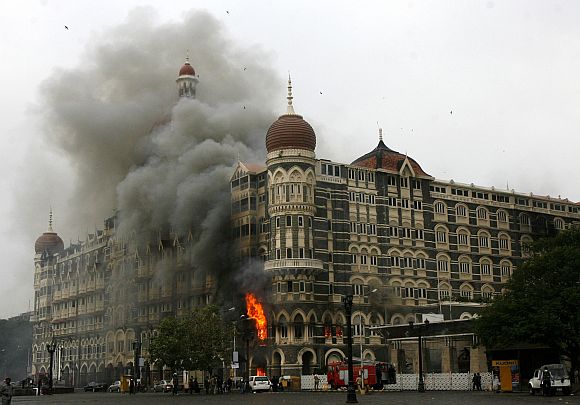
'Headley's testimony indicates to what extent the Pakistan government and its proxies can go to destroy not only Indian scientific talent but also international expertise.'

The powerful United Nations Security Council on Monday unanimously adopted a resolution that endorses the landmark nuclear deal between Iran and six world powers.

About one-third of the world's poor live in India but there are countries where 88 per cent of population is extremely poor.

India should enhance its economic, cultural and defence ties with Mongolia. It is high time Modi should focus on gaining clout in smaller Asian countries such as Mongolia. It is in this context, India's engagement with Mongolia would give much-needed impetus to India's foreign policy, says Sana Hashmi.
'When the cause of the leak is identified, is the AERB going to order a shutdown of all the other pressurised heavy water reactors in the country to fix the underlying problem?'
'Stand-alone' trip to North American nation and a strong track record in Gujarat open doors to business.

India wants more business and closer engagement with ASEAN even as China's influence spreads in the region. Rediff.com's Sheela Bhatt, who is travelling with the prime minister on his visit to Brunei, reports from Bandar Seri Begawan, capital of the tiny oil-rich country.

Ignoring all previous protests and opposition to the deal, the saffron party has changed its stance, without providing any explanation. What has changed? Accountability and explanations on this U-turn will be welcomed.

Making nuclear exemptions for India, says Senator Edward Markey, 'only infuriates Pakistan and leads them to further increase their own nuclear capacities.'

20 years ago this day, May 11, 1998, India conducted its second nuclear test at Pokharan in Rajasthan. In a fascinating interview on Rediff.com, K Subrahmanyam revealed how Indian PMs reacted to nuclear ambitions.
'Modi and Abe are working seriously for India-Japan bonhomie to grow stronger.' 'It is a win-win situation for both countries and the future look promising,' says Rajaram Panda, the Indian Council for Cultural Relations India Chair Visiting Professor at Reitaku University, Japan.

The success of the government will depend substantially on the quality of its team of key ministers, officials and advisors

Top 20 images of all the events of the week that was.

After Pyongyang tests a missile potentially capable of reaching the US, Dr Rajaram Panda explores the realistic -- and peaceful -- options before Donald Trump and the international community at large.

'If the Iran nuke deal holds, Iran becomes a gateway to Afghanistan, and a better one than Pakistan because the route is not so mountainous. Correspondingly, I imagine Pakistan's value to the US will fall,' says Rajeev Srinivasan.

'The India-France relationship has been that of the elites of two countries, who appreciate each other's philosophical traditions -- whether it is ancient Indian civilisation and Sanskrit texts or the French tradition of Rene Descartes, Albert Camus, (Jean-Paul) Sartre... This is a drawback. It doesn't create the buzz, the excitement necessary for a relationship. We need more people-to-people contact, especially among students,' says former Ambassador to Paris, Rakesh Sood.

A list of all the foreign visits taken up by PM Narendra Modi this year and their outcomes.

Swadeshi economist, columnist and chartered accountant S Gurumurthy speaks to Shobha Warrier about one year of Modi Sarkar.

Negotiating a sustainable compromise with Iran is not getting any easier, and this delay might not yield the desired result of bringing Tehran's nuclear programme under stringent limits, says Claude Smadja
'If India employed a strategy of a 'thousand cuts', Pakistan will wither away.'

'Political meetings will be a mere side show; the main show is economic investment and the business partnership. The success of Modi's US visit will be judged on the basis of India's ability to attract American investment and setting up of manufacturing in India to give jobs to millions,' says Colonel Anil A Athale (retd).
The deal with Iran does not address any of the major issues thrown up by Tehran's ambitions, says Claude Smadja.

From being on the verge of war and violence, West Asia has actually got a sudden reprieve. Seema Mustafa explains

'Modi's promise of change during the election campaign was on the domestic front, but his first year in office focused on foreign policy beyond all expectations,' says Ambassador T P Sreenivasan.

The joint statement issued after Prime Minister Narendra Modi and President Barack Obama's first-ever summit is high on intent and ambition. Notably missing from the statement is India's refusal to be America's partner in its war against ISIS.

Charles Darwin found his passion playing with rocks halfway around the world.

'With the recent challenging of the notion of the Indian Ocean Region being India's strategic backyard, China is gradually upping the ante in the maritime realm around India.'
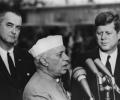
As Prime Minister Narendra Modi begins his historic visit of the United States of America, here's a look at some landmark visits by Indian prime ministers to the United States of America.

President Obama had no intention of risking a global conflagration on account of the use of chemical weapons in Syria, especially at a time when he was struggling to wind up the wars his predecessor had started, says T P Sreenivasan

India's nuclear establishment is continuing its march of folly at the expense of safety in the false belief that atomic power is the energy of the future. It's not. Nuclear power is in relentless global decline, says Praful Bidwai.

Moving ahead with their new mantra -- Chalein Saath Saath: Forward Together We Go -- Prime Minister Narendra Modi and United States President Barack Obama on Tuesday vowed to deepen cooperation in every sector for the benefit of global stability and people's livelihoods over the next ten years.

This is the joint statement issued by the ministry of external affairs on the visit of US President Barack Obama to India.

Read the full transcript of President Obama's State of the Union address on Wednesday at the US Capitol in Washington.
