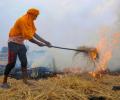
The Commission for Air Quality Management (CAQM) has directed Punjab, Haryana, Uttar Pradesh, and Rajasthan to implement drone-based surveillance to monitor and prevent stubble burning. This initiative aims to counter late-evening burning incidents that evade satellite detection, leveraging drone technology for real-time monitoring, accurate detection, and evidence collection to ensure effective enforcement against agricultural residue burning.
The Commission for Air Quality Management (CAQM) has directed state governments and agencies to implement stricter enforcement mechanisms to address the sudden spike in stubble burning incidents in Punjab and Haryana.

The Supreme Court on Wednesday rapped the Haryana and Punjab governments over non-prosecution of violators found guilty of stubble burning and summoned the state chief secretaries to appear before it on October 23 and submit. an explanation.
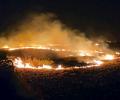
The Supreme Court has expressed concern over the increasing pollution levels during winter and has suggested that the Punjab government arrest farmers who engage in stubble burning. The court believes that this action would send a strong message and help curb air pollution.

Irrigation woes have contributed to the problem of stubble burning in the state, reports Sarthak Choudhury.

During his tenure as an apex court judge, Justice Lokur had dealt with pollution matter which included the aspect of stubble burning.

While Solicitor General Tushar Mehta during the hearing claimed that the stubble burning only contribute 10 per cent of the air pollution, senior advocate Vikas Singh, appearing for the petitioners seeking action to curb air pollution, pointed out that the Centre's Sunday meeting had recorded a finding that stubble burning is responsible for 35-40 per cent in Delhi air pollution.

With paddy growers being blamed for causing air pollution, farm experts and farmers' outfits said they are compelled to burn stubble as they do not have any other feasible and cheap option.

A bench headed by Chief Justice S A Bobde passed the order while considering the Centre's stand that it is coming out with a comprehensive legislation to deal with air pollution, including the aspect of stubble burning.

'If we do not burn the residue, wheat sowing will be delayed and that will ultimately affect the yield'

A bench of Justices Sanjay Kishan Kaul and Sudhanshu Dhulia also suggested why should there be any purchase under the minimum support price system from farmers who indulge in crop residue burning, irrespective of the fact that citizens and children were affected due to pollution.

The national capital on Friday recorded a 24-hour average air quality index of 239. On Thursday, it was 315, the worst since February 12 when the AQI was 320.

Amid a spike in pollution levels in Delhi-NCR, the Supreme Court on Tuesday directed Punjab, Haryana, Uttar Pradesh and Rajasthan to ensure crop residue burning was stopped "forthwith", saying it cannot let "people die" due to pollution.
To prevent rise in air pollution levels, oil marketing companies and thermal power units were planning to procure stubble from farmers to make bioethanol and promote the central government's 'Agricultural Mechanization' for crop residue management. But both have seen minimal success.

A purported video of the entire incident also surfaced on social media. Police have lodged an FIR in the matter after an order by Mann on Saturday. The chief minister termed the incident as an "inhuman crime" against the people of the state.

A recent survey reveals that a significant number of households in Delhi-NCR are experiencing health problems due to the worsening air quality, with residents reporting symptoms like sore throat, cough, and burning eyes.

The Supreme Court on Wednesday asked the Commission for Air Quality Management (CAQM) to consider directing schools in Delhi-NCR to postpone open air sports competitions planned in November and December to 'safer months' keeping in mind air pollution levels.

Noida, Bahadurgarh, Delhi, Hapur, Greater Noida, Baghpat, Sonipat, Meerut and Rohtak joined Ghaziabad among the 10 most polluted cities, the report by think tank Centre for Research on Energy and Clean Air said.
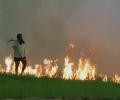
To justify that farmers must burn if they are not paid cash incentive is doing injustice to them and to the lungs of the children of the country, notes Sunita Narain.
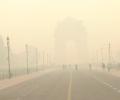
Delhi residents woke up on Tuesday to heavy grey haze darkening the city skies, reduced visibility and the air quality in the 'red zone' after many celebrated Diwali last night by bursting firecrackers beyond the two-hour limit set by the Supreme Court.

A bench of Justices Abhay S Oka, Ahsanuddin Amanulllah and Augustine George Masih said the Commission for Air Quality Management in National Capital Region and Adjoining Areas Act of 2021 (CAQM Act) was enacted without creating required machinery for implementing the provision to curb air pollution.

'Crossing my fingers that it will be better in the summer when the World Championships take place in Delhi.'

The finance ministry has clarified that its letter to state chief secretaries, urging them to align their bonus policy to promote pulses, oilseeds, and millets, was an advisory and not a directive. This clarification comes in response to Tamil Nadu Chief Minister M K Stalin's criticism, who called the advisory a 'treacherous act against farmers'.

Amid rising air pollution caused by the burning of crop residue, the Bihar government has decided to identify farmers who are indulging in this practice and put up their names at the block offices, officials said on Saturday.

Delhi's air quality deteriorates to 'very poor' levels, sparking a blame game between AAP and BJP over the causes and responsibility for the pollution.

Air quality index (AQI) soared past 350 level in parts of Delhi on Thursday and experts cautioned that as weather turns colder it may breach the 400-mark ceiling and enter the 'severe' zone soon, notwithstanding the incidents of stubble burnings which have nosedived from 17,529 in 2020 to 4,262 this year.

The Commission for Air Quality Management (CAQM) has revoked restrictions imposed under GRAP 3 in Delhi-NCR following improvements in air quality. Non-essential construction and demolition activities are now allowed to restart, and restrictions on vehicles have been lifted.

'Punjab farmers were unnecessarily being targeted and defamed for air pollution in Delhi'

Delhi choked under a thick blanket of smog on Monday, with the Air Quality Index (AQI) settling at 498, which falls in the higher spectrum of 'severe' category.

The city's air quality dropped to the "very poor" category, with an Air Quality Index of 330 at 10 pm.

The Supreme Court on Friday agreed to list for hearing on November 10 a PIL seeking issuance of fresh guidelines on stubble burning to curb rising air pollution in Delhi and the national capital region (NCR).
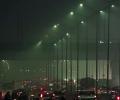
Delhi government mandates 50% work from home for offices and private establishments under GRAP stage three due to severe air pollution. Essential services are exempted.

The increase in stubble burning has kicked off a political slugfest, with Union Environment Minister Bhupender Yadav on Wednesday saying that there had been a 19 per cent rise in farm fires over 2021 in Punjab and that the Aam Aadmi Party had turned the national capital into a gas chamber.

The Supreme Court of India has directed the NHAI and MCD to consider relocating or temporarily closing toll plazas at Delhi's borders to alleviate traffic congestion and reduce air pollution. The court also addressed school closures and financial aid for construction workers affected by pollution control measures.

The government is working to make India's automobile industry number one in the world within five years, Union Minister Nitin Gadkari said on Monday. Inaugurating the 'International Value Summit 2025', Gadkari said the automobile sector pays maximum GST revenue to the government and generates employment opportunities.

The top court also asked the state governments of Punjab and Haryana to pursue the farmers for two weeks not to do stubble burning.
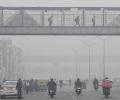
Delhi University and Jawaharlal Nehru University have announced a shift to online classes until November 23 and November 22, respectively, due to the alarmingly high air pollution levels in the city. The decision comes as Delhi and the National Capital Region (NCR) face "alarmingly high" air quality levels, prompting concerns about health and safety. The schedule of exams and interviews remains unchanged, the universities said. The Delhi government has termed the air situation a "medical emergency" and urged institutions to take preventive measures. Several schools and colleges in the region have already started shifting to online classes due to the poor air.

Low temperature -- Delhi recorded a minimum of 13.5 degrees Celsius on Tuesday, the season's lowest so far -- allowed accumulation of pollutants, said Mahesh Palawat, vice president (meteorology and climate change), Skymet Weather.

The Delhi Pollution Control Committee has issued detailed instructions to ensure the effective implementation of the ban.

Delhi Chief Minister Arvind Kejriwal announced that primary schools will be closed from Saturday in view of spike in pollution levels in the national capital.
