General Bajwa gets inputs from his senior officers, but he has the final word, notes Rana Banerji, who headed the Pakistan desk at the Research and Analysis Wing, India's external intelligence agency.

'The military aim in a future conflict, if it can't be avoided, should be to cause maximum damage to the adversary's war waging capability and capture limited amount of territory as a bargaining counter,' says Brigadier Gurmeet Kanwal (retd).

>Putin's last-minute intervention with PM salvages $5.43 bn pact.

The army chief said that radicalisation in Kashmir was being addressed with a "lot of seriousness"

'New Delhi showed itself willing -- at least for a period -- to tolerate the risk of conflict and to withstand Beijing's implicit and explicit threats.' 'But it also continued to try to cut some kind of deal with China to reduce tensions.'

India's plan to buy futuristic tanks and infantry combat vehicles -- estimated to be worth Rs 80,000 crore to Rs 100,000 crore each -- will certainly intimidate Pakistan which already feels threatened by our vast tank strength.
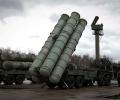
With cruise missile and air strikes being India's most likely response to a hypothetical Pakistani terrorist outrage in the future, retaliation from the Pakistan air force is inevitable. That is where the S-400 will come into play, says Ajai Shukla.
'Landmark developments herald the end of two decades of stagnation in the army's modernisation plans,' notes Brigadier Gurmeet Kanwal (retd).

The defence ministry has signed off on a national security plan that it cannot fund. Ajai Shukla reports

Boosting the army's war fighting capabilities along the Line of Actual Control, the government on Wednesday given a go ahead to the creation of a corps including deployment of 50,000 additional troops along the China border at a cost of around Rs 65,000 crore.
'Offensive operations to capture objectives across the LoC to eliminate terrorist launch pads and deny the use of the most dangerous routes of infiltration, are likely to be limited to brigade-level attacks.' 'These limited operations are unlikely to escalate to war across the international boundary,' says Brigadier Gurmeet Kanwal (retd).
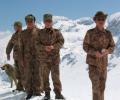
'The border standoff, if not properly addressed by both sides, could escalate to a conventional or sub-conventional conflict between India and China,' predicts Srikanth Kondapalli, one of India's leading China experts.

Outgoing Army Chief Gen Bikram Singh on Thursday said that India had given a befitting reply to Pakistan after the beheading of an Indian soldier by Pakistani troops in 2013 along the Line of Control even as he did not rule out the possibility of skirmishes on the western front in future.

Flexible, maneuverable, mobile and swift, the M-777A2 Ultra-Light Howitzers are just what India needed to replace its aging battle-tested Bofors guns, says Debalina Ghoshal.

Ordnance Factory Board officials say upgrading the 39-calibre FH-77 into the 45-calibre Dhanush has increased the gun's range from 27 to 38 kilometres, using enhanced range ammunition.

'Why has the rhetoric gone down on the Indian side, Durrani wondered aloud.' 'I said because almost total normalcy and peace had returned on the ground in Kashmir,' recalls Shekhar Gupta. 'The general gave me that career spook's laser look. And he said: "That situation on the ground can change in no time".' 'This was precisely when the Pakistanis began their first incursions into Kargil.' 'Durrani had been retired for five years.' 'But once the ISI boss, you are always in the know.'

The Chinese have just one commander for all the forces confronting India. Commanders of all these forces answer to one man, and one headquarter. India, on the other hand, offers a diversity of options that is a military embarrassment in the 21st century. In Arunachal and Sikkim-Bhutan, the Eastern Army Commander is in charge. In the Uttarakhand (central) sector, it will be the Central Army Commander. The Himachal-Tibet border is the domain of the Western Army Commander. And all of Kashmir and Ladakh further on, the Northern Army's. Effectively, an array of at least eight 'three-star' commanders will be arrayed against one Chinese, says Shekhar Gupta.
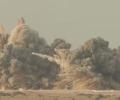
'A conventional war is not in fashion today and not seen as being able to deliver the objective.' 'Perhaps surgical strikes that are deeper, this time not on Pakistan's terrorist facilities, but on Pakistan army facilities.' 'The nation has to be prepared for losses.' 'War is not something that can be pussyfooted around.' 'If we go for limited number of posts in Kashmir, these are very difficult posts to capture and very difficult operations.' 'Be prepared for 200 to 300 killed.'
"Our worry is that a small mistake, an accidental exchange of fire at night, might lead to an unintended escalation," a senior officer confessed
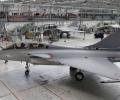
Last week, Defence Minister Manohar Parrikar said buying 90 less Rafale fighter jets than the 126 planned earlier would save him money to buy more Tejas Light Combat Aircraft for the India Air Force.

The key airbase at Panagarh in West Bengal has been renamed as 'Air Force Station Arjan Singh' in honour of the Marshal of the Air Force, who turned 97 on Friday.

The PM's vision of a lean, agile, mobile and technology driven force requires more than 1.7 percent of GDP that it now gets.

With ambitious generals knowing that political patronage might be rewarded, a worrying era of politicisation of the military looms ahead, observes retired Colonel Ajai Shukla who has known Generals Rawat, Bakshi and Hariz for a long time.
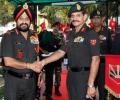
It would perhaps have been better for Lieutenant General Dalbir Singh to have been elevated to the top post by the new government, notes R S Chauhan.

With Pakistan's powerful army chief Gen Ashfaq Parvez Kayani's term coming to an end in November, names of top generals who are likely to succeed him are being discussed in the political circles and in the corridors of power.

It is worrisome that salaries are consuming as much expenditure as equipment.

'India's military posture has become significantly stronger than China's on the 3,500-kilometre Line of Actual Control.' 'This is enhancing confrontation between the two sides,' points out Ajai Shukla.

What India has failed to acknowledge is that sub-conventional war is the name of the game and irregular forces have emerged with greater strategic value over conventional and even nuclear forces, and reliance purely on conventional force and diplomacy is grossly inadequate, says Lt Gen Prakash Katoch (retired).
India's cumbersome arms procurement procedures and a plodding Ministry of Defence bureaucracy have long been blamed for shortfalls in combat capability. Now there is another, more worrying, reason - a growing crisis of funds, magnified by the lack of tri-service coordination.
The National Democratic Alliance government has adopted half measures instead of moving decisively on defence.

Both India and China have realised that if border incursions keep reoccurring, other issues of mutual interest will remain unstable. Sheela Bhatt reports

Will China's new military reforms endanger Xi Jinping's rule?

'General Bajwa is believed to consider the internal threats to Pakistan's security as far more serious than the bogey of the Indian threat.' 'This doesn't mean that he is soft on India, only that he is more rational and sensible than his predecessor who had a bit of a chip on his shoulder about India,' points out Pakistan expert Sushant Sareen.

'India-US defence pacts are seen by many analysts as a subtle move to jointly contain China's growing militarism, especially in the strategic Indian Ocean Region.'

The allocation in the defence budget is inadequate to meet India's long-term threats, especially from China and Pakistan, says Gurmeet Kanwal.

'The range of purchases throw a light on India's threat perception as also its perceived role of being a stabilising influence in the region,' says Brigadier S K Chatterji (retd).

China is spending billions of dollars to improve infrastructure in Tibet and other parts of its border with India. Claude Arpi explains why New Delhi can't afford to ignore Beijing's plans.
The finance minister hiked the total defence expenditure from Rs 203,672 crore in FY 2013-2014 to Rs 229,000 crore for FY 2014-2015. Though the increase appears substantial, it is insufficient to undertake the military modernisation necessary to meet the emerging threats, feels Brigadier Gurmeet Kanwal (retd).
 © 2026 Rediff.com - Advertise with us - Disclaimer - Privacy Policy - Sitemap - Feedback - About us - Terms of use - Grievances