
"The RSS is trying to change the nature of India. Other parties haven't tried to capture India's institutions," he said.

'The new generation voter is hyper-nationalistic, but it isn't essentially illiberal.' 'They will find the rants of Adityanath as laughable as Irfan Habib's. They will also find the BJP's polarising approach to vote-gathering unacceptable if it fails to deliver jobs and growth,' says Shekhar Gupta.
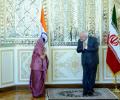
India's low passion, very cautious, relationship with Iran of the last 36 years awaits transformation, says Lieutenant General Syed Ata Hasnain (retd). Prime Minister Modi's visit cannot be a negotiating event; it is a symbolic one to strengthen the politico-diplomatic relationship.
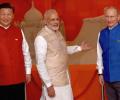
'With Pakistan's 'first use doctrine' threatening the use of nuclear weapons early in a war with India, the S-400 will shield vulnerable targets like Delhi and Mumbai, complicating Pakistan's targeting calculations.'
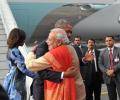
'A three generation US-Pakistan relationship is not likely to be snapped any time soon. All this presents an irritant to an India that wishes to concentrate on economic development,' says Colonel Anil A Athale (retd).

The market could be influenced by events elsewhere in the world and regardless of what happens to India's economy

It's been 100 years since Lenin and the Bolsheviks overthrew the government, and its legacy remains visible even today in the buildings and monuments scattered throughout St Petersburg.
'New Delhi feels that given the internal dynamics in Pakistan and the overwhelming powers wielded by the army, one will have to wait for better times to see any meaningful progress in the India-Pakistan relationship,' says Ambassador G Parthasarthy.

'Much can be done by India under the provisions of the treaty to make full use of its rights it has.' 'The impact of that will be felt downstream.'

Borrowing from BRICS bank will help India avoid other kinds of politics emanating from the West. Overall, the BRICS institutions will necessarily adopt alternative ways of doing things based on their own cultural and socio economic needs, says M K Venu.

'One big problem for the RSS is, while they spread their ideology of hard, Hindu-ised Indian nationalism, the absence of their own pantheon of modern nationalist giants. They missed out on the freedom movement quite comprehensively, in some ways comparable to the Muslim League and latter-day Communists. They have to find heroes elsewhere.' 'They borrow who they can from the Congress, like Madan Mohan Malviya and Sardar Patel, and then steal the entire lot of revolutionaries, from Bhagat Singh to Netaji, never mind that many of them were extreme leftists.'

Donald Trump's executive order prohibiting the entry of people from seven Muslim-majority nations widened the rift between the Trump administration and several leading American companies.

West Bengal was the second-most industrialised state in terms of value added and first in terms of number of factories and employment even in the mid-1960s. With a severe and long process of deindustrialisation, it lost its primacy.

A new West Asia is emerging and India must engage at the highest level and help shape this change, says Saeed Naqvi
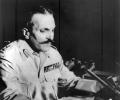
29 years ago this August, Pakistan's dictator, the general who made jihad part of Pakistani State policy, died in a mysterious air crash. Did the KGB, the then USSR's dreaded espionage agency, assassinate Zia-ul Haq? Was India's RA&W responsible for blowing Zia's military aircraft out of the skies? Was it Zia's many enemies in Pakistan's military? Was it a box of mangoes as Mohammad Hanif speculated in his fascinating novel about Zia's death? Or was the assassin someone else?
29 years ago this August, Pakistan's dictator, the general who made jihad part of Pakistani State policy, died in a mysterious air crash. Did the KGB, the then USSR's dreaded espionage agency, assassinate Zia-ul Haq? Was India's RA&W responsible for blowing Zia's military aircraft out of the skies? Was it Zia's many enemies in Pakistan's military? Was it a box of mangoes as Mohammad Hanif speculated in his fascinating novel about Zia's death? Or was the assassin someone else?
29 years ago this August, Pakistan's dictator, the general who made jihad part of Pakistani State policy, died in a mysterious air crash. Did the KGB, the then USSR's dreaded espionage agency, assassinate Zia-ul Haq? Was India's RA&W responsible for blowing Zia's military aircraft out of the skies? Was it Zia's many enemies in Pakistan's military? Was it a box of mangoes as Mohammad Hanif speculated in his fascinating novel about Zia's death? Or was the assassin someone else?

'Muslims are depressed and disillusioned.' 'The safety valve is that we still have a multicultural mosaic in West Bengal, Tamil Nadu, Karnataka and Kerala.'

It's a packed 5-nation, 9-day, visit for Prime Minister Modi as he heads to Uzbekistan, Kazakhstan, Kyrgyzstan, Turkmenistan and Tajikistan, apart from Ufa in Russia.

'Arthur was a charming, quirky, funny, smart journalist who loved all things about films. And he would change my life forever.'
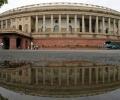
The need for co-ordinated policy between Centre and states was likewise foreseen and assigned.

The remarkable story of Wing Commander Rakesh Sharma, the first Indian in space, will be seen in a film featuring Aamir Khan.

COP 21 is about how much carbon space is left and who gets how much of that space

Ambitious diplomats continue to be attracted to politics but do they make good politicians, asks Jyoti Malhotra

'Make in India' could suffer the same fate as did privatisation and the command economy, says Ajit Balakrishnan.

It's a wrap! Rediff.com presents a roundup of the World Gymnastics Championships, Glasgow, which were held from October 23 to November 1.
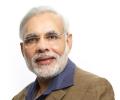
The major driver of Mod's foreign policy can be gauged from his economic priorities such as creating employment opportunities for the youth bulge. Related to this is emphasis on manufacturing, and infrastructure development, which in turn raises the issue of FDI. He has already articulated his views on all these issues, says Rup Narayan Das.

'This has absolutely nothing to do with Kalburgi or anybody else, it only has to do with two words: Bihar elections. It's electioneering by other means, let's save the fig leaf of morality,' says Rajeev Srinivasan.

'It would not be incorrect to say that the Chinese-Pakistani strategy of containing India began in the aftermath of the 1965 war.'

'15, 17 years back we were not even in existence in the US. Today nearly 1/3 of prescriptions written comes from India.' 'India is showing that in a very competitive environment -- like the US and Europe -- our industry is doing very well.'

'Imagine for a moment that the Coast Guard was unable to stop the vessel and it reached Porbandar with its cargo/personnel and targeted the event at which the prime minister was present,' says Colonel Anil A Athale (retd).

News of all that's transpired on and off the football field

The winners of the 60th annual World Press Photo Contest have been announced. The winning shot was taken by Turkish Associated Press photographer called Burhan Ozbilici, with an image he has simply titled An Assassination in Turkey. Showing Mevlut Mert Altintas shouting after shooting Andrei Karlov, the Russian ambassador to Turkey, at an art gallery in Ankara, Turkey, on December 19 2016.

'Why would the Communists do this? I have three possible answers: One, they are specifically opposed to the Global Education Meet that the ambassador organised. Two, they are beginning to realise their days are numbered in Kerala. Three, the standard modus operandi of leftists is anarchism because they are not constrained by any codes of ethics. Roughly, the bad, the good, and the ugly,' says Rajeev Srinivasan.

'The creation of Pakistan was integral to Britain's grand strategy.' 'If they were to ever leave India, Britain's military planners had made it clear that they needed to retain a foothold in the NWFP and Baluchistan because that would provide the means to retain control of Iran, Iraq, Kuwait, the UAE, Bahrain and Qatar.'

Aziz Haniffa, who has covered every Indian Prime Minister's visit to the US since Rajiv Gandhi in 1985, gives us a peek into what's happening in Washington, DC on the eve of the Modi-Trump summit.

'What should worry India and which needs to be expressed is Russia's simultaneous proximity to both China and Pakistan from a strategic angle. That hasn't happened ever before,' says Lieutenant General Syed Ata Hasnain (retd).

'The only narrative before India is what Modi and the BJP is presenting.' 'Nationalism has been taken as a serious plank by the BJP and RSS.' 'They want to keep the nationalism thing alive to make people forget the economic reality.'
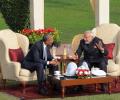
'When George Bush Senior decided in 1992 that India and the United States must start talking in this-now-changed world, who would have thought that 10, 15 years down the road, we will start looking at each other as strategic partners?'
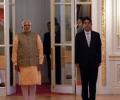
Narendra Modi and his government should look at the emerging geo-politics realistically and not get sucked into having to make a choice between China and Japan. India has enough economic space for both, says Mohan Guruswamy.
