
'Unless they create some spectacular event people don't take cognisance of them. So they will select targets that will give them publicity and prominence,' says Lt Gen D B Shekatkar (retd).

Almost five years later, the three services have still not fully understood that joint/theatre commands are not a discussion point; they are the prime minister's diktat on a military reform measure that is in line with what armed forces around the world have implemented, points out Ajai Shukla.
'Such barbaric acts reflect that there has been a Talibanisation of the Pakistan army. An army that gets used to barbarism cannot overnight change and behave in a humanitarian manner and abide by the code of conventional/unconventional operations,' says retired Lieutenant General D B Shekatkar.
'These incidents of indiscipline in army units are happening with increased frequency which is a dangerous trend and is a wake up call for the senior leadership of the armed forces,' says Lieutenant General D B Shekatkar (retd).

'100 Fayazs will bring a change in Kashmir, that's why they don't want a Fayaz.'

The experts also said China's military 'misadventure' may have been driven in part by President Xi Jinping's attempt to show 'gains somewhere" after the growing global criticism against his country over the origin of COVID-19.

'Increased help from China to North East insurgents will create more trouble for us.'
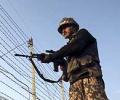
'The magnitude of the incidents shows that it is not done on the instruction of junior officers on the Pakistani side of the Line of Control, but is well planned and coordinated at the top level,' says Lieutenant General D B Shekatkar (retd).
Over-stretched middle rung officers, high stress levels and the fragile officer-jawan relationship are increasingly taking a toll on discipline, the cornerstone upon which the tradition name, fame, and valour of the armed forces is built, says Colonel John Taylor (retd).
'The bedrock of the armed force is discipline. An indisciplined armed force is not only undesirable, it is extremely dangerous,' says Lieutenant General B T Pandit (retd).

Defence Minister Arun Jaitley said perhaps for the first time after Independence, such a big and 'far-reaching' reform process is being initiated in the Army.
'If the Indian Army is deployed aganist Naxals it would mean that the whole political system has failed,' says Lt Gen D B Shekatkar (retd).
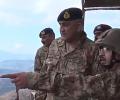
'Not only in Kashmir, but in the rest of the country.'
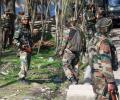
'An unconventional war cannot be fought by conventional means,' says Lieutenant General D B Shekatkar (retd).
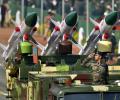
Officers responsible for preparing budgets say their detailed costing projections are mostly ignored. The defence ministry simply takes the previous year's budgetary allocations for each service and adds a small percentage to those.
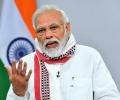
The military brass is learnt to have apprised Modi about the evolving situation in eastern Ladakh, though officials maintained that the agenda of the pre-scheduled meeting was to discuss the ambitious military reforms and ways to boost India's combat prowess.

'Tying somebody to the jeep is not the military way, but the officer was able to come out of the situation without any bloodshed.' 'I am not supporting him, but I am also not criticising him.' 'He had to use some mechanism to save the uniformed personnel, many of whom were Kashmiri boys of the J&K police,' points out Lieutenant General D B Shekatkar (retd), who was instrumental in the surrender of a record 1,267 terrorists in Kashmir.

The PM's vision of a lean, agile, mobile and technology driven force requires more than 1.7 percent of GDP that it now gets.

'We have to cut down on manpower to make more for equipment,' Indian Army chief General Bipin Rawat tells Ajai Shukla.

The defence minister has 20 months to learn the military's ethos, culture and to publicly bat for an organisation that feels increasingly marginalised and underappreciated.
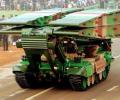
Given the importance of equipment modernisation, the overall defence budget should rise at least at the same pace as salaries and pensions, so that equipment modernisation is not hit.

'When sensitive territory goes into the hands of your enemy. he becomes more powerful in military terms.' 'Assuming the Chinese take over the Doklam Plateau they will not stop at that.' 'They will keep ingressing, and it will be easier for them to further expand their territory.' 'I feel the Chinese will vacate that area in two months after it begins to snow.'

'Defence does not new 'planning commissions'; it needs an implementation commission.'
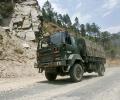
Some organisational changes are likely in some of the key army formations.

'She has to get the funds, cut through bureaucratic flab, speed up modernisation, ensure planned acquisitions stick to timelines, make organisational changes and ensure the military is capable of performing the task that it is given,' says Brigadier S K Chatterjee (retd).

'We don't know what the reasons were that we gave back the Haji Pir Pass which was strategically very important. Today the entire infiltration into Kashmir takes place from that area. If we had retained that post that we had captured, things could have been different.' 'A lesson we need to learn is if you start losing the gains of war at the negotiating table, they become a disincentive for future wars,' says Lieutenant General D B Shekatkar (retd), reviewing the lessons from the 1965 War.

'She must first change the Rules of Business 1961 that makes the defence secretary and not the defence minister responsible for the defence of the country!' says Colonel Anil A Athale (retd.)
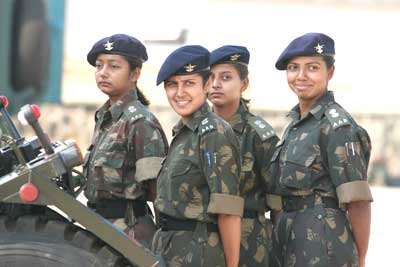
Currently women are allowed in a number of select areas including in medical, legal, educational, signals and engineering wings of the army.
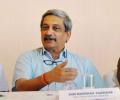
Instead of ramming through change, Mr Parrikar has tied his own hands by placing reform at the mercy of numerous committees, says Ajai Shukla.

Jaitley can make his innings -- notwithstanding its likely length -- to be a watershed tenure, or just add to the image of the MoD drifting rudderless, says Brigadier S K Chatterji (retd).

'If you destroy the assets in Pathankot, you degrade the combat potential of India; you degrade the war potential of India.'

'It is the government's most important duty to ensure that when war breaks out, the armed forces are absolutely ready to face the adversary -- well equipped, well trained and in high spirits,' says Brigadier Gurmeet Kanwal (retd).

'We should hit Pakistan, continue to prepare for surgical strikes, continue to punish Pakistani posts in the proximity of the LoC and we should start adopting counter terrorist measures.' 'That should be India's action without escalating it to a full-fledged war.'

'The cost of the Rafale contract will be substantially lower than being talked about.' 'If you throw away the price they demand, our coffers will soon become empty.' 'When it comes to spending the nation's money I am very careful and stingy.'
 © 2026 Rediff.com - Advertise with us - Disclaimer - Privacy Policy - Sitemap - Feedback - About us - Terms of use - Grievances