
The two countries also asked all nations to stop cross-border movement of terrorists and asserted that a decisive collective response from the international community without 'double standards and selectivity' was required to combat the threat of terrorism.

China continues to hold out on fingering Pakistan as the 'mothership of terror,' declaring Masood Azhar a terrorist at the UN, and India's membership of the NSG, says China expert Srikanth Kondapalli.

Xi and Modi met soon after their arrival at a summit of the BRICS group of emerging powers. Xi said the two countries should join hands in setting global rules and suggested he attend the November meeting of the 21-nation APEC in Beijing, as well as take part in Chinese-led regional initiatives.

India is keen on the issue of equal share holding since it doesn't want a repeat of the distortions that have crept into Bretton Woods institutions like International Monetary Fund, World Bank and the Asian Development Bank in which rich countries like the US and Japan have a strangle hold.

India on Monday did some plain-speaking with China over its blocking of the Indian bid to get JeM chief Masood Azhar banned by the UN and warned the global community of "serious consequences" if it continues to adopt "double standards" in dealing with terrorism.

The Indian Institute of Science, Bangalore and Indian Institute of Technology, Bombay were ranked among the Top 40 as per Times Higher Education BRICS and Emerging Economies Rankings 2015.

The prime minister also said that country nurtures a mindset that loudly proclaims that terrorism is justified for political gains.

The Doha Round of talks of the World Trade Organisation (WTO) faces a new challenge and if some statements emanating after the General Council meeting on July 25 at Geneva are to be taken at face value, this could derail the process of trade liberalisation through a multilateral route for some time.

India will have the presidency of the BRICS' $100 billion New Development Bank for six years with headquarters in China that will become operational in about two years, a major step for reshaping the international financial system dominated by the West.
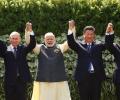
Narendra Modi's success at the BRICS summit is the best Diwali gift for India's diplomacy and marks her ascendancy to global leadership, says Tarun Vijay.

Chinese President Xi Jinping's visit to India is a time for the two countries to get away from the haze of rhetoric and stale euphoria, says Sana Hashmi.

Any additional effort to assuage the growing worldwide hunger for infrastructure funding is more than welcome, says Barun Roy.

Inflation is down and there's every chance that crude prices will be subdued through the next year.

The new government needs to clearly insist on diplomatic reciprocal arrangements with China. While reciprocity is a function of power in bilateral relations, the Modi-led government's responses should be based on India'S inherent strengths, says China expert Srikanth Kondapalli.

Opportunity for India to take leadership in economic diplomacy.

'He is the man,' US President Barack Obama had said at a G-20 gathering, enhancing Lula's stature. Six years later, has Brazil's impressive economic growth turned to sand? Will a President, who enjoyed an 80 per cent approval rate in his country, be arrested? Ambassador B S Prakash, India's former envoy to Brazil, explains what has gone wrong in one of India's BRICS partner nations.

'We have to make doing business in India easier.'

India and Russia on Thursday decided to expand cooperation in various sectors as they signed 16 pacts, including on joint manufacture of 226 military helicopters.

Even as the United States snuggles closer to India with the thinly veiled objective of containing China, the Indian strategy is to avoid alienating either nation.

It asked all nations to work together to expedite the adoption of the Comprehensive Convention on International Terrorism in the UN General Assembly without any further delay.

The BRICS model will need to demonstrate the efficacy of a second alternative governance structure to reform the Bretton Woods legacy.
Borrowing from BRICS bank will help India avoid other kinds of politics emanating from the West. Overall, the BRICS institutions will necessarily adopt alternative ways of doing things based on their own cultural and socio economic needs, says M K Venu.

Group still far from coordinating monetary/forex policy

It's a packed 5-nation, 9-day, visit for Prime Minister Modi as he heads to Uzbekistan, Kazakhstan, Kyrgyzstan, Turkmenistan and Tajikistan, apart from Ufa in Russia.

He said the UPA had left the economy in a dire state, with Consumer Price Index and food inflation at double digit, Wholesale Price Index inflation around 6-7 per cent and growth prospects were limited.

'This has to be seen in the context not only of the legacy we inherited, but also of global economic weakness.'
'If after inheriting the very bad situation we have reached this level despite consecutive years of drought and no growth in the world economy, it is no accident.' 'It is a result of the sound macro economic policies followed by this government.' 'We have eschewed populism and stuck to a path of fiscal prudence.'
'To consider BRICS anything more than a temporary club with some common interests would be folly. The goal should be to induce others (Japan, ASEAN, South Africa) to align with us -- a non-threatening, democratic nation, rather than with malevolent China or waning America. For us to consider aligning with either China or the US would be absurd. India is just too big to be a sidekick,' says Rajeev Srinivasan.

Rajeev Srinivasan on how Indians are satisfied with illusions, not reality.
The corporate sector does not care from where the money is coming.

The announcement of the formation of the BRICS bank will have as much an impact about how the non-G7 countries manage their economies and their foreign reserves, as it does on the intellectual discourse. The development priorities and agenda which was hitherto set by western experts responding mostly to western priorities and notions will now have to compete with an intellectual tradition that is and can be very different, says Mohan Guruswamy.

 © 2026 Rediff.com - Advertise with us - Disclaimer - Privacy Policy - Sitemap - Feedback - About us - Terms of use - Grievances