
A high-level committee investigating the failures of ISRO's PSLV rockets, which have impacted strategic satellite missions, has yet to release its report and recommendations, raising concerns about the future of the ageing launch vehicle.

India's move to privatise PSLV rocket production through IN-SPACe has triggered debate over national security, ageing technology and the agency's role.

The move follows a quiet visit by National Security Advisor Ajit Kumar Doval to the Vikram Sarabhai Space Centre in Thiruvananthapuram.
'A solid motor, once ignited, burns until the propellant is exhausted. It cannot simply stop mid-burn,' said a retired senior ISRO official. 'That is what makes this failure puzzling.' Venkatachari Jagannathan reports on the latest PSLV failure.

The EoI comes at a time when ISRO is working to enhance LVM3's payload capacity to five tonnes in GTO and is also evaluating the procurement of a Russian semi-cryogenic engine for the vehicle's second stage.
ISRO's PSLV-C62 successfully launched an earth observation satellite along with 14 other commercial payloads from Sriharikota, marking the first launch of the year.

We who were dreaming of being the third largest economy in dollar terms, have slid back to sixth, thanks to the falling rupee. We are moving about with begging bowls for investments and trade opportunities, which will be a while in materialising, if ever, notes Shreekant Sambrani.

A Spanish startup, Orbital Paradigm, claims its payload, KID, survived the failed PSLV-C62 mission and transmitted data, despite ISRO's silence on the matter. The mission, carrying 16 satellites, failed due to issues in the rocket's third stage.
A PSLV rocket carrying Earth observation satellite EOS-09 failed to launch from the Sriharikota spaceport early on Sunday.
Based on the broadcast visuals, a rocket expert said the failure appeared similar to the anomaly seen during the PSLV-C61 mission.

While India's interplanetary ambitions remain significant, the current pace of financial and technical progress raises questions about whether the 2027-2028 timelines can be met.

These upcoming launches carry added significance in light of setbacks suffered in recent years.
ISRO is preparing for the PSLV-C62 mission launch on January 12 from Sriharikota, carrying the EOS-N1 satellite and multiple other payloads.

In terms of success rate, the PSLV rocket has an enviable record of 57 successful missions out of 58 commercial ones.

ISRO has announced plans for seven launch missions by March, including the first uncrewed mission for the Gaganyaan project and demonstrations of new satellite technologies.

India is set to take its first steps towards its own human space flight when the uncrewed Gaganyaan mission soars to the skies later this year. Private players in the space sector are also gearing up for launching satellites on home-built rockets.

ISRO said the upper stage of the Polar Satellite Launch Vehicle - C37 (PSLV-C37) re-entered the earth's atmosphere on October 6, 2024 and the impact point was the North Atlantic Ocean.

In a first-of-its-kind initiative involving precision-flying, Indian Space Research Organisation on Thursday successfully launched the Proba-3 mission onboard a PSLV-C59 rocket, a solar experiment undertaken by the European Space Agency.
Indian Space Research Organisation is gearing up for one of its busiest times with seven more launches planned this financial year, even as India's first human spaceflight remains scheduled for 2027, its chairman V Narayanan said.
The heaviest communication satellite to be launched from the Indian soil onboard a new generation, homegrown 'Bahubali' rocket was successfully placed into the intended orbit on Sunday, the Indian Space Research Organisation said.
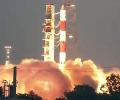
ISRO chairman announces plans for nine major launches by the end of the fiscal year, including the Blue Bird Block2 communication satellite for the US in collaboration with NASA.
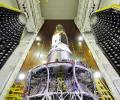
India will launch the PSLV-C56 carrying DS-SAR satellites from Singapore, along with six co-passenger satellites, from ISRO's Sriharikota spaceport on Sunday, July 30, 2023.
'There's too much coincidence in back-to-back failures of missions critical to national security.'

Indian Space Research Organisation's 101st mission from Sriharikota, an earth observation satellite onboard the agency's trusted Polar Satellite Launch Vehicle (PSLV) rocket, could not be accomplished on Sunday following a pressure issue in the third stage of the launch vehicle, the space agency said.

Around 23 minutes after lift-off, the primary satellite got separated and it was followed by six other co-passenger satellites, which were deployed into the intended orbits sequentially, ISRO said.
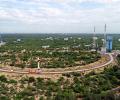
The Polar Satellite Launch Vehicle (PSLV) in its 63rd mission, would carry the earth observation satellite (EOS-09) which would be capable of capturing high-resolution images of the Earth's surface under all weather conditions.

India and the US on Wednesday marked their maiden space collaboration with the successful flight of a GSLV rocket that placed an earth observation satellite, jointly developed by the two space agencies, in a precise orbit.

While the mission is a follow-up to the PSLV-C55 TeLEOS-2 mission launched in April this year, scientists in Sunday's mission will place the fourth stage of the PSLV rocket in a lower orbit.
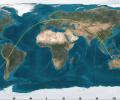
The Indian Space Research Organisation (ISRO) announced that the fourth edition of the PSLV Orbital platform Experiment Module (POEM-4), used for the space docking experiment mission, has successfully re-entered the Earth's atmosphere. The module, a repurposed spent upper stage of the Polar Satellite Launch Vehicle, impacted at 02:33 UTC (08:03 IST) on April 04, 2025, in the Indian Ocean. This successful re-entry signifies ISRO's commitment to mitigating space debris and contributing to the long-term sustainability of the outer space environment. POEM-4 had hosted 24 payloads during its mission life, yielding valuable science data. ISRO and the United States Space Command (USSPACECOM) closely monitored the module's orbit decay and predicted the re-entry date. This event showcases ISRO's proactive approach to responsible space operations.

The 25-hour countdown has begun for the launch of the Indian Space Research Organisation's PSLV-C53 mission in Sriharikota.
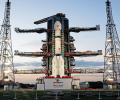
The imaging technology in Nisar can provide very high-resolution data on changes as small as one centimetre in size on the earth's surface.
ISRO to launch a 6,500 kg communication satellite built by the US, marking a significant milestone in the Indian space program after the successful launch of the NASA-ISRO NISAR mission.

The mission objective is to ensure data continuity of ocean color and wind vector data to sustain the operational applications.
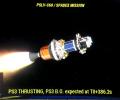
Dubbed as a prelude to ISRO setting up its own Space Station by 2035, the PSLV-C60 mission would also make India join an elite club in achieving this feat which is expected to take place in the coming days.
'The solution is to replace, clean up, retest and proceed.' 'There is nothing to worry about if corrected.'
State-run Hindustan Aeronautics Limited has won a bid under which it will receive technology from the Indian Space Research Organisation for the end-to-end commercial production of the Small Satellite Launch Vehicle (SSLV), a first for the industry as India seeks to become a global hub for small satellite manufacturing and launches.

On Thursday, the four-stage, 44.4 metre tall PSLV-C53 that blasted off from the second launch pad of Satish Dhawan Space Centre and placed the three Singapore satellites--DS-EO, NeuSAR and SCOOB-1 in intended orbit.
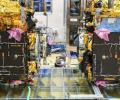
Demonstration of seed germination in outer space, a robotic arm to catch a tethered debris there, and testing of green propulsion systems are some of the experiments planned on the POEM-4 -- the fourth stage of ISRO's PSLV rocket that remains in orbit after launching a satellite.
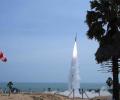
The fuel cost will come down if rockets are launched from Kulasekarapattinam as they will have a straight trajectory and need not have to avoid Sri Lanka, which is being done by rockets flown from Sriharikota.
The Indian government has approved the construction of a third launch pad at Sriharikota, capable of sending heavier spacecraft into orbit. This new facility will support India's ambitious space program, including the Gaganyaan human spaceflight mission and a lunar landing. The launch pad will be built at the Satish Dhawan Space Centre and is expected to be operational within four years.
