
For a rising country like China with its sights set on global and regional power, any coming together of the US and India is the worst case scenario. Hence, China is concerned with the emerging equations between New Delhi and Washington, says Srikanth Kondapalli.

When Vietnam's India born Foreign Minister Pham Binh Minh arrives in New Delhi on Wednesday evening, he will have many areas of similar interest to discuss with his counterpart, External Affairs Minister Salman Khurshid.

India and China on Friday agreed to set up a dedicated communication channel to boost security cooperation as Home Minister Rajnath Singh held talks with China's security czar on issues like cross border terrorism from Pakistan and the Afghan situation.

Nevertheless, border dispute will feature prominently on Modi's agenda but the matter won't be discussed at length. Nayanima Basu reports

'While visits and personal meetings are useful, changes of strategic significance have occurred recently, with Beijing trying to take the lead which Modi must take note of.'

Chinese President Xi Jinping's visit to India is a time for the two countries to get away from the haze of rhetoric and stale euphoria, says Sana Hashmi.

'Assuming the official defence allocations represent the true picture, the $142 billion figure still represents a phenomenal increase and surpasses that of Japan ($42 billion), India ($40 billion), South Korea ($33 billion) and several other Asian countries put together and shows that China is flexing its military muscle.'

Prime Minister Manmohan Singh on Sunday left for a five-day visit to Russia and China.
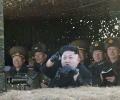
Whom will North Korean dictator Kim Jong-un kill next, and how?

In a rare gesture, China's official media in Beijing on Tuesday extended its biggest coverage to an Indian political event projecting Narendra Modi's takeover as Prime Minister as a harbinger of "big boost" to China-India relations.
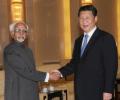
Vice President Hamid Ansari on Monday held talks with Chinese President Xi Jinping and conveyed the new Indian government's interest in furthering bilateral ties, even as he flagged off India's concerns over border related issues during his parleys with the top leadership in Beijing.

At least 35 people, including 25women, were killed and 48 others injured in a stampede during New Year revelry at Shanghai's iconic waterfront area, one of the worst tragedies to hit China in recent years.

There are still a few lingering issues towards the progress of India-China bilateral relations, the approach for dealing with each other seems to be quite different. With Modi-Xi bonhomie strengthening, it seems that India and China are ready to recalibrate their approaches towards each other, says Sana Hashmi.

Unlike in the past, Modi made candid, frank and direct remarks on his hosts by suggesting that the Chinese side is holding back on further improving relations, says Srikanth Kondapalli.
Public interest centres on whether the two leaders might make headway in resolving the Sino-Indian boundary dispute.

Playing down the continuing standoff at the Ladakh border region, China's military on Thursday said such incidents are "sometimes inevitable" but the situation is under "effective control" with the joint efforts of the two sides.

Srikanth Kondapalli on what to expect from the seventh BRICS summit meeting to be held in Russia in July.

Prime Minister Narendra Modi had gone to China with a bagful of initiatives, but not all seems to have been fulfilled given China's reluctance to go the whole hog with him

Modi, who is undertaking his first visit to China as prime minister, will reach the ancient city of Xi'an, the home town of President Xi Jinping, for a summit meeting, an unusual departure from normal protocol and seen as a reciprocal gesture by the Chinese leader who was hosted by Modi in Ahmedabad when he visited India in September last year.

Considering Modi's style of practicing diplomacy, it is likely that a clear message would be conveyed to China that it is high time Beijing stops using its good relations with Pakistan as a pressure tactic against India. This is imperative not only for strengthening India-China relations at the bilateral level but also for maintaining stability at the regional level, says Sana Hashmi.
.jpg)
Both India and China have demonstrated levels of maturity in diffusing tensions and ensuring that the border remains by and large incident free, says Seema Mustafa

India wants more business and closer engagement with ASEAN even as China's influence spreads in the region. Rediff.com's Sheela Bhatt, who is travelling with the prime minister on his visit to Brunei, reports from Bandar Seri Begawan, capital of the tiny oil-rich country.

'China might soon have to seriously consider whether it prefers an Indo-US hyphenation to a Sino-Indian one.'
Beijing wants assurance that its investments won't come under scrutiny

'The "Hollandisation" of British policy may not bring the expected gains as the future may show,' says Claude Arpi.

Being a pragmatist Modi is not likely to give preference to China over Japan. Both security and economic aspects are likely to shape Modi's decision in terms of engaging the two biggest economies of Asia, says Sana Hashmi.
In recent years India-Japan relations have acquired rich economic content and strategic intents. Although the bilateral trade at $18 billion between the two countries is not very impressive and leaves much to be desired, the economic engagement between the two countries is both qualitatively and quantitatively noteworthy. India-Japan defence cooperation, however, has generated a lot interest among the strategic community in the context of rise of China. There has been a lot of speculation about India-Japan strategic partnership to hedge China, says Rup Narayan Das.

In spite of irritants and hiccups in the relationship, a few deliverables are expected of the prime minister's visit to China, says Rup Narayan Das.

Dr Manmohan Singh would be faced with very few choices in Beijing given the Chinese conceived notions of the world today and India's low place in their calculus, says Srikanth Kondapalli.

Amid souring ties, the president visited Beijing for three days. On his return to India, a hope of better ties has arisen, says senior correspondent R Rajagopalan, who travelled with Pranab Mukherjee to the Asian superpower.

China has relaxed its one-child policy and further freed up markets in order to put the world's second-largest economy on a more stable footing.

Despite vast differences in the way the media operates in the two countries, an India-China media forum will go a long way in improving understanding between the two countries, says Srikanth Kondapalli.

As Chinese army incursions continue to recur, India has cautioned China that any disturbance of peace and tranquility in the border areas can vitiate the overall atmosphere of bilateral ties.

What was the need for Xi Jinping, general secretary of the Chinese Communist Party, President of the People's Republic of China and Chairman, Central Military Commission, to don the new role of Commander in-Chief? Does this mean that the most powerful Chinese leader since Mao faces numerous threats from within the Communist Party?

The chaos on its stock markets, a fierce battle between the old and new guard in the Communist Party and the restive border provinces of Tibet and Xinjiang forebode tough times ahead for China, says Claude Arpi.

'It was China's rise that caused the New Cold War in Asia as it prompted the United States to rebalance its forces in Asia to experiment with engagement and containment at the same time,' says T P Sreenivasan.


It was clear in Brunei at the 8th East Asia Summit that China doesn't want the South China Sea issue to even dominate the discussion, reports Sheela Bhatt, who is part of the prime minister's media contingent to the summit

If the chemistry between Modi and Xi Jinping goes well, it will herald a new future not just for the region but for the world, says Tarun Vijay.

'Chinese leaders rarely receive their foreign guests in cities other than Beijing. Such respect for India!' 'Does it mean that Modi could replicate "the warmth and unconventional way" by sending Indian troops into Tibet, as Xi did in Chumur (Ladakh) when he arrived in India? Of course, Indians are far too polite to do so,' says Claude Arpi.
 © 2026 Rediff.com - Investor Information - Advertise with us - Disclaimer - Privacy Policy - Sitemap - Feedback - About us - Terms of use - Grievances