
The move follows a quiet visit by National Security Advisor Ajit Kumar Doval to the Vikram Sarabhai Space Centre in Thiruvananthapuram.

ISRO stated that the disengagement of at least one contact -- in both the main and redundant paths -- of a connector led to the failure of NVS-02.

Based on the broadcast visuals, a rocket expert said the failure appeared similar to the anomaly seen during the PSLV-C61 mission.
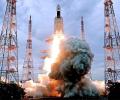
ISRO is developing a third launch pad at Shriharikota to accommodate heavier satellites and next-generation launch vehicles. The new facility will support both crewed and uncrewed missions.

These upcoming launches carry added significance in light of setbacks suffered in recent years.

ISRO has announced plans for seven launch missions by March, including the first uncrewed mission for the Gaganyaan project and demonstrations of new satellite technologies.

India is set to take its first steps towards its own human space flight when the uncrewed Gaganyaan mission soars to the skies later this year. Private players in the space sector are also gearing up for launching satellites on home-built rockets.
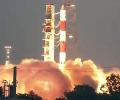
ISRO chairman announces plans for nine major launches by the end of the fiscal year, including the Blue Bird Block2 communication satellite for the US in collaboration with NASA.
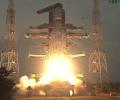
The heaviest communication satellite to be launched from the Indian soil onboard a new generation, homegrown 'Bahubali' rocket was successfully placed into the intended orbit on Sunday, the Indian Space Research Organisation said.

Indian Space Research Organisation's 101st mission from Sriharikota, an earth observation satellite onboard the agency's trusted Polar Satellite Launch Vehicle (PSLV) rocket, could not be accomplished on Sunday following a pressure issue in the third stage of the launch vehicle, the space agency said.
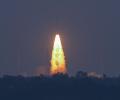
A PSLV rocket carrying Earth observation satellite EOS-09 failed to launch from the Sriharikota spaceport early on Sunday.
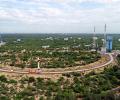
The Polar Satellite Launch Vehicle (PSLV) in its 63rd mission, would carry the earth observation satellite (EOS-09) which would be capable of capturing high-resolution images of the Earth's surface under all weather conditions.
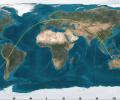
The Indian Space Research Organisation (ISRO) announced that the fourth edition of the PSLV Orbital platform Experiment Module (POEM-4), used for the space docking experiment mission, has successfully re-entered the Earth's atmosphere. The module, a repurposed spent upper stage of the Polar Satellite Launch Vehicle, impacted at 02:33 UTC (08:03 IST) on April 04, 2025, in the Indian Ocean. This successful re-entry signifies ISRO's commitment to mitigating space debris and contributing to the long-term sustainability of the outer space environment. POEM-4 had hosted 24 payloads during its mission life, yielding valuable science data. ISRO and the United States Space Command (USSPACECOM) closely monitored the module's orbit decay and predicted the re-entry date. This event showcases ISRO's proactive approach to responsible space operations.
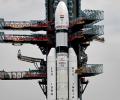
'The LVM3 rocket will orbit one Block 2 BlueBird satellite in Low Earth Orbit.'
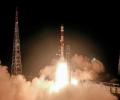
State-run Hindustan Aeronautics Limited has won a bid under which it will receive technology from the Indian Space Research Organisation for the end-to-end commercial production of the Small Satellite Launch Vehicle (SSLV), a first for the industry as India seeks to become a global hub for small satellite manufacturing and launches.
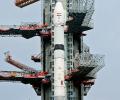
The main focus of the all weather RISAT-1B satellite will be to observe the Indian land with its C-band synthetic aperture radar.
'There's too much coincidence in back-to-back failures of missions critical to national security.'

ISRO said the upper stage of the Polar Satellite Launch Vehicle - C37 (PSLV-C37) re-entered the earth's atmosphere on October 6, 2024 and the impact point was the North Atlantic Ocean.
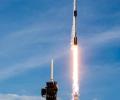
'The solution is to replace, clean up, retest and proceed.' 'There is nothing to worry about if corrected.'
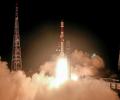
The two Space Docking Experiment (SpaDeX) satellites that the Indian Space Research Organisation is hoping to unite are at a distance of 1.5 km and will be brought much closer on January 11, the space agency said on Friday.
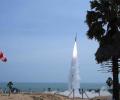
The fuel cost will come down if rockets are launched from Kulasekarapattinam as they will have a straight trajectory and need not have to avoid Sri Lanka, which is being done by rockets flown from Sriharikota.
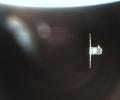
The Indian Space Research Organisation (ISRO) has successfully performed the docking of satellites as part of the Space Docking Experiment (SpaDeX). The docking was achieved after a series of maneuvers, including a trial attempt on January 12. The SpaDeX mission, launched on December 30, 2024, aims to demonstrate in-space docking technology using two small spacecraft. This technology is crucial for achieving complex mission objectives that require multiple rocket launches.
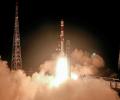
The Indian government has approved the construction of a third launch pad at Sriharikota, capable of sending heavier spacecraft into orbit. This new facility will support India's ambitious space program, including the Gaganyaan human spaceflight mission and a lunar landing. The launch pad will be built at the Satish Dhawan Space Centre and is expected to be operational within four years.

In terms of success rate, the PSLV rocket has an enviable record of 57 successful missions out of 58 commercial ones.
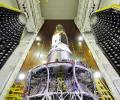
India will launch the PSLV-C56 carrying DS-SAR satellites from Singapore, along with six co-passenger satellites, from ISRO's Sriharikota spaceport on Sunday, July 30, 2023.

On Sunday, July 30, 2023, the Indian Space Research Organisation successfully launched its proven Polar Satellite Launch Vehicle rocket carrying seven Singapore satellites from the Satish Dhawan Space Centre in Sriharikota and placed them into intended orbits.

Docking technology is crucial for sending people and cargo to space stations.
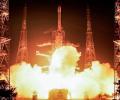
ISRO's vendor policy and quality control processes are under scanner.

The Indian Space Research Organisation (ISRO) on Monday successfully launched its maiden X-Ray Polarimeter Satellite that would offer several insights into celestial objects like black holes.
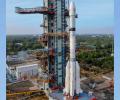
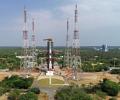
At 6.23 am on 29.1.2025, the 50.9 metre tall and weighing 420.7 ton Geosynchronous Satellite Launch Vehicle-F15 (GSLV-F15) is slated to blast off from the second launch pad carrying the 2,250 kg NVS-02 navigation satellite.
The Aditya-L1 mission carries seven scientific payloads to carry out the study.
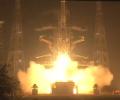
The Indian Space Research Organisation successfully launched its 100th mission on Wednesday, with a GSLV rocket carrying navigation satellite NVS-02.
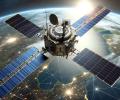
India is marching towards becoming the fourth country in the world to have space docking technology.

The polar satellite launch vehicle's 52nd mission is scheduled for lift-off at 15.41 hours on Thursday from the second launch pad at the spaceport of Sriharikota 'subject to weather conditions'.

The 51-hour countdown for India's landmark 100th space mission began on Friday with Indian Space Research Organisation's old warhorse Polar Satellite Launch Vehicle rocket all set to soar into space on September 9 with two foreign satellites from the spaceport of Sriharikota in Andhra Pradesh.

This would be the 44th flight of the PSLV and the third launch by ISRO this year.

According to ISRO officials, the spacecraft will be placed in a halo orbit around Lagrange point 1 (L1) of the Sun-Earth system, about 1.5 million km from the Earth. The L1 point is about one per cent of the total distance between the Earth and the Sun.

The Indian Space Research Organisation (ISRO) will perform the final manoeuvre on Saturday to inject Aditya-L1 spacecraft -- the first space-based Indian observatory to study the Sun -- into its final destination orbit, some 1.5 million kilometres from the Earth.
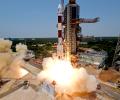
The successful launch of Aditya-L1 - the country's maiden mission to study the Sun - is expected to garner increased investor interest in the Indian space sector and trigger more funding for private players. Several private sector players, including Larsen & Toubro (L&T), MTAR Technologies, and Ananth Technologies, have played a pivotal role in the Indian Space Research Organisation's (Isro's) solar observatory mission. Aditya-L1 on Saturday set off on a 125-day journey on a PSLV-C57 rocket, in its attempt to study various elements relating to the nearest star from the halo orbit around Lagrange point 1 (L1) of the Sun-Earth system, which is about 1.5 million km from Earth.

ISRO chairman S Somanath said the success gave the space agency "greater confidence," as the GSLV will be next deployed in the NISAR mission, a collaborative effort with the US' NASA.
 © 2026 Rediff.com - Advertise with us - Disclaimer - Privacy Policy - Sitemap - Feedback - About us - Terms of use - Grievances