
Thursday's launch is the last one of 2020 for ISRO.
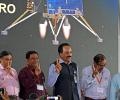
Ex-ISRO chairman G Madhavan Nair said the scientists at space agency have achieved this historic success by getting a salary one-fifth of the scientists in the developed world.

Aditya-L1 is the first Indian space-based observatory that will study the Sun from a halo orbit around the first Sun-Earth Lagrangian point (L1), which is located roughly 1.5 million km from the Earth.

Aditya L1, the first space based Indian mission to study the Sun underwent the second earth-bound manoeuvre successfully, during the early hours on Tuesday, Indian Space Research Organisation (ISRO) said.

EOS-01 is an earth observation satellite intended for applications in agriculture, forestry and disaster management support, ISRO has said.

The primary satellite TeLEOS-2 is a synthetic aperture radar satellite developed under partnership between Defence Science and Technology Agency (DSTA) representing the Government of Singapore and ST Engineering.
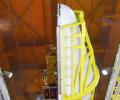
PSLV-C51/Amazonia-1 is the first dedicated commercial mission of NewSpace India Limited, Indian Space Research Organisation's commercial arm.

ISRO has released the footage of the injection of PSLV-37 which launched a record 104 nano-satellites overseas customers into the orbit in blocks in a series of separations.

The launch is tentatively scheduled at 09.28 hrs IST on November 25, 2019 subject to weather conditions, ISRO said.

In a landmark journey into a new era of space application, India successfully launched its first dedicated navigation satellite using the Polar Satellite Launch Vehicle, which blasted off from the Satish Dhawan Space Centre in Sriharikota, Andhra Pradesh.

The 436-kg EMISAT and other satellites would be launched from the Satish Dhawan Space Centre in Sriharikota.
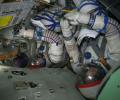
He also said it may be adopted for use in every stage of a rocket. He was speaking at the 16th convocation of SRM Institute of Science and Technology, near Chennai.
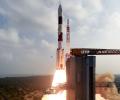
The Indian Space Research Organisation (ISRO) is all set to make its maiden commercial launch of 36 broadband communication satellites on board the space agency's heaviest rocket LVM3-M2, the countdown for which began early on Saturday at Sriharikota spaceport in Andhra Pradesh.

The Lagrange point 1 (L1) of the Sun-Earth system is about 1.5 million km from the Earth. It is about one per cent of the total distance between the Earth and the Sun.

The Trans-Lagrangian Point 1 Insertion manoeuvre marks the beginning of the spacecraft's about 110-day trajectory to the destination around the L1 Lagrange point, a balanced gravitational location between the Earth and the Sun.

While the mission is a follow-up to the PSLV-C55 TeLEOS-2 mission launched in April this year, scientists in Sunday's mission will place the fourth stage of the PSLV rocket in a lower orbit.
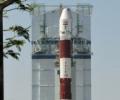
Indo-French oceanographic study satellite 'SARAL' and six foreign mini and micro spacecrafts were successfully launched on Monday by Indian Space Research Organisation's PSLV-C20 rocket from this spaceport.

The earth observation satellite would provide real-time images of the country and also be able to quickly monitor natural disasters.
The placing of four satellites into orbit on October 12, 2011 is yet another milestone in the glorious career of Indian Space Research Organisation's trusted Polar Satellite Launch Vehicle.
India's Polar Satellite Launch vehicle-C16 rocket on Wednesday successfully launched into orbit the latest remote sensing satellite Resourcesat-2 that would study and help manage natural resources along with two nano satellites.

The Indian Space Research Organisation (ISRO) is set to welcome the new year with the launch of its first X-Ray Polarimeter Satellite that would offer insights into celestial objects like black holes, onboard a Polar Satellite Launch Vehicle rocket on Monday.
The placing of four satellites into orbit on October 12, 2011 is yet another milestone in the glorious career of Indian Space Research Organisation's trusted Polar Satellite Launch Vehicle.
India's Polar Satellite Launch Vehicle on Wednesday successfully sent into orbit four satellites, including the Indo-French tropical weather satellite Megha-Tropiques.

The new year will witness two unmanned missions under the "Gaganyaan" project, deep ocean exploration project, "Samudrayaan" and many more.

The 1,858 kg spacecraft, the country's first microwave remote sensing satellite, was injected into orbit by the Polar Satellite Launch Vehicle about 19 minutes after a perfect lift off at 5.47 am at the end of the 71-hour countdown from the Satish Dhawan Space Centre, around 90 km from Chennai.
ISRO plans to launch 720-kg SPOT-6 remote sensing satellite from France (built by ASTRIUM SAS) and a 15-kg Japanese spacecraft Protiers on board the home-grown Polar Satellite Launch Vehicle (PSLV-C21) in the second week of September, in a major milestone of sorts.

India's ambitious space mission to explore planet Mars would be launched on November 5 from the spaceport of Sriharikota, ISRO announced on Tuesday.

Launched on September 23, 2009 using the Polar Satellite Launch Vehicle from Sriharikota, Oceansat-2; is designed to provide service continuity for operational users of the Ocean Colour Monitor (OCM) instrument on Oceansat-1. The agreement with the Indian Space Research Organisation will lead to the use of data from Oceansat-2 for various US agencies for research, education and other activities of public good, including weather forecasting.
Indian Space Research Organisation is using the most powerful configuration of its rocket Polar Satellite Launch Vehicle to launch a communication satellite from Sriharikota on July 15, as it braces for the nearly Rs 200 crore mission.
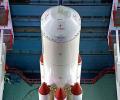
India on Friday successfully launched its latest communication satellite GSAT-12 onboard a powerful variant of homegrown Polar Satellite Launch Vehicle, PSLV-C17, from the spaceport in Sriharikota.
The 51-hour countdown for the 17th flight launch of Indian space agency's Polar Satellite Launch Vehicle PSLV-C 15 from Sriharikota spaceport is expected to begin on Saturday morning."The rocket will put into orbit five satellites remote sensing satellite Cartosat-2B from India, Alsat from Algeria, two nano satellites from Canada and Switzerland, and a pico (very small) satellite called Studsat built by 7 Indian engineering students.
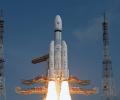
The mission is targeted for launch in the fourth quarter of 2024.
For the first time in the history of Indian space research, a satellite developed by a university in India will be launched by the Indian Space Research Institute (Isro) during the next flight of the Polar Satellite Launch Vehicle (PSLV). Tentatively scheduled for launch in March-April this year, the vehicle will carry a small remote-sensing satellite completely developed and fabricated by Chennai-based Anna University, sources in Isro said.
The GSAT-12 communication satellite, launched onboard PSLV-C17, has been successfully placed in geosynchronous orbit with a perigee of 35,684 km, apogee of 35,715 km and an orbital inclination of 0.17 deg with respect to the equatorial plane.
The Indian Space Research Organisation on Wednesday successfully launched seven satellites in 1,200 seconds with the help of its most trusted Polar Satellite Launch Vehicle from the Sriharikota spaceport in Andhra Pradesh coast.The launch was carried out as per schedule at 11.51 am and ended at 12.06 pm.Vice President Hamid Ansari, who was present at the Satish Dhavan Space Centre, congratulated the scientists and technocrats over this splendid achievement for the nation.

The launch of Polar Satellite Launch Vehicle (PSLV-C52) is scheduled at 05:59 hours on Monday from the First Launch Pad of Satish Dhawan Space Centre, Sriharikota, the Bengaluru-headquartered space agency said.
The final 52-hour countdown for the October 22 launch of the country's first moon mission, Chandrayaan-I, began early on Monday morning at the Satish Dhawan Space Centre at Sriharikota in Andhra Pradesh.

The Indian Space Research Organisation on Wednesday placed in orbit seven satellites including Oceansat-2 within a span of 20 minutes, its first successful mission after the abrupt end of the ambitious Chandrayaan-I project.

Scientists of the Indian Space and Research Organisation have proved their mettle once again with the successful launch of India's very own space observatory , Astrosat.
The Polar Satellite Launch Vehicle PSLV-C15 carrying five payloads, including India's remote sensing satellite Cartosat-2B, successfully lifted off from the spaceport in Sriharikota on Monday.
 © 2026 Rediff.com - Advertise with us - Disclaimer - Privacy Policy - Sitemap - Feedback - About us - Terms of use - Grievances