
When questioned about the absence of any mention of the Indian Navy's role in the operation, Hua said China's ministry of defence should be approached for details.
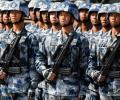
'This is the first time that active PLA army personnel would be reduced to below one million,' PLA Daily said.

The government has adopted a multi-pronged approach involving the Army, the Indian Air Force and the Navy as well as diplomacy and economic measures to send out a firm and clear message to China that its misadventure in eastern Ladakh was not acceptable at all.

The US said it has strong evidence that China has deployed anti-ship missiles, surface-to-air missile systems and electronic jammers to contested features in the Spratly Islands region of the South China Sea.

'Clearly, there is a wide gap between the stated intentions of China's top leadership to improve relations with India and the PLA's aggressive border management,' says Brigadier Gurmeet Kanwal (retd).

'Despite the current tension at Doklam and the risk of escalation on the Himalayan land frontier, it is the Indian Ocean we need to worry about more,' says Nitin Pai.

The aircraft carrier is China first domestically-built ship. Shandong is bigger than China's first aircraft carrier Liaoning and could house 36 fighter jets.

With tensions between China and Taiwan rapidly increasing, the tone of China's official media has also become progressively more strident, observes former senior RA&W officer and China expert Jayadeva Ranade.
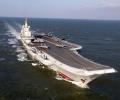
'The Chinese being focussed more seawards is definitely better for India with China being the looming threat along our land borders,' says Brigadier S K Chatterji (retd).

New Delhi must clearly demonstrate to Beijing that China will pay a price for its relentless strategic undermining of India, says Ajai Shukla.

The agreement would divert China's attention and keep them busy in the Pacific theatre, probably resulting in a reduction in threat perception in our area of interest in the Indian Ocean, notes Commodore Venugopal Menon (retd).

This is perhaps the most authoritative portrayal so far of Indian air power as a threat to China.
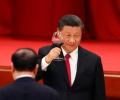
After the Ladakh fiasco where Xi Jinping did not expect the Indian Army to resist his land-grabbing tactics, he has to save face before his colleagues in the Communist party.' To bring the threat of a mega-dam to the northern Indian border is a clever move, observes Claude Arpi.
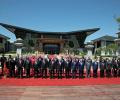
'Whichever option India chooses, it should be clear to the government that the China-Pakistan nexus poses a clear and present danger to national security,' says Brigadier Gurmeet Kanwal (retd).

'The Chinese navy is large and expanding both in numbers and capability by the day.' 'India too must take measures to safeguard its own interests, now and in the future.'

'The potential of one such LAC engagement going out of control and leading to heavy casualties cannot be ruled out,' warns Lieutenant General Syed Ata Hasnain (retd).

The seventh Tibet Work Forum was held in Beijing on August 28 and 29. Delhi should be deeply concerned, at a time India faces a precarious situation in Ladakh, because the TWF also defines China's western border policies, observes Claude Arpi.

'The military officers at China's National People's Congress reflect Xi Jinping's preference for elevating politically reliable, younger, officers with good professional qualifications,' says former RAW officer and China expert Jayadeva Ranade.
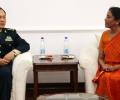
'In the case of an India-Pakistan confrontation, the Chinese may undertake more than just posturing, thereby constraining us from deploying adequate forces for decisive results,' warns Brigadier S K Chatterji (retd).

Among others, China is developing the strategically located Gwadar port in Balochistan, which is aimed towards having a military presence, says a Pentagon report

The 2.3 million strong People's Liberation Army, the world's largest, adopts a more aggressive posture with massive structural revamp.
'China's latest defence White Paper has been issued against the backdrop of the upgraded Sino-Pakistan strategic relationship which has impinged on India's sovereignty and territorial integrity, and Beijing's continuing intransigence on tackling the issue of the disputed border or intrusion by PLA troops,' says Jayadeva Ranade.

According to convention, Lieutenant General Praveen Bakshi should be named as General Dalbir Singh Suhag's successor as army chief

'Gwadar has the potential to facilitate PLAN's operations in the Arabian Sea and Indian Ocean.' 'Reports of China setting up electronic eavesdropping posts at Gwadar to monitor US and Indian naval activity and shipping traffic through the Straits of Hormuz and the Arabian Sea lend credence to this,' says former RA&W officer Jayadeva Ranade.

However, Denmark said it is difficult to conclude on the real intention behind this.

'China's moves are of direct significance to India, which will closely monitor Chinese naval activity in the Bay of Bengal and the Indian Ocean not least because of Chinese maps depicting claims over the Andaman and Nicobar Islands.'

'The military aim in a future conflict, if it can't be avoided, should be to cause maximum damage to the adversary's war waging capability and capture limited amount of territory as a bargaining counter,' says Brigadier Gurmeet Kanwal (retd).

Opposition to tri-service structures comes not just from bureaucrats and politicians as the generals like to lament, but equally from within the military. Neither the army, navy or air force chiefs want to relinquish control over their theatre commands, with these cutting edge units placed under some commander who reports elsewhere, says Ajai Shukla.

'After a strategic pause though, Beijing will revive its policy of slowly creeping towards acquiring sovereignty over the South China Sea.'

'In India, China's capacities to conduct new types of warfare is critically underestimated,' says Claude Arpi.

'With the recent challenging of the notion of the Indian Ocean Region being India's strategic backyard, China is gradually upping the ante in the maritime realm around India.'
'There are major implications for India. Though there was a transparently thin attempt to project the troop reduction as intended to promote peace, the downsizing is actually part of plans to streamline and strengthen the PLA, capable of defending China's national interests at home and abroad,' says Jayadev Ranade.

Will China's new military reforms endanger Xi Jinping's rule?

The Border Defence Cooperation Agreement with China needs closer scrutiny, says Rup Narayan Das.

'Whether it's investments in Kashmir, building naval facilities, or selling top-of-the-range military equipment, Pakistan could well benefit more under Xi's watch.' 'Do Chinese concerns about the 'Islamisation' of Pakistan give it pause about how quickly to move forward with security and economic projects? At the moment the indication is quite the opposite: China is doubling down on its support to Pakistan, partly because of its fears about where the country is headed.'
 © 2026 Rediff.com - Advertise with us - Disclaimer - Privacy Policy - Sitemap - Feedback - About us - Terms of use - Grievances