
NASA has announced three missions to the moon as part of efforts to establish a permanent base on the earth's natural satellite. The USD 20 billion plan includes lunar rovers and drones for experiments to help master skills to live and operate in the dangerous environment.

According to the space agency, Chandra's Surface Thermophysical Experiment measured the temperature profile of the lunar topsoil around the south pole, to understand the thermal behaviour of the Moon's surface.
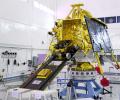
The cubical vehicle, exclusively designed for travelling on the moon, is fitted with a solar panel.

Four astronauts from NASA's Artemis II mission have safely returned to Earth after completing a historic flyby of the moon, marking the first human journey to the moon in over 50 years.
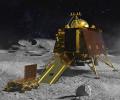
Asked if the lander was 'damaged' during the 'hard landing", Sivan said: "That we do not know".

From selfies to science, astronauts aboard Orion document life, work and discovery during their historic Moon flyby.
The successful Artemis II mission has boosted confidence in India's upcoming Gaganyaan mission, as both aim to demonstrate similar spaceflight capabilities. Experts highlight the collaboration between ISRO and NASA and the shared training programmes for astronauts.

The mission ferries four astronauts -- NASA's Reid Wiseman, Christina Koch and Victor Glover and Canada's Jeremy Hansen -- onboard the Orion spacecraft for a 10 day lunar flyby. Unlike the Apollo missions that aimed for landing, Artemis II is focused on testing. The crew will evaluate critical systems such as life support, navigation, and communication in deep space -- essential steps before humans can return to the lunar surface.

US President Donald Trump has amplified a highly surreal, artificial intelligence-generated music video across his social media network, showcasing an array of fantastical digital avatars that depict him as a globally revered icon.

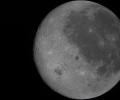
One of the most striking features in this view is the Orientale Basin, a massive impact crater about 600 miles (965 km) wide.
The National Aeronautics and Space Administration (NASA) on Monday said the crew of Artemis II is preparing for a historic lunar flyby that will take humans farther from Earth than ever before.

A crew of four astronauts boarded their spacecraft for the landmark flight, which represents a major milestone in lunar exploration.

Indian-American scientist Amit Kshatriya's journey from watching rocket launches in Houston to becoming NASA's Associate Administrator is a testament to his dedication and expertise in space exploration.

The Chandrayaan-2 mission has made the first-ever observation of the effects of the Sun's Coronal Mass Ejection (CME) on the Moon using its onboard scientific instruments. This observation would help understand the lunar exosphere and the impact of space weather on its surface.

NASA's Artemis II crew offers a rare look at Earth shrinking into space and the Moon coming into view during humanity's return to deep space.

While India's interplanetary ambitions remain significant, the current pace of financial and technical progress raises questions about whether the 2027-2028 timelines can be met.
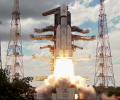
New data from India's Chandrayaan-3 mission suggests that ice might be present at more locations on the Moon's surface than previously believed. The study, published in Communications Earth and Environment, analyzed temperature data collected by the ChaSTE probe onboard the Vikram lander. The researchers found that significant variations in surface temperatures can influence the formation of ice, with slopes angled away from the Sun potentially providing favorable conditions for ice accumulation. The findings have implications for future lunar exploration, suggesting that water-ice resources could be more accessible than previously thought.

Chandrayaan-3 mission's rover 'Pragyan' has traversed a distance of about eight metres on the lunar surface, and its payloads have been turned on, ISRO said on Friday.

Russia's state space corporation, Roskosmos, according to the Reuters report, said it had lost contact with the spacecraft shortly after a problem occurred as it was shunted into pre-landing orbit on Saturday.

Its duties include experiments to further understand the lunar surface.
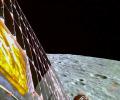
Chandrayaan-1, India's first mission to the Moon, was launched on October 22, 2008 from Sriharikota spaceport in Andhra Pradesh.
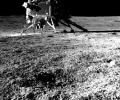
Chandrayaan-3 mission's Pragyan rover on Wednesday clicked an image of the Vikram lander, ISRO said.
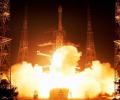
Indian Space Research Organisation is gearing up for one of its busiest times with seven more launches planned this financial year, even as India's first human spaceflight remains scheduled for 2027, its chairman V Narayanan said.

The mission objectives of Chandrayaan-3 are to demonstrate a safe and soft landing on the lunar surface, to demonstrate rover roving on the Moon, and to conduct in-situ scientific experiments.

A new study suggests that moons orbiting free-floating planets, with dense hydrogen atmospheres and tidal heating, could maintain liquid oceans for billions of years, potentially supporting the development of complex life.
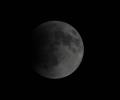
Glimpses of the Blood Moon as seen from Jaipur, Thiruvananthapuram, New Delhi and Guwahati.

India's ambitious third Moon mission's spacecraft Chandrayaan-3 after the launch on July 14, had entered into lunar orbit or the Moon's orbit on August 5.

Ahead of the T20 World Cup final, the Indian cricket team is leaving no stone unturned, from changing hotels due to perceived bad luck to considering a red soil pitch and planning a grand entertainment show featuring Ricky Martin.

Four years after it broke many hearts, Indian Space Research Organisation's Chandrayaan is all set to soar towards the moon in its third expedition on Friday in an attempt to put the country in an elite club of nations that accomplished lunar missions with a soft landing.

The Indian Space Research Organisation (ISRO) has received approval for the Chandrayaan-5 mission, which aims to study the Moon's surface using a 250kg rover. The mission will be conducted in collaboration with Japan. This follows the success of the Chandrayaan-3 mission, which achieved a soft landing on the Moon's South Pole in August 2023. ISRO is also planning to establish a space station, Bharatiya Space Station, in the near future.

All spacecraft parameters are normal, the Bengaluru headquartered space agency said after the maneuver.
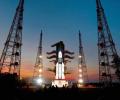
Of the 109 lunar missions during the period, 61 were successful and 48 had failed, it stated.

Vikram (with rover 'Pragyan' housed inside) is expected to touch down on the lunar surface on September 7, between 1.30 am and 2.30 am.
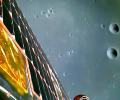
Taking to X (formerly Twitter), ISRO said, "Chandrayaan-3 Mission. Chandrayaan-3 Rover to MOX, ISTRAC, Moon walk begins!"

There will be two more orbit manoeuvres to make the spacecraft enter into its final orbit passing over the lunar poles at a distance of about 100 km from the Moon's surface.

India on Wednesday joined an elite group of three nations to have sent a spacecraft on the Moon, as Chandrayaan-3 landed a rover on the lunar surface to explore the uncharted territories near the south pole.
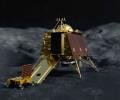
The Lander and the Rover have scientific payloads to carry out experiments on the lunar surface. The main function of the Propulsion Module (PM) was to carry the Lander Module (LM) from the launch vehicle injection till final lunar 100 km circular polar orbit and separate the LM from PM, which it did.

Vikram and Pragyan payloads are now in a power-off mode until the south pole of the lunar surface is back in the range of the Sun again.

In a giant leap for its space programme, India's Moon mission Chandrayaan-3 touched down on the lunar south pole at 6.04 pm on Wednesday, propelling the country to an exclusive club of four and making it the first country to land on the uncharted surface.
Nehru Planetarium has paid a tribute to the Chandrayaan 2 lunar mission and ISRO by revamping its iconic dome to resemble the lunar surface.
