
Glimpses of what the historic Chandrayaan Mission discovered on the dark side of the Moon.
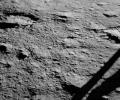
Speaking to PTI, Somanath said, "(The lander landed) perfectly in the intended site. The landing location was marked as 4.5 km x 2.5 km -- I think on that space, and the exact centre of that was identified as the location of landing. It landed within 300 metres of that point. That means it is well within the area identified for landing."

After the successful deployment of Chandrayaan-3's lander and rover on the moon, Indian Space Research Organisation (ISRO) is hoping that their mission life will not be limited to one lunar day or 14 earth days, and that they will come back to life when the sun again rises on the Moon, to carry on with the experiments and studies there.

Vikram and Pragyan payloads are now in a power-off mode until the south pole of the lunar surface is back in the range of the Sun again.

Here is ISRO's SAC Director, Nilesh M Desai explains the crucial stage of soft landing.

Interspersing their tweets and posts with an occasional 'Welcome buddy!' and 'Thanks for the ride, Mate!', ISRO's social media handles occasionally departed from using just technical terms to give updates about India's ambitious Moon mission Chandrayaan-3.

The spacecraft will now prepare for separation of the lander module -- comprising the lander and rover -- from the propulsion module.
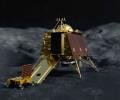
Conducting in-situ scientific experiments is underway. All payloads are performing normally, ISRO said.

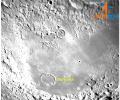
The ISRO on Monday released images of the Lunar far side area captured by the Lander Hazard Detection and Avoidance Camera (LHDAC).

Its duties include experiments to further understand the lunar surface.
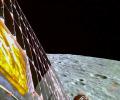
As scientists at the Indian Space Research Organisation (ISRO) gear up for the much-awaited soft landing of the Chandrayaan-3 spacecraft on the Moon's surface, the space agency may postpone the touchdown to August 27 in the event that health parameters of the lander module are found to be "abnormal", a senior official has said.
According to the Indian Situational Space Awareness Report for 2023, the nominal lift-off of the Launch Vehicle Mark-3, carrying the Chandrayaan-3 spacecraft, had to be delayed by four seconds based on the Collision on Launch Avoidance analysis.
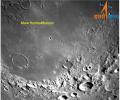
This camera that assists in locating a safe landing area -- without boulders or deep trenches -- during the descent is developed by Ahmedabad-based Space Applications Centre (SAC), a major research and development centre of ISRO.

India will become the fourth country to master the technology of soft-landing on the lunar surface after the US, China and the erstwhile Soviet Union.

This image features the left image within the red channel, and the right image within the blue and green channels, resulting in a striking cyan hue.

The mission objectives of Chandrayaan-3 are to demonstrate a safe and soft landing on the lunar surface, to demonstrate rover roving on the Moon, and to conduct in-situ scientific experiments.

The entire process being autonomous when the lander has to fire its engines at the right times and altitudes, use the right amount of fuel, and scan of the lunar surface for any obstacles or hills or craters before finally touching down.

India's ambitious third Moon mission's spacecraft Chandrayaan-3 after the launch on July 14, had entered into lunar orbit or the Moon's orbit on August 5.

ISRO chairman G Madhavan Nair said Chandrayaan-2, to be undertaken by 2010, will have a proper lander, which would land on the lunar surface and try to explore the surface in far more detail.
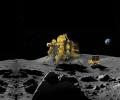
This eagerly anticipated event will be broadcast live on August 23, starting from 17:27 Hrs IST on multiple platforms, including the ISRO Website, its YouTube channel, ISRO's Facebook page, and DD National TV channel.

In his latest tweet, the 58-year-old actor said the successful landing of Chandrayaan-3 on the Moon's uncharted south pole was a moment of celebration for mankind.

In a giant leap for its space programme, India's Moon mission Chandrayaan-3 touched down on the lunar south pole at 6.04 pm on Wednesday, propelling the country to an exclusive club of four and making it the first country to land on the uncharted surface.
Snow falling from the Martian clouds have been detected by NASA's Phoenix Mars Lander, with possibilities of it even reaching the planet's surface. Laser instruments on the lander have detected the snow clouds about 2.5 miles above the spacecraft's landing site and also followed its precipitation.

According to the space agency, Chandra's Surface Thermophysical Experiment measured the temperature profile of the lunar topsoil around the south pole, to understand the thermal behaviour of the Moon's surface.

"The receiver is kept on. Hoping for a successful awakening for another set of assignments! Else, it will forever stay there as India's lunar ambassador," it said.

ISRO on Monday said a two-way communication between the Chandrayaan-2 orbiter and Chandrayaan-3's Lunar Module has been established.

'The Abdullah family is the problem and facilitator of the instability that we are seeing in Kashmir.'
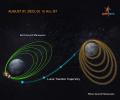
The Propulsion Module (PM) of Chandrayaan-3 has been moved from an orbit around the Moon to an orbit around Earth, the Indian Space Research Organisation (ISRO) has said, terming the operation a unique experiment.

Russia's state space corporation, Roskosmos, according to the Reuters report, said it had lost contact with the spacecraft shortly after a problem occurred as it was shunted into pre-landing orbit on Saturday.

India created history on Wednesday when the lander module of Chandrayaan-3 touched down on the lunar south pole, propelling the country to an exclusive club of four and making it the first country to land on the uncharted surface.

The Indian Space Research Organisation (ISRO) on Thursday announced that its lunar mission Chandrayaan-3 will be launched on July 14 from the space port at Sriharikota in Andhra Pradesh.

According to the European Space Agency, the unmanned spacecraft -- Schiaparelli -- exploded on impact with the Martian surface after falling from as high as 13,000 ft (4,000 m).

The space agency said the Mission Operations Complex (MOX), located at the ISRO Telemetry, Tracking and Command Network (ISTRAC) in Bengaluru, is buzzing with energy and excitement.

Four years after it broke many hearts, Indian Space Research Organisation's Chandrayaan is all set to soar towards the moon in its third expedition on Friday in an attempt to put the country in an elite club of nations that accomplished lunar missions with a soft landing.
If any factor regarding the lander module appears unfavourable, then the landing will be shifted to August 27, said the Space Applications Centre-ISRO about Chandrayaan-3 on Monday.

The Laser-Induced Breakdown Spectroscope instrument onboard 'Pragyan' rover of Chandrayaan-3 has 'unambiguously confirmed the presence of sulphur in the lunar surface near south pole, through first-ever in-situ measurements,' ISRO said on Tuesday.

'The ISRO has done enough simulations and also redundancies have been built in so that chances of such failure are remote. Still, we have to keep our fingers crossed'
Chandrayaan-1, India's first mission to the Moon, was launched on October 22, 2008 from Sriharikota spaceport in Andhra Pradesh.

It is unclear if this episode will affect or prevent the lunar lander -- which was slated to land near the moon's south pole as soon as Monday -- from attempting a touchdown.

Friday's mission is the fourth operational flight of LVM3 which aims to launch the Chandrayaan-3 spacecraft into a Geo Transfer Orbit.
 © 2026 Rediff.com - Investor Information - Advertise with us - Disclaimer - Privacy Policy - Sitemap - Feedback - About us - Terms of use - Grievances