
The Chandrayaan-2 mission has made the first-ever observation of the effects of the Sun's Coronal Mass Ejection (CME) on the Moon using its onboard scientific instruments. This observation would help understand the lunar exosphere and the impact of space weather on its surface.

Scientists at ISRO used the orbiter high resolution camera onboard the Chandrayaan-2 orbiter to study the lunar surface hours before and after the soft-landing of Vikram lander on the moon on August 23.

Chandrayaan-3 mission's lander 'Vikram' chose a relatively flat region on the lunar surface to touch down, images captured by its camera showed.
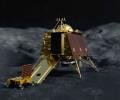
ISRO on Friday said it has made efforts to establish communication with its lunar mission Chandrayaan-3's lander Vikram and rover Pragyan to ascertain their 'wake-up condition' after they had been put into sleep mode early this month -- but no signals have been received from them as of now.

So, if ISRO is able to revive them as the Sun rises on the Moon again, information that is derived from experiments that could once again be conducted by the Chandrayaan-3 payloads would be a "bonus".

The agency said it is currently receiving a signal from the lander, which is communicating as expected.

The Vikram lander was 100 kilometers away from LRO, near Manzinus crater in the Moon's south pole region, when LRO transmitted laser pulses toward it on December 12 last year.

ISRO on Monday said the Vikram lander successfully underwent a hop test when it made the soft-landing again on the lunar surface.

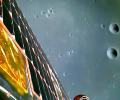
ISRO on Friday released a set of visuals of the Moon captured by cameras positioned on the Lander Module of Chandrayaan-3 spacecraft.

In 2025 alone, at least 50 suicides linked to online gambling losses have been reported across India. According to FIRs, the victims were addicted to betting, largely driven by cricket, rummy and poker.

Announcing that the health of Chandrayaan-3's Lander Module is normal, ISRO on Friday said that the module has successfully undergone a deboosting (slowing down) operation, taking it closer to the Moon.

The initial assessment of the first-ever measurements of the near-surface lunar plasma environment over the south pole region by RAMBHA-LP payload onboard Chandrayaan-3 lander indicates that plasma there is relatively sparse, ISRO said on Thursday.

Besides the scientists at the Indian Space Research Organisation, officials at the European Space Agency are also involved in tracking the lander module of the Chandrayaan-3 mission which is minutes away from making a soft landing on the surface of the moon, a senior scientist said on Wednesday.
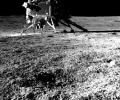
Chandrayaan-3 mission's Pragyan rover on Wednesday clicked an image of the Vikram lander, ISRO said.

Lander Module of Chandrayaan-3 spacecraft comprising the lander and rover has successfully separated from the Propulsion Module, Indian Space Research Organisation said on Thursday.

The rover will carry out in-situ chemical analysis of the lunar surface during the course of its mobility.

Zohram Kwame Mamdani would be the city's first Muslim and Indian American mayor if elected New York mayor this November.
New data from India's Chandrayaan-3 mission suggests that ice might be present at more locations on the Moon's surface than previously believed. The study, published in Communications Earth and Environment, analyzed temperature data collected by the ChaSTE probe onboard the Vikram lander. The researchers found that significant variations in surface temperatures can influence the formation of ice, with slopes angled away from the Sun potentially providing favorable conditions for ice accumulation. The findings have implications for future lunar exploration, suggesting that water-ice resources could be more accessible than previously thought.

The Indian Space Research Organisation (ISRO) has received approval for the Chandrayaan-5 mission, which aims to study the Moon's surface using a 250kg rover. The mission will be conducted in collaboration with Japan. This follows the success of the Chandrayaan-3 mission, which achieved a soft landing on the Moon's South Pole in August 2023. ISRO is also planning to establish a space station, Bharatiya Space Station, in the near future.
A complaint was lodged against the accused Mitul Trivedi, after he was seen giving interviews to the local media since the Vikram lander successfully made soft landing on August 24, claiming to have designed the lander module of Chandrayaan-3, the official said.

ISRO chief's comments came after NASA said that it had found the remains of the Vikram lander by its Lunar Reconnaissance Orbiter and credited the discovery to Chennai-based amateur astronomer and engineer Shanmuga Subramanium.

While New Jersey, US-based OrbitBeyond leads a consortium of subcontractors who have designed and developed hardware for deep space missions, Bengaluru-based Team Indus is leading OrbitBeyond's lander engineering, reports T E Narasimhan.

The Vikram Moon Lander, named after the father of India's space mission Vikram Sarabhai on his birth centenary year, is scheduled to touch the lunar surface near its south pole on September 7 about 1.55 am.

An ISRO official said: "Unless and until everything is intact (lander), it's very difficult (to re-establish contact). Chances are less. Only if it had soft-landing, and if all systems functioned, then only communication can be restored. Things are bleak as of now."

On October 3, Subramanian, a Chennai-based mechanical engineer, had tagged the Twitter handles of NASA, LRO and ISRO in a tweet, asking, "Is this Vikram lander? (1 km from the landing spot) Lander might have been buried in Lunar sand?"
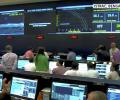
ISRO has said once the Lunar night falls, there would be no sunlight for the lander to generate power for its working and also it was not designed to operate in the heavy cold temperature of Moon during the phase.
'The Lunar Reconnaissance Orbiter imaged the area of the targeted Chandrayaan-2 Vikram landing site on October 14 but did not observe any evidence of the lander'

The space agency had got support from the entire nation, despite it losing communication with the lander ahead of the touchdown, with people from all walks of life praising ISRO and its scientists for the achievement.
"Progressively, you can imagine that it becomes that much more difficult, with each passing hour, the available power on the battery gets drained out, and there won't be anything left for it to power and operate", an ISRO official said.
If it becomes a reality, the Chennai-based company will become the first private player from India to conduct such a mission to the lunar surface.

NASA posted images clicked by its Lunar Reconnaissance Orbiter camera, showing the site's changes on the Moon and the impact point before and after the spacecraft had made a hard-landing on the lunar surface.
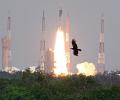
The nine-second de-orbiting or retro-orbiting manoeuvre was executed at 3.42 am using the onboard propulsion system.

'InSight will study the interior of Mars and will teach us valuable science as we prepare to send astronauts to the Moon and later to Mars.'

The crater was formed during the Nectarian period, which dates back to 3.85 billion years and is one of the oldest time periods in the Moon's history, the team, including researchers from the Physical Research Laboratory and Indian Space Research Organisation (ISRO), Ahmedabad, said.

'How many jobs will be created when you complete your course?' 'How many people will compete with you?' 'What is the minimum and maximum salary you can expect?' 'Which are the companies that will offer you a job?' 'What skills do you have to develop?' 'How long will it sustain?'

Chandrayaan-3 mission's rover 'Pragyan' has traversed a distance of about eight metres on the lunar surface, and its payloads have been turned on, ISRO said on Friday.

ISRO Chairman S Somanath had recently said the most critical part of the landing will be the process of reducing the velocity of the lander from 30 km height to the final landing, and the ability to reorient the spacecraft from horizontal to vertical direction. "This is the trick we have to play here," he said.
The Lander and the Rover have scientific payloads to carry out experiments on the lunar surface. The main function of the Propulsion Module (PM) was to carry the Lander Module (LM) from the launch vehicle injection till final lunar 100 km circular polar orbit and separate the LM from PM, which it did.
Taking to X (formerly Twitter), ISRO said, "Chandrayaan-3 Mission. Chandrayaan-3 Rover to MOX, ISTRAC, Moon walk begins!"

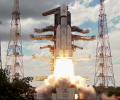
Here is a glimpse of the journey of India's third lunar exploration venture has taken so far.
 © 2026 Rediff.com - Investor Information - Advertise with us - Disclaimer - Privacy Policy - Sitemap - Feedback - About us - Terms of use - Grievances