
India, the US and 12 other members of the IPEF grouping have signed a supply chain resilience agreement that would help mitigate risks of economic disruptions from supply chain shocks and improve crisis coordination. The agreement would help member countries like India to reduce their dependence on China and provide timely information to the IPEF member countries about potential supply disruptions. The COVID outbreak severely disrupted the global supply chain, as most countries were dependent on China for various products like pharma raw materials.

Tamil Nadu, claiming to be the Detroit of India, has labour unrest in the automobile industry, among others.

Talks to sort out the 10-day workers' agitation at the Gurgaon apparel factory of Viva Global, a supplier to British retail outlet Marks & Spencer, got postponed.
The divestment department has proposed that public sector units involved in mining ores alone should qualify for 'natural asset' status while imposing additional norms concering employment of labour.\n\n\n\n
While the country's unemployment rate is falling, the quality of employment seems to have taken a hit. The pace of formalisation slowed in the five months of the current financial year (April-August) with more than half a million fewer formal jobs created in the period compared to the same period last year, according to data from the Employees' Provident Fund Organisation (EPFO). The payroll data showed that cumulatively 4.92 million new subscribers joined the social security organisation between April-August this year, compared to 5.51 million subscribers in the same period in the previous year, reflecting a 10.7 per cent decline in the number of new payrolls created.

Assuming we still have a Modi-led majority government after May 2024, there is no guarantee that reforms will move at anything more than a snail's pace, though we must be thankful even for that, notes R Jagannathan.

'When manufacturing or even services cannot generate the kind of employment they are looking for, they prefer to be unemployed rather than under-employed.'

"The Embassy urges the Indian expatriate community not to panic based on inaccurate reports published by some sections of the media," an embassy statement said.

There are around 15 lakh diamond workers in Gujarat, including nearly seven lakh employed in units in Surat, which is the largest hub of cutting and polishing of these precious stones.

A number of MEPs were wearing the anti-hate 'OneLove' armbands which seven European World Cup captains backed out from wearing following FIFA pressure.

'India's manufacturing will take 10-15 years to catch up with China.'

Vasundhara Raje may have had her faults but she is an unconventional and brave leader who deserves better, observes Aditi Phadnis.

The government's target of hitting $52 billion to $58 billion in mobile phone exports in FY26 has been faltering; an Indian corporate group with financial muscle will help.
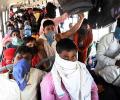
'COVID-19 is just an excuse to pass anti-labour laws.'

'Just as coronavirus has come to us from China, this disease is also coming from that country.' 'India is a strong democracy and you cannot compromise on labour laws in this manner.' 'These changes will be challenged in court.'
Chief Justice of India D Y Chandrachud on Friday termed Justice Ajay Rastogi, who will be demitting office on June 17, a "great ally" who possessed judicial compassion and sensitivity for every cause.

Congress leader Rahul Gandhi on Wednesday said that polls can be rigged through social media, and that if social media companies want, they can make any party win an election.

A pilots' grouping of Tata group-owned Air India has approached the labour department to initiate conciliation proceedings with the airline's management to sort out various issues, including concerns over possible changes in service conditions of its members. The Indian Commercial Pilots Association (ICPA), which claims to represent around 900 pilots flying narrow-body planes of Air India, has written to the Chief Labour Commissioner (CLC) as well as Deputy CLC and Assistant Labour Commissioner in New Delhi earlier this week. Apart from service condition issues, the association has flagged that the airline's plans to hire captains for its A320 fleet on a fixed-term contract may result in an anomalous situation for the existing pilots at Air India.

'We have made a pledge; those who kicked Rahul Gandhi out of the house he had lived for 19 years, will be kicked out from the corridors of power.'

The Survey noted that while women account for almost half of India's population, their participation in labour market is almost one-third and has been declining.

The contrast between the two meetings couldn't have been more stark, yet, both were organically linked, the latter a show of support for the former.

As per the recommendations of the 2nd National Commission on Labour, the ministry is codifying existing 44 central labour laws into four codes by simplifying, amalgamating and rationalising the relevant provisions of the legislations.

Companies today are taking a very fashionable way to reduce their workforce. Instead of the outright firing of employees, an alternative approach that some companies are using is the passive-aggressive method which is both deliberate and accidental, points out corporate lawyer Ishanee Sharma.
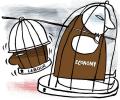
The Union government will take a bit longer to introduce the much-awaited labour codes even as the majority of states and Union Territories (UTs) have framed rules on them. There were speculations that these would be introduced from July 1. While 30 states and UTs have framed rules on the code on wages, 25 of them have done so on industrial relations. Of the two remaining codes, 24 states and UTs have framed rules on social security and 23 on occupational safety, health, and working conditions (OSH), sources said.
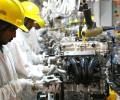
Single registration will be coupled with single licence, along with a single return, for executing projects for five years.

Apple is hoping to assemble in India 25 per cent of all iPhones produced globally to reduce its heavy dependence on China.

Stalin said he spoke to Nitish Kumar over phone and assured him that no harm would befall workers and conveyed to him that 'all workers are our workers who help Tamil Nadu's growth and nothing will happen to impact them, I have assured him'.

Medical seats for under-graduates and post-graduates remaining vacant in the NEET era, together with the Centre 'freezing' the number of medical colleges and seats in (Dravidian) Tamil Nadu and the launch of the PM's 'Vishwakarma Scheme' for the nation's craftsmen, are all seen as a bid to further reverse the state's progressive socio-economic agenda of and its achievements of the past hundred-plus years, argues N Sathiya Moorthy.

After years of pressure from human rights groups, Qatar changed its labour laws to dismantle much of its "kafala" sponsorship system, absolving workers of the need to get the permission of the employer who sponsored their visa in order to change jobs or leave the country.

Their favourite alternatives: Malaysia, Vietnam and the Philippines. Note, India is missing from that list. And this is despite an attractive financial incentive scheme for OSAT players. The reason, said a senior executive of a US chip company who had a meeting in Taiwan just a few weeks ago, is that "they want more predictability in government policy because they plan to put in big money."

Musk has blamed activists for a significant drop in the company's revenues.
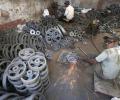
Instead of mechanically consolidating all labour laws into one, provisions of all labour laws should be relooked in terms of their substance. The irrelevant and archaic provisions have to be fixed, says Aparajita Gupta.

Qatar will be the first team since Italy in the second World Cup in 1934 to participate in the finals for the first time as a host without having previously qualified for the tournament.

"Our parents talked to us about Maradona, and we will talk to our sons about Messi. We hope that we will win the cup, and we can celebrate with him and all the people in Argentina," said Nicolas Gomez, a fan from Argentina.

India on Monday played down the controversy over the derogatory remarks by a Bharatiya Janata Party leader, saying its ambassador to Qatar has already conveyed its position to the Gulf country and there was nothing new to add.

India has emerged as one of the top three choices for investments in the next 2-3 years, with more than two-thirds of respondents in a survey of multinational companies (MNCs) citing the country as their number one choice for future investments. According to the FDI survey released on Tuesday by CII in association with EY, about half of the respondents see India amongst the top three economies or leading manufacturing destinations of the world by 2025.

The new mantra was to align Apple's ambition with the government's, focusing on Modi's favourite themes of Make in India, employment generation and India as a high-tech export hub.
After assuming power in 2014 with a full majority of its own, the BJP-led NDA government started an ambitious process of reforming labour laws in the form of codes aimed at making the framework less cumbersome with a variety of alterations. It had planned four codes each for industrial relations, wages, social security and welfare, and occupational safety, health and working conditions. To this end, 35 central labour laws were to be converted into four codes that would have had the virtue of streamlining labour relations. But none of the proposed code Bills could be converted into a law principally because neither trade unions nor industry representatives came on board. They hold the key to India's low-growth-high unemployment paradigm but the government may struggle to push them through this time as well. Somesh Jha explains why
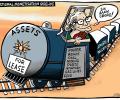
But use of that word -- privatisation -- is not encouraged. This seems to be a classic case of reforms through subtle signals, observes A K Bhattacharya.

The challenges before the coming Budget are more daunting than those in 2021, reveals A K Bhattacharya.
 © 2026 Rediff.com - Advertise with us - Disclaimer - Privacy Policy - Sitemap - Feedback - About us - Terms of use - Grievances