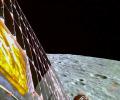
As scientists at the Indian Space Research Organisation (ISRO) gear up for the much-awaited soft landing of the Chandrayaan-3 spacecraft on the Moon's surface, the space agency may postpone the touchdown to August 27 in the event that health parameters of the lander module are found to be "abnormal", a senior official has said.

Following the postponement of the Axiom 4 mission, Group Captain Shubhanshu Shukla's father, Shambhu Dayal Shukla, said that his family is 'mentally' prepared for the mission.

Astronaut Shubhanshu Shukla returns to India after his mission to the International Space Station (ISS). He was welcomed by Union Minister Jitendra Singh, Delhi Chief Minister Rekha Gupta, and ISRO Chairman V Narayanan. Shukla is expected to meet Prime Minister Narendra Modi and participate in National Space Day celebrations.

ISRO on Monday said the Vikram lander successfully underwent a hop test when it made the soft-landing again on the lunar surface.

Indian Space Research Oganisation (ISRO) on Sunday said it has successfully performed the first earth-bound manoeuvre of the country's maiden solar mission, Aditya L1, from ISRO Telemetry, Tracking and Command Network (ISTRAC) in Bengaluru.

After the successful deployment of Chandrayaan-3's lander and rover on the moon, Indian Space Research Organisation (ISRO) is hoping that their mission life will not be limited to one lunar day or 14 earth days, and that they will come back to life when the sun again rises on the Moon, to carry on with the experiments and studies there.

After the historic success of its Chandrayaan-3 lunar mission, Indian Space Research Organisation (ISRO) is going full throttle with its plans to send Indian astronauts for the first time to the Moon by 2040, ISRO Chairman S Somanath said.

Two modules published by the NCERT, Swadeshi: Vocal for Local (for middle stage) and Swadeshi: For a Self-Reliant India (for secondary stage), carry excerpts from the prime minister's Independence Day address in which he stressed that self-reliance would drive India's journey towards a Viksit Bharat.

The ISRO chief further said that the ISRO is ready to fulfill the vision put forth by Prime Minister Narendra Modi.
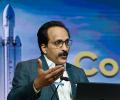
His statement came a day after the ISRO successfully launched its TV-D1 test vehicle ahead of the human space flight mission Gaganyaan.
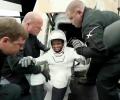
Astronaut Shubhanshu Shukla and the Axiom-4 mission crew safely returned to Earth after an 18-day stay at the International Space Station, splashing down off the coast of San Diego.

Indian Space Research Organisation (ISRO) will conduct three more test vehicle missions under the ambitious Gaganyaan programme after the maiden TV-D1 test flight, which is scheduled on October 21, the space agency's chairman S Somanath has said.

The test vehicle development flight (TV-D1) is aimed at testing the crew module that will carry Indian astronauts during the human spaceflight late next year.

ISRO made efforts to re-establish communication with rover Pragyan and lander Vikram after they were put into sleep mode in September following the onset of night on the moon.

Modi addressed scientists at the Indian Space Research Organisation command centre in Bengaluru, who were involved in the Chandrayaan-3 mission and lauded them for their efforts.

Somanath thanked all those who prayed for the mission's success, and ISRO veterans like A S Kiran Kumar , the space agency's former chief.
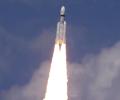
For the Gaganyaan programme, LVM3 rocket is re-configured to meet the human rating requirements and has been christened as 'Human Rated LVM3', ISRO said and it would be capable of launching the Orbital Module to an Low Earth Orbit of 400kms.

ISRO aims to send humans into space on a Low Earth Orbit of 400 km for a three-day mission and bring them safely back to earth.

Deep-tech now forms over half of VC portfolios in India as firms like Cornerstone, Unicorn India Ventures and All in Capital back startups combining research with scalable models

Aditya L1, the first space based Indian mission to study the Sun underwent the second earth-bound manoeuvre successfully, during the early hours on Tuesday, Indian Space Research Organisation (ISRO) said.

This image features the left image within the red channel, and the right image within the blue and green channels, resulting in a striking cyan hue.

Aditya-L1, the first space-based Indian observatory to study the Sun, is getting ready for its launch soon, ISRO said on Monday.

The primary satellite TeLEOS-2 is a synthetic aperture radar satellite developed under partnership between Defence Science and Technology Agency (DSTA) representing the Government of Singapore and ST Engineering.

ISRO Chairman S Somanath had recently said the most critical part of the landing will be the process of reducing the velocity of the lander from 30 km height to the final landing, and the ability to reorient the spacecraft from horizontal to vertical direction. "This is the trick we have to play here," he said.
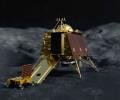
Conducting in-situ scientific experiments is underway. All payloads are performing normally, ISRO said.

Somnath said every person would have to go through some kind of challenges during their journey to reach a top position in an organisation.

The new year will witness two unmanned missions under the "Gaganyaan" project, deep ocean exploration project, "Samudrayaan" and many more.
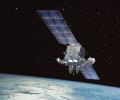
The Indian Space Research Organisation said it successfully carried out an "extremely challenging" controlled re-entry experiment of the decommissioned orbiting Megha-Tropiques-1 (MT-1) satellite.

Indian astronaut Shubhanshu Shukla and three others were getting ready for their journey to the International Space Station on board SpaceX's Falcon-9 rocket that is scheduled to blast off from the Kennedy Space Centre (KSC) in Florida on Tuesday evening.

India is now on the Moon and the success of the lunar mission has sounded the bugle for the emergence of a developed nation, Prime Minister Narendra Modi said on Wednesday as Chandrayaan-3 landed successfully on the lunar surface.
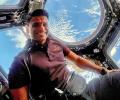
Astronaut Shubhanshu Shukla and the Axiom-4 mission crew are scheduled to return to Earth from the International Space Station on July 14, according to NASA.
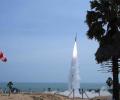
The fuel cost will come down if rockets are launched from Kulasekarapattinam as they will have a straight trajectory and need not have to avoid Sri Lanka, which is being done by rockets flown from Sriharikota.

The players all converged near the dressing room and followed the closing stages of Chandrayaan-3's landing on Moon.
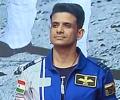
Indian astronaut Shubhanshu Shukla and three others are set to embark on the Axiom Space's fourth human spaceflight from National Aeronautics and Space Administration's (NASA) Kennedy Space Centre in Florida on June 10 and are likely to dock at the International Space Station on June 11 at about 10 pm IST, after a nearly 28-hour journey.

Indian Air Force Group Captain Shubhanshu Shukla, the first Indian to visit the International Space Station, received a hero's welcome in his hometown of Lucknow. Celebrations included family, supporters, a roadshow, and recognition from government officials.

The space agency said the Mission Operations Complex (MOX), located at the ISRO Telemetry, Tracking and Command Network (ISTRAC) in Bengaluru, is buzzing with energy and excitement.
The application process for Graduate Aptitude Test in Engineering (GATE) 2026 will begin on August 25.

'The ISRO has done enough simulations and also redundancies have been built in so that chances of such failure are remote. Still, we have to keep our fingers crossed'

Modi inaugurated the Semicon India 2025 in Delhi, in the presence of Chief Minister Rekha Gupta, and Union Minister of Commerce and Industry Jitin Prasada.

XPoSat or X-ray Polarimeter Satellite is India's first dedicated polarimetry mission to study various dynamics of bright astronomical X-ray sources in extreme conditions.
