
Heavy rains in Maharashtra have caused floods, road blockages, and widespread damage, resulting in casualties and displacement. The state government is monitoring the situation and coordinating rescue efforts.

The IMD has red and orange alerts for the hours ahead.

Heavy rains caused severe waterlogging, traffic jams, and disruptions to local train services in Mumbai. Schools and colleges were closed due to a 'red alert' issued by the IMD.

A landslide in the Vikhroli suburb of Mumbai killed two people and injured two others after heavy rains caused soil and stones to collapse on a hut.

Heavy rains lashed Mumbai, slowing traffic and affecting train services. The IMD has issued an 'Orange' alert, advising citizens to stay indoors.

A landslide on the Kedarnath route in Uttarakhand killed two pilgrims and injured six, while heavy rain led to the temporary suspension of the Char Dham and Hemkund Sahib pilgrimages.
The Army unit deployed in Ashti successfully evacuated 40 people with the help of an NDRF team and other agencies.

The BCCI press conference scheduled at 1.30pm in Mumbai is 'expected to be delayed owing to weather disruptions'.

Heavy rain lashed Delhi, leading to waterlogging and traffic disruptions. The IMD issued an 'orange' alert, warning of more rainfall.

Seven people died after a wall collapsed near Mohan Baba Mandir in Jaitpur, Delhi, following heavy rainfall. Rescue operations were conducted by police, fire services, and NDRF teams. An investigation is underway to determine the cause of the collapse.

The India Meteorological Department (IMD) forecasts above-normal rainfall for India in September, following a monsoon season marked by heavy downpours and related disasters in various regions. The forecast indicates normal to above-normal rainfall for most areas, with some exceptions in the northeast, east, extreme south peninsular India, and parts of northwest India.

A landslide triggered by continuous rainfall has disrupted traffic on National Highway 75 near Kadaba taluk in Dakshina Kannada district, halting vehicular movement between Bengaluru and Mangaluru. Authorities are working to clear the debris and restore traffic flow.

A new study identifies flash flood hotspots in India, highlighting the influence of land features, rainfall, and the growing impact of climate change.

IMD data shows in the 24 hours between September 1 and 2, Haryana received 806 per cent more rainfall than normal, Punjab 759 per cent, Himachal Pradesh 510 per cent, Delhi 740 per cent, Chandigarh a staggering 1,638 per cent, and Rajasthan 193 per cent.

Heavy rainfall across North India leads to fatalities, structural damage, travel disruptions, and school closures. Eastern states brace for more rain.
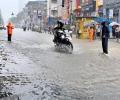
Mumbaikars woke up to very heavy rainfall on Monday, while the India meteorological department (IMD) issued a 'red' alert, forecasting extremely heavy rains at isolated places in the city and adjoining areas, prompting the civic body to declare a holiday for schools and colleges, officials said.

Heavy rains lashed Delhi, leading to a red alert, traffic snarls, and waterlogging. The IMD predicts continued rainfall.
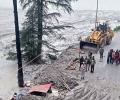
Experts question whether a cloudburst caused the recent flash flood in Uttarkashi, India, citing insufficient rainfall and other potential factors like ice chunks, rockfalls, or landslides.

The India Meteorological Department (IMD) has forecast cloudy skies with the possibility of heavy rainfall at a few places in the city and suburbs in the next 24 hours.

Heavy rains across India have led to widespread flooding, causing damage to infrastructure, displacement of residents, and disruption of normal life. Rescue efforts are underway in affected areas.

Heavy overnight rain in Gurugram caused widespread waterlogging and traffic gridlock, bringing the city to a standstill. Several residential areas and major roads were inundated, leading to commuter chaos.

Lightning claims more lives in India annually than any other extreme weather event. Between April and July this year alone, 1,621 people died due to lightning strikes.

A cloudburst in the high altitude villages of Dharali in Uttarkashi district of Uttarakhand led to flash floods, causing damage to houses and sweeping away structures. Several people are feared buried under debris.

Mumbai Indians were the first team to leave the field while Delhi players stayed back doing light training but were eventually forced to call it off.

After being pummelled by heavy downpours at the start of the week, Mumbai witnessed a brief respite on Tuesday morning, with the island city recording an average rainfall of 106 mm in 24 hours, civic officials said.

The southwest monsoon arrived in Maharashtra on Sunday, making it the earliest onset of the annual rainfall season over the state in 35 years, according to the India Meteorological Department. The monsoon is expected to advance to Mumbai and some other parts over the next three days. The monsoon advanced into some more parts of the Arabian Sea, Karnataka, entire Goa, parts of Maharashtra, north Bay of Bengal, and parts of Mizoram, parts of Manipur and Nagaland on Sunday. The northern limit of monsoon passes through Devgad, Belagavi, Haveri, Mandya, Dharmapuri, Chennai, Aizawl and Kohima. Conditions are favorable for further advance into some more parts of central Arabian Sea, more parts of Maharashtra including Mumbai, Karnataka including Bengaluru, some parts of Andhra Pradesh, remaining parts of Tamil Nadu, more parts of west-central and North Bay of Bengal and some more parts of North Eastern states during next three days. The southwest monsoon hit Kerala on Saturday, marking its earliest arrival over the Indian mainland since 2009.

The frequency of short-duration, heavy rainfall events over central India and long-duration heavy rainfall events over the north-western coasts of the country has risen considerably in the last few decades.

As many as 12 flights were diverted at the Delhi airport between 3 pm and 4 pm due to adverse weather conditions, an official said.

Temperatures are likely to remain in a similar range until Thursday, with a gradual fall expected from June 13.

The heatwave alert has been issued for Mumbai, Thane, Raigad and Ratnagiri on February 25 and 26, the IMD said.

For March 22, an Orange Alert has been issued while a Yellow Alert has been issued for Sunday.

Heatwave may abate over most parts of North India in next two days; temperatures likely to drop by 2-3C.

Heavy rains lashed several parts of Maharashtra, including Mumbai, on Monday, resulting in one death and the rescue of 48 people from inundated areas. The state received widespread rainfall, with Pune, Satara, Solapur, Raigad, and the Mumbai Metropolitan Region (MMR) experiencing significant precipitation. Mumbai recorded 135.4 mm of rainfall in the past 24 hours, leading to waterlogging and power outages in some areas. The India Meteorological Department has predicted more rain in Mumbai over the next 24 hours, accompanied by thunderstorms and strong winds.

The southwest monsoon has arrived in Mumbai 16 days before its usual date, making it the earliest arrival since 1950. This early onset follows the monsoon's arrival in Kerala, the southernmost state, on Saturday, marking the earliest arrival since 2009. The India Meteorological Department (IMD) predicts an above-normal rainfall for the 2025 monsoon season, with rainfall between 96 per cent and 104 per cent of the 50-year average of 87 cm considered 'normal'. The monsoon is crucial for India's economy, providing vital water for agriculture and replenishing reservoirs.

From the Sensex firms, Mahindra & Mahindra, HCL Tech, Tata Motors, Nestle, ITC, Hindustan Unilever, Larsen & Toubro, and Tech Mahindra were the biggest gainers. In contrast, Eternal, UltraTech Cement, Power Grid, Tata Steel and Kotak Mahindra Bank were among the laggards. Eternal dropped 4.51 per cent.

Data since 2005 show that the five years with the highest rainfall saw average market returns of 8.98 per cent, while the five driest years returned 25.7 per cent on average.

Bhavnagar was also one of the worst affected districts, they said, adding that more downpour is likely over the next four day in parts of the state.

A thunderstorm accompanied by heavy rain battered Delhi overnight, disrupting flight operations, uprooting trees and electricity poles, and causing waterlogging in several areas while bringing relief from stifling heat. The sudden change in weather led to a sharp drop in mercury with the city recording a minimum temperature of 19.8 degrees Celsius, 6.9 notches below the normal. The India Meteorological Department said the city's primary weather station at Safdarjung recorded winds gusting up to 82 kmph and 81.2 mm of rain in six hours -- between 11.30 pm and 5.30 am.

The early onset of the southwest monsoon brought continuous rainfall across southern and eastern India, contributing to this record.
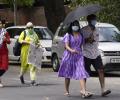
The India meteorological department said heatwave conditions will persist for at least two more days.
 © 2026 Rediff.com - Investor Information - Advertise with us - Disclaimer - Privacy Policy - Sitemap - Feedback - About us - Terms of use - Grievances