
An engineer by profession, Fasih Mehmood is under probe by investigation agencies for his suspected role in the Chinnaswamy stadium blasts at Bengaluru in April 2010.

Indian Mujahideen co-founder Yasin Bhatkal's aide Fasih Mahmood, deported from Saudi Arabia in 2012 for his alleged involvement in terror acts, has been allegedly assaulted by a jail inmate inside the high security Tihar jail.
Suspected Indian Mujahideen terrorist Fasih Mohammed, who was deported from Saudi Arabia last year and is accused in terror strikes in India, Tuesday sought bail from a Delhi court.
Fasih Memhmood, a suspected Indian Mujahideen terrorist and an accused in Delhi and Bangalore blasts, was on Thursday remanded by a court in New Delhi in judicial custody and was then ordered to be handed over to Karnataka police.
After his deportation and arrest, Fasih Mohammed, a suspected Indian Mujahideen terrorist and an accused in the Delhi and Bangalore blasts, has been sent to ten-day police custody by a Delhi court.
The questioning of suspected Indian Mujahideen operative Fasih Mahmood is currently going on at Bengaluru and it has revealed details of the logistical support he provided in carrying out the blasts at the Chinnaswamy Stadium at Bangalore. Fasih, who was extradited from Saudi Arabia, was first questioned by a team of the Delhi police and the Intelligence Bureau. Fasih has been named as the eighth accused in the blasts case.

India had been pushing for Fasih Mehmood's deportation for the past six months, but required much coaxing before the Saudi authorities were convinced.

Vicky Nanjappa reports on how Fasih Mahmood, who was recently deported to India recently, could lead investigating agencies to the doorsteps of other absconding Indian Mujahideen operatives settled in Saudi Arabia
Suspected Indian Mujahideen operative Fasih Mahmood, who was deported from Saudi Arabia last year, was on Saturday chargesheeted for terror acts in connection with the 2010 Jama Masjid attack.

Family of Fasih Mohammed, a suspected Indian Mujahideen terrorist who has been deported to India after five months of detention in Saudi Arabia, has decided to move the Supreme Court for speedy trial.
Indian agencies will tread very carefully on the case of Fasih Mehmood, an engineer based out of Saudi Arabia who is under the scanner for his alleged role in the Chinnaswamy stadium blasts in Bangalore, for if something goes wrong there will be risk of jeopardising a perfect relationship that has been set up with that country, reports Vicky Nanjappa.
Family of Fasih Mohammed, a suspected Indian Mujahideen terrorist who has been deported to India after five months of detention in Saudi Arabia, has decided to move the Supreme Court for speedy trial.
Additional Solicitor General Gourab Banerjee told a bench of justices P Sathasivam and Ranjan Gogoi that as the Saudi Arabia police has officially announced that Fasih was in its custody, the habeas corpus petition filed by his wife Nikhat Parveen has become infructuous.
Nikhat Parween, wife of terror suspect Fasih Mehmood, who was arrested on Monday for his involvement in the bomb blasts in Delhi and Bengaluru, said her husband was innocent and his arrest unlawful.
A case very similar to Fasih Mehmood, a Saudi Arabia-based engineer hailing from Bihar arrested in that country by Indian police for his alleged role in the 2010 Chinnaswamy Stadium blasts in Bangalore, is doing the rounds. While the family of Fasih Mehmood had alleged that he had gone missing after the Indian agencies had picked up him up from Saudi Arabia, this time it is the family of a doctor who are making similar allegations.
Interpol issued the Red Corner notice against 28-year-old Mehmood on a request from the Central Bureau of Investigation for offences of terrorism and crimes involving the use of weapons and explosives, the official website of the international police said
In a joint response, the ministry of external affairs, the home ministry and the Delhi police rejected the allegation that Fasih Mohammed was abducted by the Indian police personnel for custodial interrogation and his whereabouts were not known
The Supreme Court on Monday refused to direct the Centre to get alleged Indian Mujahideen member Fasih Mohammed, detained by Saudi Arabia authority, extradited or deported to the country.
The Centre on Wednesday told the Supreme Court that a red corner notice has been issued against Bihar youth Fasih Mehmood for his alleged role in various terrorist activities, but refuted his wife's claim that he was abducted in a joint operation by Indian and Saudi police in Dubai.
Saudi Arabia has told Indian authorities that Faish Mohammed, a suspected terrorist, has been apprehended by local authorities and may be deported soon. An engineer by profession, 28-year old Fasih is alleged to have been involved in the Chinnaswamy Stadium blast in Bangalore and the shooting incident near Delhi's Jama Masjid in 2010. He is wanted by both the Delhi and Karnataka police.

Amra Jamal has left behind her family and village in Bihar to trace her son, Fasih Mehmood, who went missing after being allegedly arrested in Saudi Arabia and deported to India on terror charges. M I Khan reports

As he basks in glory after a string of arrests of several wanted terrorists during his tenure, Home Minister Sushilkumar Shinde said underworld don and India's most wanted fugitive Dawood Ibrahim will be also brought back to India to face justice.
Pakistan Prime Minister Raja Pervez Ashraf gained a reprieve on Thursday as the Supreme Court adjourned a case alleging corruption by him till January 23 after the chief of the country's anti-graft agency said he lacked evidence to make arrests.

Pakistan has said that fugitive underworld don Dawood Ibrahim is not present in the country, a day after India asserted that its most wanted terrorist was living in the neighbouring country.

India's most wanted terrorist Dawood Ibrahim is in Pakistan and joint efforts with the United States were being made to nab him, Union Home Minister Sushilkumar Shinde said on Friday.
Pakistan's anti-graft body National Accountability Bureau on Thursday told Supreme Court that the evidence in a corruption case involving Premier Raja Pervez Ashraf was weak and unlikely to lead to conviction, a statement that irked the top court which directed him to submit to it all records of the investigation.
stan's anti-corruption agency has formed a Special Investigating Team to probe allegations that Supreme Court Chief Justice Iftikhar Chaudhry's son was paid over Rs 342 million by a real estate tycoon to influence cases in the apex court. National Accountability Bureau Chairman Fasih Bukhari told a news conference on Saturday that the investigating team, comprising officials of the Federal Investigation Agency and police, will be headed by a NAB official.
The extradition of 26/11 key handler and Lashkar-e-Tayiba operative Abu Jundal and alleged Indian Mujahideen operative Fasih Mahmood, showed the close ties between Saudi Arabia and India. However, India was not lucky a third time in the case of Dr Usman Ghani whose extradition was sought in connection with the Bengaluru assassinations plot, Vicky Nanjappa reports
Does the deportation of 26/11 prime accused Abu Jundal/Abu Hamza/Zabiuddin Ansari by Saudi Arabia signal a tectonic shift in India's Middle-East policy? Colonel (retd) Anil Athale tries to explain.
The Centre on Monday told the Supreme Court that the alleged abduction of a Bihari youth by the Indian police in Saudi Arabia has turned into a diplomatic issue with Riyadh "not saying anything."
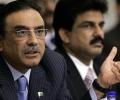
In a setback to former President Asif Ali Zardari, a Pakistani court on Friday reopened five anti-corruption cases against him and sought his response to the charges within two weeks.

One of the key questions that the Intelligence Bureau officials asked Yasin Bhatkal was about the whereabouts of his neighbours and friends -- Riyaz and Iqbal Bhatkal -- the founders of the Indian Mujahideen.

The arrest of Yasin Bhatkal comes as a huge relief to the Bihar police, who expect to now crackdown down on active terror units in the state, reports Vicky Nanjappa.

Statistics show the failure of the Bihar government in acting against Naxals in the state who are able to set up bases without much difficulty. Vicky Nanjappa reports

A dossier on the Indian Mujahideen, which was prepared following its resurrection post the Batla House encounter, had termed the outfit as a "start to finish jihad factory."

The Bihar government has always been extremely touchy when it came to the subject of terrorism and in the past two years they have made it clear twice.

Setting up the Darabhanga module was perhaps the easiest job the Indian Mujahideen ever pulled off. With politics, appeasement and a safe hiding ground on offer, the agencies are finding this terror module the toughest one to crack.

NIA officials told rediff.com that they have intimated both the Intelligence Bureau and the Research and Analysis Wing to seek more information from Bangladesh regarding the operational capabilities of an outfit named Hizbut Tahrir, which since the past three years has been working closely with the Indian Mujahideen.
 © 2026 Rediff.com - Investor Information - Advertise with us - Disclaimer - Privacy Policy - Sitemap - Feedback - About us - Terms of use - Grievances