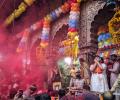
The Supreme Court has stated it will not make structural changes to religious practices at the Bankey Bihari temple in Vrindavan, hearing a petition challenging administrative decisions affecting traditions.
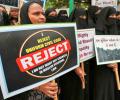
The Karnataka high court, which dismissed the batch of petitions by some Muslim girl students from Udupi seeking permission to wear the hijab inside classrooms, said there was no material placed on record to prima facie show that wearing the headscarf was an essential religious practice.

The Supreme Court of India has asserted its jurisdiction to determine what constitutes a superstitious practice within a religion, during a hearing on petitions related to discrimination against women at religious sites.

The Supreme Court of India has dismissed the use of information from 'WhatsApp University' as evidence in a case concerning religious freedom and discrimination against women at religious sites, including the Sabarimala Temple.
The Supreme Court of India has stated that religious institutions must have structure and norms for their functioning, emphasising that the right to manage a religious institution does not imply an absence of order.

The Centre has informed the Supreme Court that the restriction on women of menstruating age entering Kerala's Sabarimala temple is a matter of religious faith and denominational autonomy, falling outside the purview of judicial review. Solicitor General Tushar Mehta argued that courts should not apply 'secular standards of reason' to religious practices.

The Supreme Court questioned the chief priest of the Sabarimala Ayyappa Temple regarding the constitutionality of preventing believers from touching the deity, during hearings on discrimination against women at religious sites.
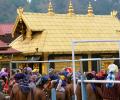
The Travancore Devaswom Board (TDB), managing the Sabarimala temple, argued in the Supreme Court that religious beliefs should be judged subjectively by the community, as the court hears petitions related to discrimination against women at religious places.
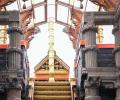
The Supreme Court observed that Hinduism is a way of life, stating that mandatory temple visits or rituals are not necessary to be considered a Hindu; even lighting a lamp at home suffices.

The Supreme Court on Friday allowed women of all ages in the Ayyappa temple at Sabarimala in Kerala. While Justices R F Nariman and D Y Chandrachud concurred with Chief Justice of India Dipak Misra and Justice A M Khanwilkar on the ruling that banning the entry of women in the temple is gender discrimination and the practice violates the rights of Hindu women, Justice Indu Malhotra gave a dissenting verdict. Here are highlights of her judgment.
Trinamool Congress leader Abhishek Banerjee criticised the BJP over the proposed Uniform Civil Code and the delay in recognising the Kurmali language, accusing the party of dividing people and making false promises.
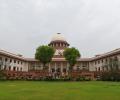
The Supreme Court of India is hearing petitions related to discrimination against women at religious places, including the Sabarimala temple in Kerala, and the scope of religious freedom practised by multiple faiths.

The move has sparked a political row, with the opposition accusing the BJP of promoting a vegetarian agenda.

During this Ramzan, another religious practice was turned into an offence: Breaking the fast, or iftar.

The Supreme Court of India has stated that the time has come for a Uniform Civil Code (UCC), while hearing a plea challenging the Shariat law of 1937. The court suggested that the legislature should address the issue of discrimination against Muslim women.
The Indian government defended the Waqf (Amendment) Act, 2025 in the Supreme Court, arguing that waqf, while an Islamic concept, is not an essential part of Islam. Solicitor General Tushar Mehta stated that waqf is essentially charity, which is recognized across religions, and cannot be considered a fundamental tenet of any faith. He also argued that the amended law addresses secular aspects of waqf and activities unrelated to Islam, and that "waqf by user" does not grant ownership of public land. Mehta highlighted the extensive consultations involved in the bill's creation, including feedback from various stakeholders. The hearing will continue on Thursday.

While tensions have eased at several friction points and mechanisms for managing the boundary have been reactivated, underlying differences persist. Disputes over naming practices in Arunachal Pradesh, continued infrastructure development on both sides, and unresolved questions regarding patrolling rights indicate that the structural gap remains, notes Dr Kumar.
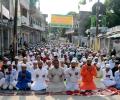
Amid a debate triggered by Uttar Pradesh Chief Minister Yogi Adityanath's recent remarks on offering namaz in public places, several Muslim clerics have said that Eid-ul-Azha prayers would be offered inside mosques and Eidgahs as in previous years, and, if required, arrangements could be made for multiple prayer shifts.

The opposition parties, including Congress, Raijor Dal and Trinamool Congress, opposed the move and demanded wider consultation with all the stakeholders before its introduction.

The armed forces of India will be wise to remember that its public interface needs to be tempered with discretion, maturity and example, keeping in mind the nation's multi-cultural and multi-religious fabric which is its greatest strength but which can also become its biggest fault-line, asserts Vice Admiral Biswajit Dasgupta (retd).
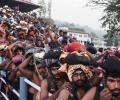
The top court said the old practices of "human sacrifices" and 'sati' amounted to murder under law and could not be saved on ground of "essential religious practice".

The Supreme Court on Friday dismissed a plea challenging the Karnataka government's decision to invite International Booker Prize winner Banu Mushtaq to inaugurate Mysuru Dasara this year.
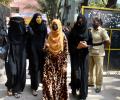
"This is our stand that hijab is not an essential religious practice. There was a statement by Dr B R Ambedkar in the Constituent Assembly where he said 'let us keep the religious instructions outside educational institutions'," Karnataka Advocate General Prabhuling Navadgi told the full bench of the high court, which is hearing the hijab case.
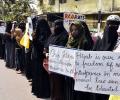
A student cannot wear hijab to a secular school as a matter of right, Supreme Court judge Justice Hemant Gupta said on Thursday, insisting that they are required to follow the discipline of the school in the matter of uniform.
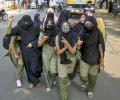
The apex court observed the five Ks in Sikhism -- Kesh, Kara, Kanga, Kaccha and Kirpan -- are well established.

The courts are not forums to solve "theological questions", Supreme Court judge Justice Sudhanshu Dhulia said on Thursday in his verdict on the Karnataka hijab ban controversy.

The Supreme Court will hear on Friday a plea challenging a Bombay high court verdict upholding a Mumbai college's decision to ban hijabs, burqas and naqabs inside the campus.
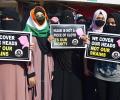
The All India Muslim Personal Law Board has moved the Supreme Court challenging the Karnataka high court verdict which had dismissed petitions seeking permission to wear the hijab inside the classroom saying hijab is not a part of the essential religious practice in the Islamic faith.
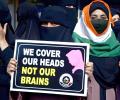
While Justice Hemant Gupta dismissed the appeals against the high court verdict, Justice Sudhanshu Dhulia allowed them.
The Bombay high court on Wednesday refused to interfere in a decision taken by a Mumbai-based college to impose a ban on hijab, burka and naqab in its premises.
The Supreme Court of India has reserved its interim orders on three key issues related to the Waqf (Amendment) Act, 2025, including the power to denotify waqf properties, the composition of waqf boards, and the provision regarding government land. The court heard arguments from both the petitioners, who challenged the validity of the amended law, and the Centre, which defended the Act as a secular concept. The petitioners sought interim orders to prevent the implementation of certain provisions while the court considers the legal challenges.
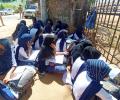
A bench comprising Chief Justice N V Ramana and Justice Krishna Murari denied the request of senior advocate Devadatt Kamat who mentioned the matter seeking urgent listing saying that examinations are going on.
The Karnataka high court on Tuesday dismissed petitions filed by a section of Muslim students from the Government Pre-University Girls College in Udupi, seeking permission to wear the hijab inside the classroom.
The counsel for the petitioners in the hijab ban row on Monday told the Supreme Court the Karnataka high court did an "objectionable" thing when it tried to "interpret" the Holy Quran and held the headscarf worn by Muslim women was not an essential religious practice.
The Supreme Court on Wednesday agreed to list for hearing after Holi vacation the pleas challenging the Karnataka high court verdict which dismissed the petitions seeking permission to wear hijab inside the classroom saying it is not a part of the essential religious practice in Islamic faith.
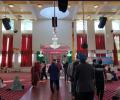
Law enforcement officials from the US Department of Homeland Security have started visiting gurdwaras in New York and New Jersey to check for the presence of illegal immigrants, drawing a sharp reaction from some Sikh organisations which see such actions as a threat to the sanctity of their faith. The Trump administration has rescinded the Biden administration's guidelines that protected places of worship from immigration enforcement actions, leading to concerns that gurdwaras are being targeted. Sikh organisations argue that gurdwaras are not just places of worship but also vital community centres and that surveillance and raids by armed law enforcement would burden religious exercise and limit the ability of Sikhs to gather and associate with one another.

A plea was filed in the Supreme Court on Tuesday challenging the Karnataka high court verdict which dismissed the petitions seeking permission to wear the hijab inside the classroom saying it is not a part of the essential religious practice in Islamic faith.
The Indian government has defended the Waqf (Amendment) Act, 2025 in the Supreme Court, arguing that there cannot be a blanket stay on the law as there is a presumption of its constitutionality. The Centre countered the pleas challenging the law's validity, asserting that the amendments were undertaken after a comprehensive study by a parliamentary panel. The government also highlighted the "reported misuse" of earlier provisions and the increase in waqf land, claiming that over 20 lakh hectares were added after 2013.
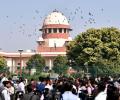
The court will consider issues related to entry of Muslim women into mosques, female genital mutilation in the Dawoodi Bohra Muslim community and barring of Parsi women, married to non-Parsi men, from the holy fire place at Agiary.

'For us, it's not always about chasing revenue. It's about sustaining happiness and energy, because that's what drives long-term growth.'
