.jpg)
While the Cabinet has approved doubling of gas price from April 1 next year, Oil Ministry is proposing that old rates of $4.2 per million British thermal unit apply to gas from D1/D3 and MA fields in eastern offshore KG-D6 block till it proved that RIL had proved less than targets only because of geological factors.

The previous United Progressive Alliance government had last year approved pricing of all forms of domestically produced gas at according to a formula suggested by a panel headed by C Rangarajan.

According to a source close to the development, the government is set to come out with a notification in this regard by the end of this week.
.jpg)
Following adverse media reaction to the June 27 decision of the Cabinet Committee on Economic Affairs, the finance ministry had issued an office memorandum asking the petroleum ministry to see if there was a way to make RIL clear its gas supply backlog at the existing price.
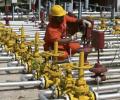
The government recently announced a new formula for determining the price of natural gas, lowering it from $8.4 suggested by the C Rangarajan committee.

As per the 15-day billing cycle, gas producers are to raise the first invoice at the revised price of $5.61 per million British thermal unit this weekend.
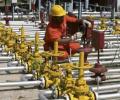
RIL had drawn 58.67 bcm from the wells up to March 31, 2015.

RIL's Dhirubhai-34, or R-Cluster field, in the flagging KG-D6 block was to produce about 13 million standard cubic metres per day of gas, equivalent to present day output from D1&D3 as well as MA fields, by 2017-18.
The government had in October 2007 set a sale price of $4.20 per million British thermal unit based on the price discovered by RIL from key customers.

Earlier this week, the ministry had come out with a clarification, saying domestic gas producers had to stick to the earlier price of $4.2 a unit until a further notification from the new government.

RIL may go to arbitration which may lead to further delay in production and extra cost associated with the arbitration.
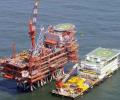
RIL has proposed to charge the government- fixed rate for natural gas on a gross calorific value (GCV) basis, instead of net calorific value (NCV).

Many stalled projects are about to get going again, providing potential relief to banks, says T N Ninan.
About two dozen discoveries of the state-owned ONGC, Reliance Industries and the Gujarat State Petroleum Corp (GSPC) in KG Basin alone are languishing for want of right price.

With the government's focus on environment-friendly fuel, Indraprastha Gas, Mahanagar Gas and Suzlon's earning prospects look bright

A bench headed by Chief Justice P Sathasivam sought response from CBI on the petition filed by Civil society members including former Cabinet Secretary T S R Subramanian and ex-Naval chief Admiral L Ramdas seeking probe by the agency in the alleged 'collusion between RIL and the political establishment'.
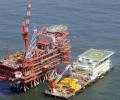
A report, by DeGoyler and MacNaughton, has put a question mark on the future production from the five ONGC discoveries.
RIL, which has faced numerous delays in getting approvals and shifting goal-posts, said the country did not have a stable policy regime and this was responsible for exit of global energy giants like Royal Dutch Shell, BHP Biliton of Australia, Statoil of Norway and Brazil's Petrobras.

In the past, the absence of commercially viable gas prices had not only discouraged high-risk new exploration activity but also hindered the development of some of the existing discoveries, such as the satellite fields in the Reliance Industries' eastern offshore KG-D6 block.
RIL estimates output from KG-D6 could reach up to 60 mscmd in the next five years, when all satellite fields are brought into production.

RIL has denied knowingly producing any gas from the ONGC block
ONGC and RIL bill their consumers like fertiliser plants and power stations in US dollar.

The government plans to take India into the top 50 ranks in ease of doing business in the next two years with efforts such as shifting all applications for industrial licenses online.

To proceed with a Cabinet proposal to grant the relaxations to RIL, the Election Commission's approval will be sought.
Govt notification on $8.4 a unit price likely by month-end

Reliance Industries will have to provide a bank guarantee of $135 million every quarter to get a higher price for natural gas from April 1 next year.
Gas prices have fallen to $10 per million British thermal unit. But the fate of the power project, run by Ratnagiri Gas and Power Pvt Ltd, will hang in balance till the committee takes a decision on gas pooling, reduction in certain taxes and providing per unit subsidy.

Both the countries have increased prices of gas recently.
If approved, gas price will rise to $6.775 per million British thermal unit from $4.2 currently.

RIL has more than half a dozen undeveloped discoveries.
In the 38-page report, across 10 chapters, RIL explained how it entered the exploration and production business; the history of the New Exploration and Licensing Policy and the introduction of production-sharing contracts.

IHS said low regulated gas prices have precipitated a supply shortfall in India, but proposed that reforms to the pricing formula could yield higher domestic production and boost India's economy.
Gas price hike seems to be a distant dream for Reliance Industries and its partners--Niko Resources and BP.

Reviving stranded gas-based power plants and substituting diesel usage is a clear near-term opportunity.

Companies to hold rates in Delhi until new government is formed.

According to an official close to the development, in the coming financial audit report, to be tabled in Parliament's Budget session next year, CAG will detail the slide in the government's share in petroleum sector profits due to a drop in gas production.

Energy conglomerate Reliance Industries and its partner BP plc on Friday said they have made a second deep-water gas condensate discovery in the Cauvery basin, off the east coast.
Affected firms note practical problems in getting discoms, consumers to pay for costlier supply; viability shadow on investments
Cabinet may tweak Rangarajan formula; new price may be further delayed.
If the EC decides to put on hold a gas price revision for RIL, it would set a precedent for pricing decisions of the government and policy decisions taken but undergoing procedural delays.
 © 2026 Rediff.com - Investor Information - Advertise with us - Disclaimer - Privacy Policy - Sitemap - Feedback - About us - Terms of use - Grievances