
For his first Budget in July 2014, Jaitley inherited a fiscal deficit target of 4.1 per cent of GDP. From 4.1 per cent, the fiscal deficit came down to 3.4 per cent by 2018-19, with two slippages from the budgeted targets, in 2017-18 and 2018-19, the former due to introduction of the GST, says Arup Roychoudhury.

Reserve Bank Governor Raghuram Rajan on Friday said banking sector will see major changes in the coming years.

Govt sees little Fed hike impact on 'fortressed' Indian markets.
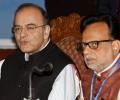
Finance Secretary Hasmukh Adhia vacates his post on November 30 and Expenditure Secretary Ajay Narayan Jha, the second seniormost bureaucrat in the finance ministry, retires on January 31, the day before Jaitley presents the 2019-20 interim budget.
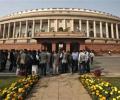
Select committees of the House have already submitted their reports
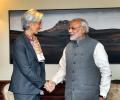
Lagarde had said an Indian could head IMF.

India's credit and banking are neither too big nor too small.

The Indian economy is reviving, helped by positive policy actions.

RBI rate cut is a welcome step for all citizens of India as everyone is looking for near-term boost in economy.
In the global context India is looking 'very special'.

The rapid deceleration in prices has ignited a debate in New Delhi whether Asia's third-largest economy is heading towards deflation.

Despite all of the PM's many strengths, it is increasingly clear that he does not necessarily have a coherent and clear worldview on matters of macro policy.
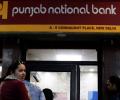
In its letter, finance ministry has pointed to sections 35, 35A and 36 of the Banking Regulation Act, 1949, to highlight the powers and functions of the RBI as regulator

The RBI expects the assessment to show if the systemic failure was only in PNB or in the overall banking universe
.jpg)
The immigration bill, from the US point of view, is going to bring in much more talent to the US, which is desirable aid, said economist Arvind Subramanian.

The revision was announced before Indian markets opened on Thursday.

Soon after RBI announcing a much- awaited rate cut, Chief Economic Advisor Arvind Subramanian on Wednesday said that the global rating agencies should look at upgrading their stance on India's credit outlook. "Now we have a 50 basis points rate cut (in two tranches within two months) and I think that is good for the economy and all rate cuts benefits... If the outlook is looking good, the rating agencies should draw their lessons from that om improving the outlook," Subramanian told reporters. After presentation of Union Budget 2015-16 last week, global and domestic agencies had ruled out any immediate upgrade in India's sovereign ratings and had red-flagged the country's delayed fiscal consolidation roadmap and had also warned against any slippages from the "ambitious" disinvestment plan proposed in Budget. Subramanian said that the rate cut is consistent with the government's views in the last week's Economic Survey and thereafter in the Union Budget for the outlook on inflation and for the outlook on overall economy. "It (rate cut) shows that RBI and government are on the same page in terms of how we view the economy. It also means that Budget can be seen as conducive to non-inflationary growth," he added. On monetary policy framework agreement, Subramanian said that both Finance Ministry and RBI have shared concern about inflation. Recently, the Finance Ministry and the Reserve Bank agreed to 'inflation rate targeting' under which the apex bank will aim to lower retail inflation to below 6 per cent by January 2016.

The cost of paying the subsidy in cash has increased the money spent by the government.

Reserve Bank of India Deputy Governor Viral Acharya is the eighth economist to quit since the Modi government took office.

Finance Minister Arun Jaitley, along with other senior ministers, on Tuesday pitched India growth story before 21 large global investors

'Look at the number of billionaires, the number of new billionaires in India.' 'Adani and Ambani are not the only ones.' 'What's wrong with people making money as long as it benefits us?'
.jpg)
Eminent free market economist Arvind Panagariya has been appointed to run Indian Prime Minister Narendra Modi's new Policy Commission, set up to modernise economic strategy after decades of Soviet-style central planning.

Prime Minister Narendra Modi on Monday reviewed the situation and favoured pushing ahead with the reforms agenda and taking more steps to strengthen the economy.

'There are two pre-conditions for big reforms. One, a sense of crisis and second, fairly concentrated levers of power.' 'India is growing at 7.5 per cent or something close to that.' 'Our levers of power are decentralised, not just between the Centre and states. Power is dispersed and there is no sense of crisis.'

Relax fiscal consolidation, boost public capex and reduce cost of finance, industry tells Centre

A government panel examined the records of employees surveyed by Labour Bureau's quarterly enterprises surveys and mapped it with the EPFO's subscribers and found "unexplained variations" between the two.

The use of RBI capital to strengthen public sector banks will have many positive implications for the economy -- and a few manageable downsides, points out R Jagannathan.
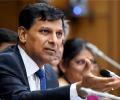
Rajan said RBI should pay as much dividend as possible to the government, which over the past two years has run into billions of dollars

the GDP estimates incorporate new source data and modified compilation techniques

The Economic Survey said that a number of indicators -- GDP, IIP, credit, investment and capacity utilisation, point to a deceleration in real activity since first quarter of 2016-17 and a further deceleration since the third quarter.

Common items between Centre and states - bread, eggs, milk, vegetables, cereals, books and salt - will continue to be exempted.
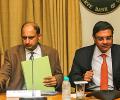
'It is likely the government may opt for an IAS officer.' 'For the government, an IAS officer will be more easy to deal with,' notes A K Bhattacharya.

The sabre-rattling between parties on rival sides of the political divide over demonetisation showed no signs of softening on Saturday with the government accusing Congress of engaging in "fear mongering" and the latter hitting back calling the exercise a "not well thought out move" whose after-effects will last long.

India is working towards policies and regulations that would encourage non-cash payments.

Of the seven surveys presented under Modi govt, predictions of three were quite close to the actual GDP growth rate, one saw the base year change in between, but the last three were way off the mark.
.jpg)
Govt expects 15.8% growth in revenue collection this year.
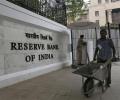
North Block and Mint Road seem likely to now stick to the earlier convention of the RBI governor coming to Delhi and being the only MPC member meeting the finance minister and senior bureaucrats on pre-policy meetings
Experts will give their inputs for Budget.

The government is scrambling to contain the fiscal deficit at 4.1 per cent of GDP in the fiscal year ending March

'Mr Modi would compliment a Nobel Prize winner, but members of his party or the government would not be restrained from either making unfair comments or criticising him for having offered advice to an Opposition political party,' says A K Bhattacharya.
