
The high court also instructed both the Mamata government and the Centre to submit detailed reports on the situation. The matter is scheduled for further hearing on April 17.

The joint committee of Parliament examining the Waqf (Amendment) Bill submitted its report to Lok Sabha Speaker Om Birla on Thursday. The panel adopted the report by a majority vote, with changes suggested by members of the ruling BJP. Opposition members, who submitted dissent notes, called the exercise an attempt to destroy Waqf boards and termed the bill an attack on the constitutional rights of the Muslim community.

A section of Biju Janata Dal (BJD) leaders in Odisha are expressing discontent over the party's decision to support the Waqf (Amendment) Bill. The issue has sparked internal turmoil, with young leaders submitting a memorandum to party president Naveen Patnaik, urging him to address the situation. Patnaik has held meetings with senior leaders, assuring them that necessary action will be taken to mitigate the fallout and maintain the party's secular image.

Banerjee said she will protect the minority people and their property.
The government has also listed three new bills for the session -- 'The Protection of Interests in Aircraft Objects Bill, 'Tribhuvan Sahkari University Bill', and the 'Immigration and Foreigners Bill'.

A bench comprising Chief Justice B R Gavai and Justice Augustine George Masih asked senior advocate Kapil Sibal, appearing for those challenging the validity of the law, and Solicitor General Tushar Mehta, representing the Centre, to file their written notes by Monday.

A chance meeting between Jammu and Kashmir Chief Minister Omar Abdullah and Union minister Kiren Rijiju at the Tulip Garden in Srinagar has sparked a political storm, with opposition parties accusing the National Conference of laying out a red carpet for the BJP leader in the aftermath of the Waqf Amendment Act. While NC sources termed the interaction as a purely coincidental encounter, opposition parties like the PDP and Peoples' Conference condemned the meeting, accusing the NC of surrendering to the BJP. The Waqf (Amendment) Bill, passed by Parliament last week, aims to streamline the management of Waqf properties with provisions to safeguard heritage sites and promote social welfare.

Congress Parliamentary Party chairperson Sonia Gandhi has criticized the Waqf (Amendment) Bill, calling it a 'brazen assault' on the Constitution and part of the BJP's strategy to keep society in a 'permanent state of polarization.' She also spoke out against the One Nation, One Election Bill, calling it a 'subversion of the Constitution.' Gandhi further accused the Modi government of ignoring the women's reservation bill and other demands for reservation, and of 'dragging the country into an abyss' where the Constitution will only exist on paper. She also criticized the government for limiting the speaking time of the Leader of the Opposition in Parliament and for not allowing discussions on important issues like the working of the defense and external affairs ministries and the challenges posed by China on the border.

The government has listed two bills related to 'one nation, one election' for introduction in the Lok Sabha on Monday.

Parliament's approval of the Waqf (Amendment) Bill, a contentious piece of legislation aimed at reforming Waqf bodies, has sparked strong reactions from the opposition, who allege that the bill was "bulldozed" through Parliament. The bill, considered the government's most consequential legislation in its third term, was passed with comfortable majorities in both the Lok Sabha and Rajya Sabha despite opposition claims of a lack of consultation and an intrusion into religious affairs. Other notable bills approved during the session included the Finance Bill, Appropriation Bill, Immigration and Foreigners Bill, and Tribhuvan Sahkari University Bill. The session, which saw high productivity, also witnessed debates on issues such as economic distress, delimitation, and the three-language policy. While the government touted its achievements, the opposition criticized the government's approach and vowed to challenge the Waqf bill in court.

Re-entry into the list could have far-reaching consequences for Pakistan, including diminished foreign investment, increased borrowing costs, and tighter scrutiny from global financial institutions.

The matter would be heard by Chief Justice B R Gavai and Justice Augustine George Masih.

The All India Muslim Personal Law Board (AIMPLB) has called for a nationwide 'lights out' protest from 9 PM to 9:15 PM on April 30 to oppose the amendments made to the Waqf Act. The AIMPLB spokesperson, SQR Ilyas, stated that the protest is a symbolic expression of solidarity against the 'discriminatory and constitutionally incompatible' amendments. The Board has been running a campaign against the amendments since April 10, organizing meetings and protests across the country.
The Parliament session is set to start today, with various issues slated to be discussed, including the Waqf Act (Amendment) Bill.

The opposition Peoples' Democratic Party and Peoples' Conference targeted the ruling National Conference over the meeting, and accused it of surrendering to the Bharatiya Janata Party without even a pretence over the passage of the Waqf act.

While the BJP went back to the drawing board to recraft its political and governance outreach and regained momentum by notching up surprisingly big wins in a string of assembly polls, the burst of fresh optimism in the main opposition Congress and other INDIA bloc parties fizzled out.
India's Parliament is set to begin its Budget session on Friday, with opposition parties poised to demand a discussion on the alleged mismanagement of the Maha Kumbh festival in Prayagraj, where 30 pilgrims died in a stampede. The opposition also accused the government of politicising parliamentary committees and pushing its agenda through its majority. The session will start with President Droupadi Murmu addressing both houses of Parliament. Finance Minister Nirmala Sitharaman will present the Union Budget on Saturday for the eighth consecutive time.

Congress MP Mohammad Jawed and AIMIM president Asaduddin Owaisi have challenged the validity of the Waqf (Amendment) Bill, 2025 in the Supreme Court, arguing that it violates constitutional provisions. The petitions claim the bill imposes arbitrary restrictions on Waqf properties and their management, undermining the religious autonomy of the Muslim community. They also allege that the bill discriminates against Muslims by imposing restrictions not present in the governance of other religious endowments. The bill was passed in the Rajya Sabha and Lok Sabha, with the petitioners arguing that it introduces limitations on the creation of Waqfs based on the duration of one's religious practice, mandates inclusion of non-Muslim members in Waqf administrative bodies, and shifts key administrative functions to government officials, thereby diluting the autonomy of Waqf management.

The report was tabled by Bharatiya Janata Party member Medha Vishram Kulkarni, a member of the panel.
'The new Waqf bill sows the seed for conflict in every town and village of India.'
Five individuals have been arrested in Ahmedabad, India, for allegedly impersonating trustees and collecting rent for 17 years from properties belonging to two Waqf Board-registered trusts. The accused, who are not actual trustees, constructed around 100 houses and shops on the trust land and collected rent from them, misusing the properties for personal benefits. An FIR has been registered against them for cheating and forging documents.

Home Minister Amit Shah and Samajwadi Party president Akhilesh Yadav engaged in a humorous exchange during a Lok Sabha debate on the Waqf (Amendment) Bill, with Shah taking jabs at Yadav's attempts to highlight internal party dynamics. Yadav, in turn, poked fun at the BJP's leadership selection process and hinted at potential internal divisions within the party.
The Lok Sabha passed the Waqf (Amendment) Bill, 2025, with the ruling NDA defending it as beneficial for minorities while the opposition called it "anti-Muslim". All amendments moved by the opposition were rejected and the bill was passed with 288 votes in favor and 232 against. Union Minorities Affairs Minister Kiren Rijiju asserted that India is the safest place in the world for minorities, refuting claims of their insecurity.

The Supreme Court of India has agreed to hear on May 6 the pleas of the Kerala government against the governor over the delay in approving bills passed by the state assembly. The court will consider whether the issues raised in the Kerala petition are covered by a recent judgment on a similar plea by Tamil Nadu, which set timelines for governors and the President on granting assent to bills.

The house of the BJP Minority Morcha's Manipur president, Asker Ali, was set on fire by a mob allegedly for supporting the Waqf Amendment Act. The incident happened at Lilong in Thoubal district on Sunday night. Ali had expressed his support for the Act on social media on Saturday. An irate mob gathered outside his residence around 9 pm, vandalised it and later set it on fire. Following the incident, Ali posted a video on social media, apologising for his earlier statement. He also expressed opposition to the Act.

The Supreme Court on Monday agreed to consider listing for urgent hearing the petitions challenging the constitutional validity of the Waqf (Amendment) Act, 2025.

The Archaeological Survey of India informed the JPC that 280 protected monuments have been listed as Waqf properties.

Several petitions were filed in the apex court challenging the Act, contending that it was discriminatory towards the Muslim community and violated their fundamental rights.

'It is not as if Hindus are not being touched at all, and only Muslims are.'

The Supreme Court of India will likely hear a batch of petitions challenging the constitutional validity of the Waqf (Amendment) Act, 2025 on April 15. The Act, which came into force on April 8, has been met with widespread criticism from various stakeholders, including politicians, the All India Muslim Personal Law Board (AIMPLB), and Jamiat Ulama-i-Hind. They argue that the law is discriminatory and violates the fundamental rights guaranteed under Articles 25 and 26 of the Constitution. The petitions allege that the amendments give the government more control over the administration of Waqf, effectively sidelining the Muslim minority from managing their own religious endowments.
Introducing the bill, Rijiju said the consultation process of the Joint Parliamentary Committee (JPC) was the largest ever exercise carried out by a parliamentary panel in India's democratic history.

'Muslims need to work according to strategy and not fall into the trap of Opposition parties.'
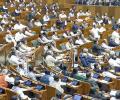
The government has deferred the introduction of bills related to 'one nation one election' in the Lok Sabha till after the completion of financial business, sources said.

The All India Muslim Personal Law Board (AIMPLB) has announced its intention to challenge the Waqf (Amendment) Bill in court, labeling it a "black law" that threatens the community's rights. The AIMPLB, a major organization representing Muslims in India, asserts that the Bill, if passed, would lead to the seizure of Muslim properties and undermine the autonomy of Waqf Boards. The organization plans to launch nationwide protests against the Bill, echoing the farmers' agitation, and has urged all citizens to resist the legislation. The Bill has been met with criticism from various quarters, including opposition parties, who claim that the Centre is rushing it through Parliament without adequately addressing concerns raised by the Joint Parliamentary Committee (JPC).

A three-judge Supreme Court bench will hear petitions challenging the constitutional validity of the Waqf (Amendment) Act, 2025, on April 16. The petitions, including those by politicians and the All India Muslim Personal Law Board (AIMPLB) and Jamiat Ulama-i-Hind, were filed in the top court challenging the validity of the newly-enacted law. The Centre has filed a caveat in the apex court, seeking a hearing before any order is passed.

Opposition MPs, some of whom have given their dissent, slammed the exercise as undemocratic, claiming that they were given little time to study the final report and frame their dissent notes.

Protests against the Waqf (Amendment) Act turned violent in Cachar district of Assam on Sunday, with protesters throwing stones at police and the police using batons to disperse the crowd. The incident occurred in Berenga area of Silchar town where around 300-400 people protested without permission. The Cachar district administration imposed prohibitory measures across the district under Section 163 of the Bharatiya Nagarik Suraksha Sanhita (BNSS) to prevent further unrest. The order prohibits gatherings of five or more people without permission, carrying weapons, organizing protests, and traffic disruptions.

The situation in Muslim-dominated Murshidabad district of West Bengal, which was marred by incidents of violence following protests over the Waqf (Amendment) Act, was calm and peaceful on Wednesday with no reports of any untoward incident. Prohibitory orders were clamped in and around Raghunathganj and Suti police station areas and large police force deployed in all sensitive areas of the district, especially in and around Jangipur town, where a large number of people had assembled on Tuesday afternoon, demanding the withdrawal of the legislation. Internet connectivity remained suspended within the areas under the Jangipur sub-division to prevent the spread of any disinformation. Protestors, who had gathered in large numbers on the NH-12 in the Jangipur area to protest against the Waqf Bill, hurled stones at the police who were deployed in the area, on Tuesday afternoon. A couple of vehicles belonging to the police were allegedly torched during the protest and police had to resort to lathi-charge and use tear gas shells to bring the situation under control. A few policemen were injured in the stone pelting. Police have also detained a few people in connection with the incident. West Bengal Governor C V Ananda Bose condemned the incident and said attempts to disturb the law and order situation in the state "should be put down with an iron hand". The opposition BJP alleged that the law and order situation in the state was "crumbling" under Chief Minister Mamata Banerjee, who was busy with "minority appeasement". The Waqf (Amendment) Bill was passed by the Lok Sabha on Thursday, and by the Rajya Sabha in the early hours of Friday after marathon debates in both Houses of Parliament. The Act aims to streamline the management of Waqf properties (assets permanently donated by Muslims for religious or charitable purposes) with provisions to safeguard heritage sites and promote social welfare. It also seeks to improve governance by enhancing transparency in property management, streamlining coordination between Waqf boards and local authorities and protecting stakeholders' rights.

Karnataka Governor Thaawarchand Gehlot has reserved the Bill pertaining to four percent reservation for Muslims in government contracts for the President's assent, citing constitutional concerns. The Bill, which has been a subject of controversy in Karnataka, was passed by both houses of the state legislature amid protests from the opposition BJP. The Governor's decision to reserve the Bill highlights the ongoing debate over the constitutionality of religious-based reservations in India.

Eighteen BJP MLAs were suspended for six months from the Karnataka Legislative Assembly for disrupting the budget session and disrespecting the Speaker. The incident occurred on the last day of the budget session, when the opposition BJP MLAs staged a massive protest over the allocation of a four percent reservation to Muslims in public contracts. The MLAs climbed onto the podium where the Speaker's chair is situated and threw papers at him.
 © 2026 Rediff.com - Investor Information - Advertise with us - Disclaimer - Privacy Policy - Sitemap - Feedback - About us - Terms of use - Grievances