
'The numbers of troops on both sides are enormous.' 'They are about 50,000-60,000 soldiers facing each other in that sector -- that's about the total number of troops that both sides had in the 1962 War in all sectors.'

The answer to Chinese tactics of nibbling territory is not defence of every inch -- a military impossibility -- but instead, nibbling at Chinese territory wherever we are in a stronger position, counsels Colonel Anil A Athale (retd).
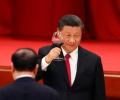
After the Ladakh fiasco where Xi Jinping did not expect the Indian Army to resist his land-grabbing tactics, he has to save face before his colleagues in the Communist party.' To bring the threat of a mega-dam to the northern Indian border is a clever move, observes Claude Arpi.

'The sooner Pakistan and India face these geopolitical realities, the better it will be for their own security and prosperity,' observes Ambassador M K Bhadrakumar.

'They know that India is no pushover.' 'We have to be extremely vigilant, remain ready and keep strengthening our positions.' 'We have to be militarily strong, whatever be the cost.'
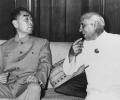
'Unquestionably, the spirit behind the Panchsheel agreement and the 'Hindi Chini bhai bhai' slogan were thrown overboard by the Chinese, and a trust deficit was injected between the two nations.' A revealing excerpt from General J J Singh's The McMahon Line: A Century Of Discord.
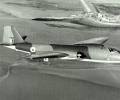
'If we had sent a few airplanes (into Tibet), we could have wiped the Chinese out.' 'And everything could have been different in the 1962 War.' 'They did not believe me there was no Chinese air force.' 'Can you imagine what would have happened if we had used the IAF at that time?' 'The Chinese would have never dared do anything down the line.'
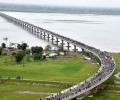
The 9.5-km long bridge inaugurated by Prime Minister Modi on May 26 is India's longest bridge.

"Even though the first Sino-Indian war took place in 1962, the Chinese incursion had started taking place in 1957. The government knew it but it did not inform the public. After five decades, the same thing is happening as the Chinese incursion has been taking in Aksai Chin for long, but we have woken up now," said Ram Pradhan, former Union home secretary and former governor of Arunachal Pradesh.

16 Indian Army divisions face China, 20 face Pakistan and two divisions are reserves. This powerful signal can hardly be missed in China or Pakistan, notes Ajai Shukla.
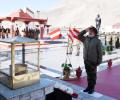
Lieutenant General Harinder Singh, who commands the 'Fire and Fury' 14 Corps, has the experience and talent to face down the Chinese challenge. The general is a rare combination of thinker and tough-minded doer, observes David Devadas.
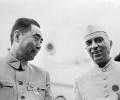
The Indians felt that if they acceded to Chinese claims in Ladakh, Beijing would simply be emboldened to press for further concessions in the future. A revealing excerpt from India And The Cold War.
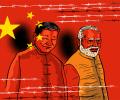
The reasons for China's negative response are located in its territorial dispute with India but also to its grand designs of dominating the region from its previous position of being merely a "balancer" between India and Pakistan, points out Srikanth Kondapalli, Professor in Chinese Studies at JNU.
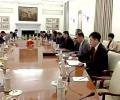
India-China Special representatives are currently holding their 18th round of border dispute talks in the capital.
'During disengagement, you don't find violence.' 'And that, too, the killing of a commanding officer.' 'This indicates that this is more serious than previous incidents.'

A deft hand on India-China relations, Bambawale earlier handled the China desk at the MEA.

It is well-known, and the Brooks-Bhagat report vouches for it, that the real failure for the 1962 debacle against China was not military, but political, says Ram Madhav.

'At critical moments an inability to take tough decisions resulted in potentially far-reaching solutions slipping out of our grasp.' 'If similar opportunities come Narendra Modi's way will he act differently?' asks Karan Thapar.

China will use airpower to support Pakistan from the start of a war. China will use the opportunity to at least take Ladakh. Its growing navy will prevent India from blockading or attacking the Makran Coast. And thanks to Chinese weapons, Pakistan keeps expanding its forces, observes Ravi Rikhye.
'The Modi government's grandstanding has hardened the reflexes in Beijing, Islamabad and Kathmandu and complicated India's relations with these three countries, which were even otherwise highly problematic.' 'Whatever prospects existed for a fair and balanced resolution of the territorial disputes may also have receded,' observes Ambassador M K Bhadrakumar.

'All the government needs to do is to identify clear political and strategic objectives and to give the military planners a free hand,' asserts Ajai Shukla.

'Unless India ups the ante, Beijing will continue to believe its transgressions are cost free and will feel encouraged to do more of the same.'
Amidst reports of Chinese incursions, the Peoples Liberation Army and the Indian Army on Sunday decided to uphold treaties and agreements signed between the governments of the two sides to maintain peace and tranquility along the Line of Actual Control.
...with extravagant claims in both the eastern and western sectors, observes Ambassador Talmiz Ahmad, as India is fixated on asserting its border claims based on the McMahon Line.

'The MEA, hopefully, made it clear that the Indian PM can't be seen in Xi Jinping's company when China has, for all intents and purposes, annexed over 1,000 sq kms of Indian territory in eastern Ladakh, and essentially that the Wuhan spirit and the Mamallapuram spirit have turned into vinegar.'

If you are serious about countering the Chinese threat, then the best weapon is investing in real freedom, plurality, elections and democracy. Unfortunately, it isn't an approach all Indians currently seem to agree on, asserts Shyam G Menon.
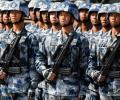
'The unfortunate truth is that China, having exploited the initiative to seize pieces of India's claimed territory, can now hold on to its new acquisitions forever unless India chooses to eject Chinese troops by force or decides to impose tit-for-tat costs on China by symmetrically occupying other pockets in disputed territory where it possesses a tactical advantage'
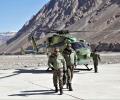
'This reluctance to respond forcefully to Chinese PLA provocations and outright aggression has as much to do with Prime Minister Modi personally, as with the institutional mindset of the MEA or even the Indian Army.' 'They are scarred by the 1962 War and are still cowed by China.'
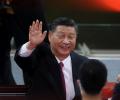
Xi's visit to Nyingchi, bordering Arunachal Pradesh, signals China's opening of another front to India in the eastern sector, observes Srikanth Kondapalli, the leading China expert.
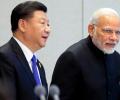
It is apparent that an easing of tensions at the border and a disengagement of troops is on the cards, observes Ambassador M K Bhadrakumar.

'These tactics are particularly evident in China's pursuit of its territorial and maritime claims in the South and East China Seas as well as along its border with India and Bhutan'

A weaker Russia, a sobered China at a time when Xi Jinping is manoeuvring to protect his third term prospects, a reunited West, a chaotic Pakistan. This is a perfect set of strategic circumstances. It is for India now to consummate this historic opportunity, argues Shekhar Gupta.

The people in both places have lived in a state of denial, refusing to accept the bald fact that resorting to violence against an infinitely superior force is suicidal, observes T N Ninan.

The 17th Gyalwang Karmapa Ogyen Trinley Dorje last week visited Arunachal Pradesh, which China claims as a part of southern Tibet.

'A participant in many rounds of the border talks with China once told me that China seemed not interested in resolving the border issue as it wanted to keep it as a ready excuse to intervene in the sub-continent,' says Colonel (retd) Anil A Athale.

'Unlike the Chinese army that has been largely a peace time force, the Indian Army is a battle hardened force,' explains Colonel Anil A Athale (retd).
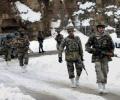
Within the army, there is growing concern that New Delhi will allow the Chinese to retain the territory they have occupied in the last month.

'The border stand-off and the uncertainties that come with it should be a wake-up call on what makes for real rather than illusory power,' observes T N Ninan.

'There was a wrong policy of government during the Congress regime. They didn't construct roads up to the border which left a buffer zone of 3-4 km which China occupied. Construction of new villages isn't a new thing, it's all inherited from Congress'

International news channel Al Jazeera was on Wednesday forced to go off air in the country for five days as the government penalised it for repeatedly showing wrong maps of India.
