
The Central government has extended the Armed Forces (Special Powers) Act, 1958, for another six months in specified areas of Nagaland, Manipur, and Arunachal Pradesh, effective from October 1. This decision follows a review of the law and order situation in these northeastern states, maintaining the "disturbed area" declaration in various districts and police station jurisdictions.

A tripartite pact -- amid the promise of removing AFSPA from almost all of the North East -- revives hydrocarbon exploration along the Assam-Nagaland border after decades of dormancy.
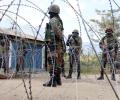
The Armed Forces (Special Powers) Act (AFSPA) has been extended for six months in parts of Manipur, Nagaland, and Arunachal Pradesh due to the prevailing law and order situation.
The AFSPA, often criticised as a draconian law, gives armed forces operating in disturbed areas sweeping powers to search, arrest and open fire if they deem it necessary.

The Centre has reimposed the Armed Forces (Special Powers) Act in Manipur's six police station areas, including the violence-hit Jiribam.

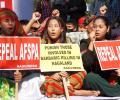
A day after AFSPA was extended in most parts of Manipur, rights activist Irom Sharmila said the "oppressive law" was not a solution to the conflict in the state.

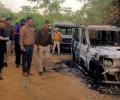
Two jawans of the Assam Rifles were killed and five others injured when a group of armed men ambushed a vehicle of the paramilitary force on September 19.

'This is leading to anarchy.'

The Armed Forces (Special Powers) Act or AFSPA was extended by another six months in Manipur on Wednesday barring 19 police stations falling under the Imphal valley and an area that shares its boundary with neighbouring Assam.

The defence minister, however, said the matter is under the domain of the Union home ministry and it will take appropriate decisions.

The incident took place on September 19 at around 5:50 pm when a vehicle-based column of troops of 33 Assam Rifles was moving from its Patsoi Company Operating Base to Nambol Company Operating Base.

Sarma said his government will take further steps based on the suggestions of the home minister.
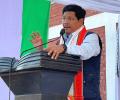
Shah said for the first time in India's history, Modi prioritised security, peace and development in the northeast and as a result of it, the region is now rapidly heading on the path of peace and development.

On the controversial AFSPA, the home minister said, "We will also think of revoking AFSPA."

The 'key person' involved with the plan is still absconding, though the police have his whereabouts and he will be nabbed soon, Sarma said.

According to two separate notifications, the decisions have been taken after review of the law-and-order situation in both the states.
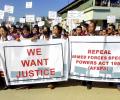
Locals in Manipur protest the killing of two Assam Rifles personnel in an ambush. Search operations are underway as tensions remain high.
Retired army personnel will be appointed as additional superintendents of police to impart training to the police force in Assam, Chief Minister Himanta Biswa Sarma said in Dergaon on Monday.
AFSPA confers special powers on the armed forces in areas deemed as disturbed.
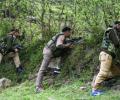
The army has been left to do justice to itself for crimes it is accused of committing against civilians. As a force inside the government, obviously it will want that there be no intrusion into what they do, points out Aakar Patel.
A home ministry spokesperson, however, said the decision does not imply that the AFSPA has been completely withdrawn from the three insurgency-hit states but will continue to be in force in some areas of the three states.
The AFSPA is in force in Assam, Nagaland, Manipur (excluding Imphal Municipal Council Area), Changlang, Longding and Tirap districts of Arunachal Pradesh, and areas falling within the jurisdiction of eight police stations of districts in Arunachal Pradesh bordering Assam.

Security forces in Manipur have launched a major crackdown on the banned People's Liberation Army (PLA) following an ambush on an Assam Rifles convoy. Fifteen cadres have been arrested, including suspects directly involved in the attack. Investigations are underway to determine if the PLA has political patronage and if weapons looted during ethnic clashes are being used against security forces.
The resolution moved by Chief Minister Neiphiu Rio was adopted by voice vote during the one-day special session of the Assembly held to discuss the AFSPA, 1958, and its application to Nagaland in the aftermath of the killing of 14 civilians by security forces, including six in a botched anti-terrorist operation, and eight others in subsequent incidents in Mon district on December 4 and 5.
The extension comes three days after the Centre constituted a high-level committee under the chairmanship of Registrar General and Census Commissioner Vivek Joshi with Additional Secretary in the Union Home Ministry Piyush Goyal as its Member-Secretary.

'The government needs to think if a draconian, outdated and colonial law is needed in a democratic, multi religious, diverse country governed by a democratic government.'

AFSPA can be safely lifted from almost 90 per cent of Nagaland, argues Shekhar Gupta.

Manipur Chief Minister N Biren Singh on Sunday said the people of his state, including himself, want the withdrawal of the Armed Forces Special Powers Act but only after mutual understanding with the Centre as national security is their top priority.

'Due to the imposition of AFSPA, our people have for so long suffered untold miseries and discrimination at the hands of security forces'

The Armed Forces (Special Powers) Act, 1958, was completely withdrawn in Meghalaya in 2018, Tripura in 2015 and Mizoram in the 1980s.
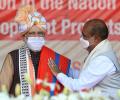
Now, the chief minister is under pressure to make good his promise after the December 4 incident in Nagaland's Mon, where 14 people were killedAFSPA has eclipsed all other achievements of the Biren Singh government.
The Supreme Court found enough grounds to order a CBI probe into 1,528 extra-judicial killings in Manipur between 2000 and 2012.
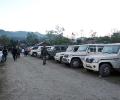
A fresh cycle of violence erupted in Manipur last Monday after 11 suspected militants, who allegedly attacked a police station and adjoining CRPF camp with sophisticated weapons in Manipur's Jiribam district, were killed in an exchange of fire.

The Congress has promised to review and amend a host of laws, rules and regulations.
In a relief to 30 Army personnel, the Supreme Court on Tuesday closed the criminal proceedings initiated against them by the Nagaland government for allegedly killing 13 civilians in a 2021 botched operation to ambush militants in Mon district for want of prosecution sanction.
Nagaland Chief Minister Neiphiu Rio on Sunday said that the Centre has decided to institute a five-member committee to look into withdrawal of Armed Forces (Special Powers) Act, 1958 from the northeastern state.
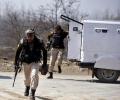
Brigadier Gurmeet Kanwal (retd) lists why India must not do away with AFSPA, but ensure enough transparency to avoid confrontation with human rights.
The National Socialist Council of Nagaland-Isak-Muivah on Wednesday said no peace talks were possible 'under the shadow' of the Armed Forces Special Powers Act and termed Union home minister Amit Shah's statement in Parliament on the botched counter-insurgency operation as 'irresponsible.'

The Centre's decision to extend the enforcement of the Armed Forces (Special Powers) Act, 1958, to 12 districts of Arunachal Pradesh bordering Assam and Nagaland, has sparked sharp reactions.

'One of our MLA's homes has already been attacked by the mob. This legislator was beaten. This MLA belongs to the Meitei community.' 'There is a complete collapse of law and order in Manipur.'
