
A report by Scholars at Risk, 'Free to Think 2026', states that academic freedom in India is "severely restricted" due to increasing government influence over higher education, university governance, and curbs on student expression. India is listed among six countries in this category, with its Academic Freedom Index score sharply declining. The report cites instances of faculty dismissals, event cancellations, and pressure on student protests, highlighting the alleged use of the UGC as a vehicle for state influence.

The Manipur government has announced a holiday for all educational institutions on July 20, 2026, allowing students to watch the FIFA World Cup 2026 final. The order covers schools, colleges, and universities across the state.
Union Education Minister Pralhad Joshi announced that revised NCERT textbooks for classes 10 to 12 are being prepared in "mission mode," while textbooks for classes 1 to 9 under the new National Curriculum Framework have already been released. He emphasised NCERT's role in building a 'Viksit Bharat' and highlighted the need for curricula to evolve with AI advancements and the importance of India's young population as a global asset.

'It interferes in administrative matters of institutions, robbing them of their independence in day-to-day affairs and appointments.'

Southern chief ministers fear population stabilisation could reduce their parliamentary representation and tax devolution benefits.

'Everything will be decided by the Centre.' 'Universities will have no autonomy to start a new course or introduce a new syllabus.'

'We can integrate AI and tech into education, but that is just a means and not an end.' 'Ultimately, we need to control what happens in a classroom and we need to let teachers innovate their teaching style to suit the needs of Gen Z and beyond.'
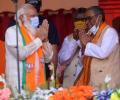
Ten days after the expansion of the BJP government's cabinet in West Bengal, key portfolios have been allocated, with senior leader Tapas Roy taking charge of industries and journalist-turned-politician Swapan Dasgupta appointed finance minister.

A parliamentary panel flagged staffing shortages at NCERT and CBSE, inadequate education spending, falling enrolment and poor internet connectivity in government schools.

How did hundreds of errors slip through multiple stages of drafting, editing, proofreading, expert review and final approval before making their way into classrooms?

The Students and Alumni of the National Law School of India University (NLSIU) in Bengaluru have opposed Chief Justice of India Surya Kant and Bar Council of India chairman Manan Kumar Mishra attending the upcoming convocation of the varsity.

'The prohibition regime has been accompanied by concerns regarding the expansion of the illicit liquor trade, increased enforcement challenges and corruption, and the growing use of alternative intoxicants, including illicit drugs.'

The Indian government has introduced a 0.4% transaction fee on Unified Payments Interface (UPI) payments exceeding Rs 2,000 for merchants, effective October 15, marking the end of nearly six years of free service. Person-to-person transfers and small-value transactions below Rs 2,000 remain free. The new Merchant Discount Rate (MDR) is capped at Rs 300 for transactions above Rs 75,000, with differentiated rates for essential sectors and investments, and safeguards to prevent costs from being passed to consumers.

There is clearly something deeply rotten in the systems of institutional governance in the bastions of higher education in India, says TCA Anant.

Amidst ongoing controversy surrounding the NEET and CUET UG 2026 exams, the National Testing Agency (NTA) faced tough questions from a parliamentary standing committee regarding safeguards against paper leaks and hacking vulnerabilities.

A research paper by the National Council of Applied Economic Research (NCAER) recommends that Bihar revoke its alcohol ban, citing its failure to reduce violence against women and a rise in illicit drug and alcohol consumption. The report suggests that reinstating the liquor excise tax would significantly increase state revenues and decrease enforcement costs.

Delhi University has instructed St Stephen's College to halt the appointment of a new principal, citing that the selection committee was not formed in accordance with the University Grants Commission (UGC) Regulations, 2018.

The NCERT Class 8 social science textbook has undergone significant revisions, including a tweaked narrative on the 1947 Partition, the inclusion of VD Savarkar's demand for Swaraj, and the removal of references to Adolf Hitler and Nazi ideology. These changes follow a Supreme Court intervention regarding controversial content on the judiciary.
A one-day patent workshop was held at CSIR-NIIST to promote intellectual property awareness and equip researchers and startups with essential knowledge in patent filing and innovation.

15 states have rolled out unconditional cash transfer schemes for women, with an estimated annual outlay of around Rs 1.7 trillion covering nearly 120 million beneficiaries.

One of the most important provisions this year is that qualifying NEET-PG does not automatically guarantee participation in counselling.
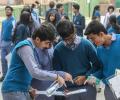
The Supreme Court has agreed to examine a plea challenging the CBSE's policy mandating the study of three languages, including two native Indian languages, for Class 9 students starting July 1. The court has sought responses from the Centre, CBSE, and NCERT and will hear the matter in July.

The Supreme Court has modified its previous order regarding three academics involved in a controversial NCERT textbook chapter on corruption in the judiciary, allowing government bodies to make independent decisions about their association with the academics.

Through his commitment to democratic norms, debate, dissent and constitutionalism, Jawaharlal Nehru helped ensure that parliamentary democracy took deep root in independent India. Utkarsh Mishra evaluates Nehru's 17 years as India's first prime minister, examining his role in nation-building, democratic institution-building, economic planning, scientific advancement and foreign policy.
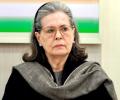
Noting that these three Cs haunt Indian education today, the Congress Parliamentary Party chairperson said in an article that this "carnage" of India's public education system must end.

Eminent historian and academic K.N. Panikkar, known for his Marxist interpretation of history and advocacy for secularism, has passed away at the age of 90. His contributions to historical research and defence of secular values are widely recognised.

MEA data show that the number of Indian students in the UAE in 2025 was 253,832, just behind the United States with 255,447 students, and Canada being on top at 427,085.
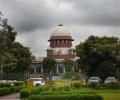
Three academics involved in drafting a controversial NCERT textbook chapter on corruption in the judiciary have approached the Supreme Court to defend their work, stating it was a collective effort and not the view of any single individual.

Opposition-ruled states warn of steep annual losses; Centre assures higher consumption will offset revenue hit.

India and the European Union have finalized a comprehensive mobility pact that will create new opportunities for Indian students and professionals in Europe. The agreement was reached during summit talks between Prime Minister Narendra Modi and top EU officials.
The Centre has directed the NCERT to review all textbooks after the Supreme Court raised concerns about 'offending' content on corruption in the judiciary in a Class 8 social science book.

'Our problem is not a budget deficit but a trust deficit. We need to trust our institutions and industries to innovate and lead. That is the way forward for India.'

The government on Sunday gave a strong push to upgradation and expansion of healthcare infrastructure, medical education and pharma sector with the Union Budget 2026-27 announcing a slew of steps, including those aimed at making India a global hub for allied healthcare professionals and biopharma manufacturing.

This was perhaps a missed opportunity for India to spotlight a core domestic challenge: The scale of workforce preparation required for a young, populous, rapidly growing country seeking to reach net zero, points out Radha Roy Biswas.

The Supreme Court of India has announced its intention to establish an effective mechanism to address caste-based discrimination in educational institutions throughout the country. The court directed the University Grants Commission (UGC) to draft regulations to prevent such discrimination and to provide data on institutions that have implemented equal opportunity cells as mandated by the 2012 UGC equity regulations. The court's decision stems from a public interest litigation filed in 2019 highlighting the prevalence of caste-based discrimination in higher education institutions and its tragic consequences, including the suicides of students like Rohith Vemula and Payal Tadvi.

Gujarat Chief Minister Bhupendra Patel allocated portfolios following a major cabinet reshuffle, with Harsh Sanghavi becoming Deputy CM and receiving Home and Industries. New ministers, including Rivaba Jadeja, were also assigned responsibilities.

A series of decisions were taken under the Public Health Department, including an approval to increase honoraria for field-level workers engaged under the Ayushman BharatPradhan Mantri Jan Arogya Yojana and Mahatma Jyotirao Phule Jan Arogya Yojana.

An ECI statement issued from New Delhi put the voter turnout at 68.76 per cent. The female turnout (74.03 per cent) was significantly higher, compared with males (64.1 per cent).
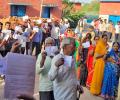
Bihar recorded its highest-ever voter turnout of 67.14 per cent in the second and final phase of the assembly elections. The election is seen as a referendum on Chief Minister Nitish Kumar. Kishanganj recorded the highest polling percentage at 76.26.

'There are very few issues and a political call needs to be taken about some of them.'
