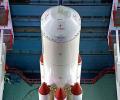
India on Friday successfully launched its latest communication satellite GSAT-12 onboard a powerful variant of homegrown Polar Satellite Launch Vehicle, PSLV-C17, from the spaceport in Sriharikota.

The 50-hour countdown for the launch of Indo-French climate monitoring satellite Megha-Tropiques and three other nano satellites on board PSLV-C18 on October 12 from the spaceport of Sriharikota is progressing well, the Indian Space Research Organisation said.
Chief of the Indian Space Research Organisation K Radhakrishnan, while commenting on the failure of the latest communication satellite GSAT-5P onboard homegrown GSLV-F06 powered by a Russian cryogenic engine, said that the vehicle faced problems 50 seconds after its launch."The command for aborting the launch was issued when the vehicle was at an altitude of 8 km and 2.5 km away from Sriharikota," said the ISRO chief.
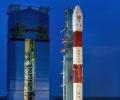
Antrix, ISRO's commercial arm, is eyeing 10% of the $357 billion global market.

Launched on September 23, 2009 using the Polar Satellite Launch Vehicle from Sriharikota, Oceansat-2; is designed to provide service continuity for operational users of the Ocean Colour Monitor (OCM) instrument on Oceansat-1. The agreement with the Indian Space Research Organisation will lead to the use of data from Oceansat-2 for various US agencies for research, education and other activities of public good, including weather forecasting.
The 51-hour countdown for the 17th flight launch of Indian space agency's Polar Satellite Launch Vehicle PSLV-C 15 from Sriharikota spaceport is expected to begin on Saturday morning."The rocket will put into orbit five satellites remote sensing satellite Cartosat-2B from India, Alsat from Algeria, two nano satellites from Canada and Switzerland, and a pico (very small) satellite called Studsat built by 7 Indian engineering students.

Indian Space Research Organisation plans to undertake next month the first developmental flight of a "game-changer" rocket capable of launching four-ton class of satellites from Sriharikota spaceport, says its Chairman A S Kiran Kumar.
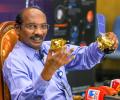
ISRO chairman K Sivan said all activities related to the third lunar mission -- Chandrayaan-3 -- were going on smoothly but its launch may shift to next year.
Launch of India's latest communication satellite GSAT-5P onboard homegrown GSLV-F06, powered by Russian cryogenic engine, failed on Saturday when the rocket developed a snag soon after lift-off from the spaceport in Sriharikota.
India's top space scientists will be meeting in Thiruvananthapuram on Saturday to analyse the data and find the cause for failure of GSLV-D3 rocket, which was launched for the first time on Thursday using an indigenously made cryogenic engine.
India's ambitious attempt to flight-test its indigenous cryogenic engine on Thursday received a setback as the homegrown rocket Geosynchronous Satellite Launch Vehicle (GSLV-D3) deviated from path within seconds of lift-off.
Indian Space Research Organisation is all set for the launch of the first flight-testing of indigenous cryogenic engine on homespun rocket, Geosynchronous Satellite Launch Vehicle (GSLV-D3), from the Satish Dhawan Space Centre at Sriharikota at 4.27 pm on Thursday.

A recap of events that occurred in India in the past week.

The Vikram Moon Lander, named after the father of India's space mission Vikram Sarabhai on his birth centenary year, is scheduled to touch the lunar surface near its south pole on September 7 about 1.55 am.

India is all set to script history by launching a record number of 22 satellites, including a number of micro and nano ones from foreign countries, in a single mission in May this year.
The Indian Space Research Organisation's Satish Dhawan Space Centre in Sriharikota will soon initiate the process of creating Third Launch Pad for human transportation into space, SHRC Director Chandra Datttan on Tuesday said during Republic Day celebrations.
Indian Space Research Organisation is preparing to launch a geosynchronous satellite launch vehicle (GSLV-D3), powered for the first time by a home-made cryogenic engine, from Sriharikota spaceport this month, its chief K Radhakrishnan said on Friday.
The Polar Satellite Launch Vehicle PSLV-C15 carrying five payloads, including India's remote sensing satellite Cartosat-2B, successfully lifted off from the spaceport in Sriharikota on Monday.
The Indian Space Research Organisation on Wednesday successfully launched seven satellites in 1,200 seconds with the help of its most trusted Polar Satellite Launch Vehicle from the Sriharikota spaceport in Andhra Pradesh coast.The launch was carried out as per schedule at 11.51 am and ended at 12.06 pm.Vice President Hamid Ansari, who was present at the Satish Dhavan Space Centre, congratulated the scientists and technocrats over this splendid achievement for the nation.

Here's a recap of the events from the past 24 hours.
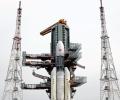
India's second mission to the moon will be launched on Monday at 2.43 pm after its initial launch on July 15 was called off owing to a "technical glitch."
RISAT-2, India's spy satellite, was successfully placed into the 550 km orbit around Earth on Monday morning.Earlier, the PSLV-C12, carrying 300-kg Radar Imaging Satellite and 40-kg Micro Satellite ANUSAT, had lifted off from Indian Space Research Organisation's Satish Dhawan space Centre in Sriharikota today morning. The RISAT-2 has an all weather capability to take images of Earth.
On Thursday, scientists sent the 1,380 kg spacecraft to its next destination -- highly elliptical orbit of 300 km perigee and 1.6 lakh km apogee respectively. This will be followed by three more orbit-transfer exercises.

The space agency lines up GSLV-III and Chandrayan-II in 2017-18.

The space agency launched 104 satellites, breaking the previous record of 37 by Russia.
A "small" fuel spill mishap when the Polar rocket with the Chandrayaan-I spacecraft atop was being fuelled created a near "scare" during the final countdown for the launch of India's maiden unmanned moon mission, ISRO Chief Madhavan Nair said.
Click here to watch the live broadcast of the historic launch!
The final 52-hour countdown for the October 22 launch of the country's first moon mission, Chandrayaan-I, began early on Monday morning at the Satish Dhawan Space Centre at Sriharikota in Andhra Pradesh.

GSAT-6, the country's latest communication satellite has been successfully positioned in its orbital slot, Indian Space Research Organisation said on Sunday.
The Indian Space Research Organisation has begun the work on its next Rs 10,000 crore ambitious project the ''manned mission'' which will witness an Indian transported to space, Chandradathan, Director of Sathish Dhavan Space Centre said in Sriharikota in Andhra Pradesh on Tuesday.

The satellite would provide a thrust to mobile communication through multi-beam coverage facility, the ISRO said.

If the April launch of the Chandrayaan-2, the country's second mission to the Moon, is not possible, then the ISRO will aim for a launch by October.
"The United Progressive Alliance government should demand an end to the Israeli blockade of the Gaza strip forthwith. It should call for an urgent Security Council session to discuss the matter," the party Politburo said in a statement in New Delhi.
"It (the cost of setting up the launch pad) is around Rs 600 crore. A major national facility (for training astronauts) will be established in Bengaluru, Indian Space Research Organisation Chairman G Madhavan Nair told PTI.
India on Friday moved a step closer to launch its maiden unmanned moon session when the lunar spacecraft Chandrayaan-I was mated with the polar rocket which is set to blast off on October 22 from the Sriharikota spaceport. Gearing up for the final countdown, Space officials said all operations for the mission are progressing satisfactorily and barring a cyclone threat the PSLV-C11 will keep the date with the country's historic mission on October 22.

Since Pakistan has 'opted out' of the project, it is now being called South Asian satellite.
Indian Space agency Indian Space Research Organisation would launch the Geo-synchronous Satellite Launch Vehicle-Mark III (LVM3 X mission) on December 18 which would carry active solid boosters, liquid core stage and a passive cryo-stage.
"It is beautiful to see the countryside. There are so many colours. I think I have mentioned that before how colourful it is being in India. From the space, it is the same," she said.
Even as the rain kept the country on tenterhooks with regard to the launch of the Chandrayaan, good news has come from the Met department which says that the weather may not play spoilsport after all.
Stage is set for the launch of PSLV-C9 from the Satish Dhawan Space Centre, Sriharikota. As many as ten satellites will be launched on Monday by the Indian Space Research Organisation, including country's latest remote sensing satellite and eight nano satellites.
