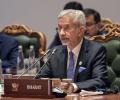
India has expressed serious concerns about the West Asia crisis and its potential impact on energy supplies and maritime stability, urging BRICS nations to find practical solutions to geopolitical challenges and unilateral sanctions.

Russia and China vetoed a Bahrain-backed UN resolution aimed at reopening the Strait of Hormuz. A resolution that was already diluted to secure their abstentions.

Pakistan summoned a senior US diplomat here and lodged a strong protest over America's alleged "interference" in its internal affairs, according to media reports on Friday.

Egypt, Pakistan, Saudi Arabia and Turkey met in Islamabad in what analysts say is the formal opening of a new diplomatic formation that could reshape the post-war regional order. Their immediate goal is a ceasefire; their larger ambition is to ensure that neither Iran nor Israel emerges from this war in a dominant position. Pakistan's foreign minister then flew directly to Beijing and mooted a Chinese role as guarantor of any eventual agreement. Prem Panicker continues his must read daily blog on the Gulf War.

Russia and China on Saturday condemned the United States airstrikes on Venezuela and the capture of its president, Nicolas Maduro and his wife.

Iran is fighting a different war: Older, slower, and in some ways more dangerous. Iran doesn't need to shoot down an F/A-18. It only needs to make the Strait of Hormuz feel dangerous long enough for insurance markets, shipping companies, and oil futures traders to do the rest. Prem Panicker continues his must-read daily blog on the war in the Middle East.
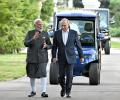
Russian Foreign Minister Sergey Lavrov has confirmed that President Vladimir Putin has accepted an invitation from Prime Minister Narendra Modi to visit India. The visit is currently being prepared, though the dates have not yet been revealed. This visit follows Prime Minister Modi's trip to Russia in July 2024, his first since 2019. The two leaders have maintained regular contact and have emphasized the strength of the Russian-Indian strategic partnership.

United States Attorney General Pamela Bondi on Saturday announced that captured Venezuelan dictator Nicolas Maduro has been charged with Narco-Terrorism and would face US justice.

Israel and the United States had a plan. Iran punched back. And now the Gulf is reeling, the world is beginning to feel the pain and, as on date, no one in Washington or Tel Aviv appears willing to admit that the punch has landed, notes Prem Panicker, continuing his must-read blog on the war in the Middle East.
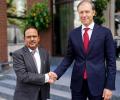
National Security Advisor Ajit Doval met with Russian First Deputy Prime Minister Denis Manturov to discuss bilateral military-technical ties and implementation of joint projects in strategic sectors. The meeting comes amid growing US pressure and tariffs on Indian goods.

In the Indo-Pacific's new era -- where perception shapes reality faster than treaties -- the real entrapment is not of China or the United States. It is the test Japan has set for itself -- and whether partners like India, acting as balancers rather than accelerants, can help ensure that the story ends in stability, points out Varun Arya.

The BRICS nations have expressed concern over the proliferation of trade-restrictive actions in the form of 'indiscriminate rising' of tariffs, particularly measures used as a means of 'coercion', cautioning that such practices risk marginalising the Global South countries.
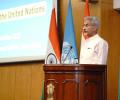
External Affairs Minister S Jaishankar criticizes Pakistan's attempts to protect a terror group at the UN Security Council, highlighting the need for urgent reforms within the global body.
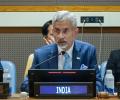
External Affairs Minister S Jaishankar has called on Brazil, Russia, India, China, South Africa (BRICS) to defend the multilateral trading system amid increasing protectionism and tariff volatility during a meeting of the bloc's foreign ministers in New York on the sidelines of the United Nations General Assembly session.
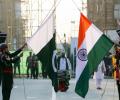
The UN Security Council will hold closed consultations on Monday on the situation between India and Pakistan after Islamabad sought an emergency meeting on the issue. Pakistan, which currently sits as a non-permanent member of the council, requested the meeting in light of rising tensions between the two countries following a terror attack in India. The meeting comes after India's foreign minister spoke with all council members except China and Pakistan, emphasizing the need to bring perpetrators of the attack to justice. The Pakistani envoy has argued that the situation in Jammu and Kashmir poses a threat to regional and international peace and security, justifying the need for a council discussion.
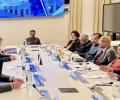
India has secured international support in its fight against terrorism, with Russia, Japan, and the United Arab Emirates expressing solidarity and a commitment to working together to combat the threat. This follows a recent terrorist attack in Pahalgam, India, which claimed 26 lives. Multi-party parliamentary delegations from India briefed the leaderships of these countries on Operation Sindoor, India's response to the attack, and discussed ways to enhance cooperation in counter-terrorism and combating radicalism. These developments highlight the growing global consensus against terrorism and the importance of international collaboration to address this shared challenge.
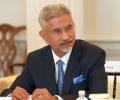
External Affairs Minister S Jaishankar says Operation Sindoor conveyed India's resolve to act against terrorism, following UN Security Council's call to bring Pahalgam attackers to justice.

'...it should not delude itself into thinking that India's security or its great-power ambitions will be advanced by those partnerships.'
'Instead, what India should focus on is on riding out the next three-and-a-half years of Trump's presidency with minimal damage to itself.'
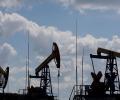
India has voiced regret over the Ukraine conflict's 'collateral consequences', including prices of fuel, saying countries of the Global South have been left to fend for themselves, as Delhi underscored that diplomatic efforts hold the promise to end the war and bring lasting peace.

A UN Security Council report states that The Resistance Front (TRF) claimed responsibility for the Pahalgam terror attack and published a photograph of the attack site. The report also cites assertions that the attack could not have happened without the support of Pakistan-based Lashkar-e-Tayyiba (LeT).
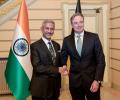
The era where nations thrived through rigid alignments is giving way to an age where the connective State defines power. For India, that era has arrived, points out Dr Nishakant Ojha.
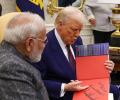
'The current strain in the relationship is serious and likely to be long lasting.' 'Even if Trump suddenly changes his attitude toward India -- which he is entirely capable of doing -- it is unlikely that New Delhi will be able to pick up the pieces and respond as if nothing has happened.'

'We should watch -- in the near term -- for signs that the two have totally fallen out at a personal, political level.' 'Trump and Modi know how to be dealmakers, but they also know how to hold a grudge.'
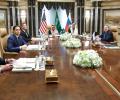
After more than four hours of talks in Saudi Arabia, the US and Russia agreed on four key principles, Rubio said on Tuesday. These include appointing a high-level team to help "negotiate and work through the end of the conflict in Ukraine" in a way that's "acceptable to all the parties engaged."

EAM Jaishankar's mission is aimed at strengthening India's strategic autonomy in a complex international environment, observes Ambassador M K Bhadrakumar.
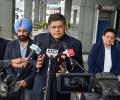
'It is high time that the 'war on terror' is removed from our diplomatic toolbox.' 'Certainly, our parliamentarians have no role in it,' asserts Ambassador M K Bhadrakumar.
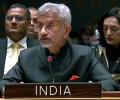
India abstained on two UN General Assembly resolutions calling for a de-escalation, an early cessation of hostilities and a peaceful resolution of the war against Ukraine. The resolutions were adopted on the third anniversary of the Russia-Ukraine conflict, with the UN Secretary General stressing that the war in Ukraine stands as a grave threat to the peace and security of Europe and the core principles of the United Nations.

Chess governing body FIDE's general assembly agreed to consider lifting parts of a ban on Russian and Belarusian players imposed after Moscow invaded Ukraine in February 2022, in a vote on Sunday in Budapest.
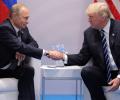
The US ended up abstaining from the vote for its own resolution at the General Assembly after several amendments were passed ahead of the vote to strengthen the language against Russia and reaffirm Ukraine's territorial integrity.

In New Delhi, Singh will continue US administration's ongoing consultations with India, and advance a range of issues in the US-India economic relationship and strategic partnership.

Russian Foreign Minister Sergey Lavrov said Moscow sees the prospect of making the Security Council more democratic, exclusively, through broadening the representation of countries from Africa, Asia and Latin America.

More than 5,00,000 people have left Ukraine since the start of Russia's military operation and about 1,60,000 have become internally displaced, UN Under-Secretary-General for Humanitarian Affairs and Emergency Relief Coordinator Martin Griffiths told the UN Security Council on Monday.
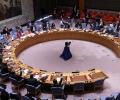
India has abstained on a draft resolution tabled in the United Nations Security Council which condemned Russia's 'illegal referenda' and annexation of four Ukrainian territories and called for an immediate cessation of violence while underlining the need to find pathways for a return to the negotiating table.

India is a great power that determines its national interests and chooses its partners, Russian Foreign Minister Sergey Lavrov has said, describing as "completely unjustified" the "enormous pressure" on New Delhi due to its energy cooperation with Moscow.

Times have changed, situations have changed, but the basic nature of superpower geo-politics remains the same and so also India's diplomacy -- call it non-alignment, strategic autonomy or neutrality; it all depends on the time scale, notes Rup Narayan Das.

New Delhi has reached out to Moscow while waiting for a new president in Washington. New Delhi knows well that in international relations, there are no permanent friends or foes, only permanent national interests, points out Dr Rup Narayan Das.

Ukrainian President Volodymyr Zelenskyy told the United Nations Security Council that 'we have to prepare' the second peace summit to end the Russia-Ukraine war 'altogether' and he has invited India and other countries to join the peace process.

His remarks without naming any country came against the backdrop of tension between India and Pakistan after New Delhi revoked Jammu and Kashmir's special status.
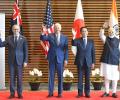
Chinese and Russian warplanes on Tuesday conducted joint air patrols over the Sea of Japan, the East China Sea and the West Pacific Ocean as the leaders of Quad held their in-person summit in Tokyo, in an apparent attempt to send a message of unity between Beijing and Moscow.

Jaishankar said the world has experienced its consequences in terms of higher costs and shortages of foodgrains and fertilizers and fuel.
 © 2026 Rediff.com - Advertise with us - Disclaimer - Privacy Policy - Sitemap - Feedback - About us - Terms of use - Grievances