

'We should watch -- in the near term -- for signs that the two have totally fallen out at a personal, political level.'
'Trump and Modi know how to be dealmakers, but they also know how to hold a grudge.'
How quickly the world changes on Donald Trump's watch!
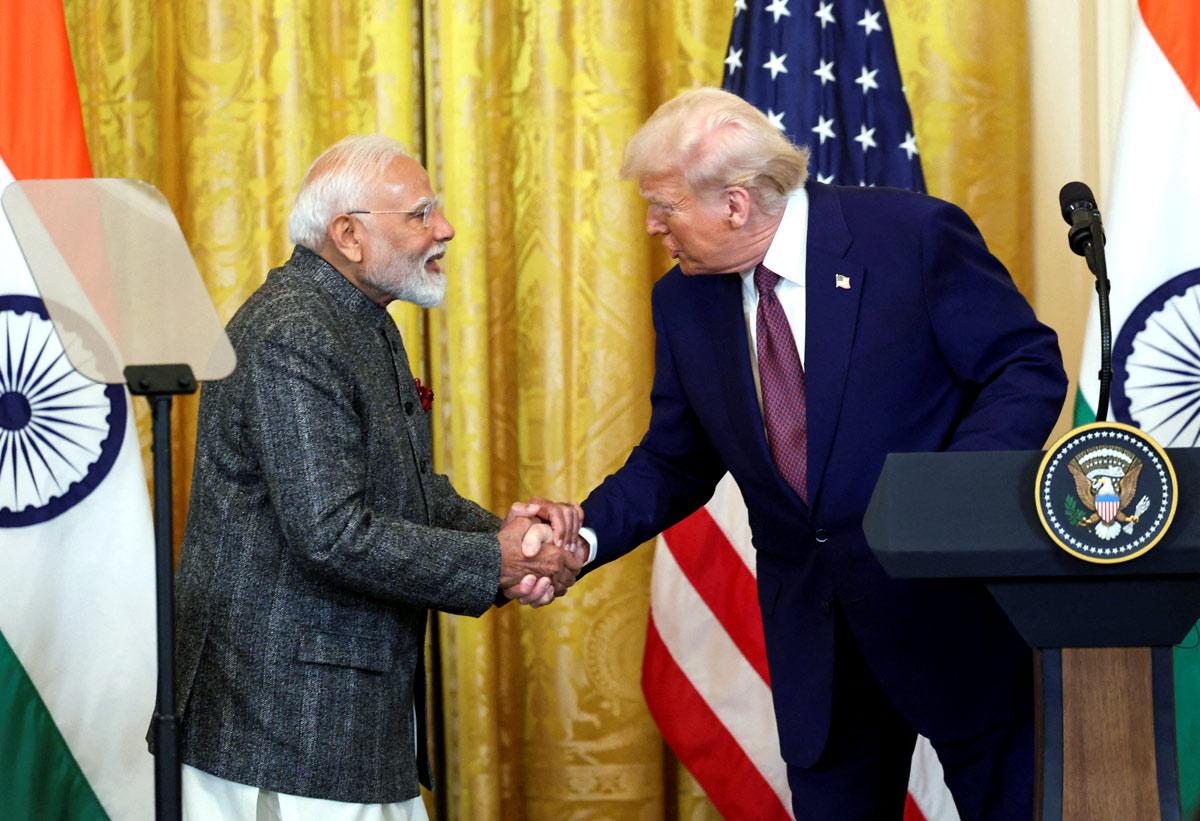
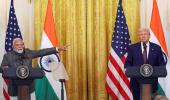
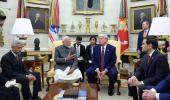
When Rediff spoke to Daniel S Markey after Prime Minister Narendra Modi met Trump at the White House in February, his assessment was that "By his words, actions, and body language Trump wanted to convey his personal respect for Modi and, more broadly, his desire to work closely with India."
When Rediff's Nikhil Lakshman spoke to Dr Markey last week after the Trump tariff tantrums, he observed, "During Trump 2.0, the US-India relationship has fallen farther faster than anyone could have anticipated. Still, it is too soon to judge whether the current moment is a hiccup or death spiral."
Dr Markey -- senior advisor on South Asia at the United States Institute of Peace, the Washington, DC-based think-tank -- is one of America's most astute observers of the India-US relationship.
Dr Markey is also a senior fellow at the Johns Hopkins University's School of Advanced International Studies Foreign Policy Institute. From 2007 to 2015, Dr Markey was a senior fellow for India, Pakistan, and South Asia at the Council on Foreign Relations. From 2003 to 2007, Dr Markey was a member of the US State Department's Policy Planning Staff, focusing on US strategy in South Asia.
"The real question is whether Prime Minister Modi would be willing to play to Trump's vanity, or if he believes that would fundamentally undermine his own political and strategic aims," Dr Markey notes in the first of a two-part interview.
"Not all world leaders have caved to Trump's ego; Xi Jinping and Vladimir Putin are noteworthy exceptions. On which side of that divide is Modi more likely to stand, knowing that either one comes with the potential for very high costs?"
Do you think the Trump tariff tantrum has seriously undermined the India-US relationship and endangered whatever has painstakingly been achieved over 25 years?
Is this a temporary hiccup in the relationship or is this the worst you have seen since the nuclear tests of 1998?
How endangered is the India-US security relationship? What elements of the relationship are in peril?
During Trump 2.0, the US-India relationship has fallen farther faster than anyone could have anticipated. Still, it is too soon to judge whether the current moment is a hiccup or death spiral.
Many powerful and highly incentivised groups, including in business and political circles across the United States, have enormous investments in the future of US-India relations. They are undoubtedly working around the clock to salvage the situation and will not give up easily because too much is at stake.
If the situation is deadlocked for the moment, they can afford some patience and will redouble their efforts when opportunities present.
That said, for the past two decades a central barrier to India's purchase of US arms and related defence technologies has been the question of American reliability. Trump's mercurial ways only reinforce pre-existing Indian biases that US suppliers might not deliver when India needs them most.
Furthermore, this rupture comes at precisely the time when Russian-made weaponry, including the S-400 and co-produced BrahMos, performed admirably in the fight against Pakistan. All of this will create new obstacles to US defence suppliers seeking buyers in India.
Could this be a short lived Trump tantrum, the like of what we saw with President Zelenskyy a few weeks ago, which seems to be all but forgotten now or his fusillade against China and the threat of 150 per cent tariff? Or like the early hostility against Europe, which seems to have dissolved into a bromance?
All of the above reached out in some ways to Trump with flattery and pelf and got their way in a manner of speaking. Will India need to kow-tow to Trump -- and in what way?
Yes, it is very possible that Trump would be happy to revive and expand ties with India just as soon as Prime Minister Modi kisses his ring, bends his knee, or kowtows sufficiently.
This should draw our attention to the disastrous phone call between the two leaders that, according to media reports, served as the inciting force for Trump's punitive tariffs against India.
Different countries have found different ways to regain Trump's favour, such as by promising huge investments in US markets or purchases of US goods. India could undoubtedly assemble a tribute along similar lines.
So the real question is whether Prime Minister Modi would be willing to play to Trump's vanity, or if he believes that would fundamentally undermine his own political and strategic aims. Not all world leaders have caved to Trump's ego; Xi Jinping and Vladimir Putin are noteworthy exceptions.
On which side of that divide is Modi more likely to stand, knowing that either one comes with the potential for very high costs?
What does New Delhi need to do to repair the relationship since the White House appears cussed about reaching a rapprochement at least at this point of time?
Will India need to make allowances like granting the US access to its agriculture market (which is a huge no domestically in India)? Or do you think it is something worth sacrificing if New Delhi wants the US in its corner in a future confrontation with China?
No, India does not have to make terribly painful trade concessions on agriculture or dairy in order to close a deal with the United States.
The proven formula is to come up with offsetting concessions that enable the Trump administration to show that it gained significant ground in negotiations even as India walls off parts of its economy to US competition.
However, when dealing with the Trump administration India cannot assure itself that any successful trade deal would necessarily deliver other strategic benefits.
A key feature of Trump's transactional approach to international affairs seems to be that disparate issues are managed in silos. Trade is in one silo, and security guarantees another; the two are not necessarily linked.
The Trump administration's decisions on whether to back India in a future confrontation with China will depend at least as much, and possibly more, on the trajectory of US-China bilateral ties.
India will have very little influence over that relationship, and Trump seems at least somewhat open to a live-and-let-live or 'spheres of influence' approach to Beijing that would probably worsen strategic anxieties in New Delhi.
Would India's refusal to give Mr Trump what he wants provoke the President to initiate other action, like, for instance, in the Panun case?
It is not beyond the realm of possibility that the US justice department and the FBI could embarrass the Indian establishment by linking senior officials to the conspiracy. Mr Trump is capable of doing anything, isn't he, if he does not get his way?
The United States does have a number of cards it could play with India. The relationship is, at a fundamental level, asymmetrical in Washington's favour. And it is true that the Trump administration has an untraditional view about its relationship with the justice department and its use of legal tools for other purposes, including political ones.
So it is conceivable that the Pannun case could start to play out in ways that become expedient for the White House to use it as additional leverage against New Delhi.
That said, given the plethora of other coercive tools at the Trump administration's disposal, starting with massively punitive tariffs, I do not expect that the President would resort to such indirect methods.
There is talk of an Russia-India-China (RIC) grouping emerging at this month's Shanghai Cooperation Organisation (SCO). Would that incite Mr Trump even more than BRICS and SCO?
Would it be advisable for New Delhi to steer clear of RIC while maintaining its old relationship with Moscow and continuing to be wary with Beijing even as it seeks rare earths and other commercial goods from China?
President Trump's views on Russia and China are very much a work in progress. If Trump makes headway with Putin on Ukraine talks and seeks a new, more cooperative relationship with Beijing, it is at least conceivable that he will be far less bothered by the RIC grouping.
However, the reverse is equally if not more likely, so India would probably be advised to exercise caution on the RIC, BRICS, and SCO if it chooses to place a higher priority on salvaging relations with the United States.
Could the Quad Summit -- especially if Mr Trump travels to New Delhi -- be the adhesive that glues the broken India-US vase?
Will India need to deliver a palatable-to-Trump trade deal for that time happen, else the possibility exists of the US snubbing India by sending Mr Vance or Mr Rubio instead of the President and Mr Trump visiting Pakistan instead?
With Mr Trump, who can say what will happen?
The Quad Summit cannot be an effective adhesive for US-India relations because the summit is not nearly as important to Trump's interests as a trade deal or progress on the Russia-Ukraine War.
Still, whether the President attends the summit will be an important indicator of the health of the US-India bilateral relationship. At present, all evidence points to Trump skipping the summit.
Rumours of a Trump visit to Pakistan are probably overblown, not least because it would be a huge diplomatic security challenge to ensure the President's safety.
But as you say, Trump is impossible to predict and the Pakistanis would pull out all the stops to encourage him to come, not least because it would further enflame sentiment in India.
How do you see the India-US relationship in the short term? What are the signs that we need to look out for very carefully, for better or for worse?
For US-India relations in the short term, the question is whether either President Trump or Prime Minister Modi will take steps that the other finds so infuriating that the damage cannot be undone.
We live in an era of remarkably personalised politics at the very highest levels. Trump and Modi know how to be dealmakers, but they also know how to hold a grudge.
We should watch -- in the near term -- for signs that the two have totally fallen out at a personal, political level.
My concern is that President Trump underestimates the damaging power of his words, while India -- and possibly Prime Minister Modi -- ascribe to Trump a degree of calculated intention and guile that is in fact absent.
- Part 2 of the Interview: 'Munir's US Visits: Something Else Is Afoot'






 © 2026