India needs to be technologically and militarily prepared to defend itself from both Pakistan and China, alerts Ramesh Menon.
China and Pakistan are in a tight strategic alliance. India must deal with them one at a time, but be prepared in case they decide to collude, points out Shekhar Gupta.

Sheikh Sajjad Gul, the head of Lashkar-e-Taiba proxy The Resistance Front (TRF), has been identified as the mastermind behind the Pahalgam terror attack that killed 26 people in April. Gul, who is based in Pakistan, has a history of planning terror attacks in Kashmir, including targeted killings, grenade attacks, and ambushes of police personnel. He was designated a terrorist by the NIA in 2022 and a reward of Rs 10 lakh was placed on his head. The TRF claimed responsibility for the Pahalgam attack, where tourists were shot at point-blank range after being asked their religion. Gul's history includes a 2002 arrest in Delhi for planning serial blasts and a subsequent 10-year prison sentence. After his release, he moved to Pakistan and became the leader of the TRF in 2019, a move orchestrated by the ISI to present a facade of an indigenous terror movement in Jammu and Kashmir.
Pakistan's Foreign Minister Ishaq Dar has called for a 'composite dialogue' with India to address the contentious issues between the two sides.

The Rajasthan police early on Friday removed the widows of the three CRPF jawans killed in the 2019 Pulwama terror attack from the protest site outside Congress leader Sachin Pilot's house here and shifted them to hospitals near their respective residential areas.
'Whatever we do, the purpose will be to re-establish deterrence.'

Security forces launched a cordon and search operation in the Mitrigam area of Pulwama following information about the presence of militants there, a police official said.

Political parties, cutting across affiliations and ideologies, Friday welcomed the Kashmir rail link inaugurated by Prime Minister Narendra Modi, hoping for a boost in trade and tourism in the valley.
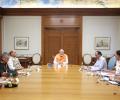
Prime Minister Narendra Modi chaired a meeting with top defence officials, including Defence Minister Rajnath Singh, National Security Advisor Ajit Doval and the chiefs of three services, amid India weighing its countermeasures following the Pahalgam terror attack which left at least 26 civilians, mostly tourists, dead. Modi has vowed to pursue the terrorists behind the attack and their patrons, a clear reference to Pakistan, to the "ends of earth" and inflict harshest punishment on them.
Pakistan's Deputy Prime Minister and Foreign Minister Ishaq Dar has warned India of a strong response, saying Pakistan will respond to a "brick with a stone" if India takes any action against Pakistan, amid heightened tensions following the April 22 terror attack in Jammu and Kashmir's Pahalgam. Dar alleged that India might have staged the Pahalgam attack to abolish the Indus Waters Treaty (IWT) and warned that any attempt by India to interfere with the treaty would be considered an act of war. He also said that Pakistan had no involvement in the Pahalgam incident and is getting support from countries like Saudi Arabia, China, the United Arab Emirates, the United Kingdom, Kuwait, Bahrain, and Hungary.
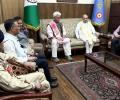
Union Home Minister Amit Shah arrived in Srinagar to review the security situation in Kashmir following a deadly terror attack in Pahalgam that killed 26 people, including tourists. Shah chaired a high-level meeting of security officials, including those from the Army, CRPF, and police. The attack, claimed by The Resistance Front (TRF), a shadow group of the banned Pakistan-based Lashkar-e-Taiba (LeT) terror group, is the deadliest in the valley since the 2019 Pulwama strike.
'You can be sure that the Pakistanis knew when the Indian Air Force aircraft took off, which type these were, and what their likely targets were.' 'The question was: How would they determine that the IAF wanted to fire, and when to bounce them?', notes Shekhar Gupta.

'Those who call for war from far-off places should realise the repercussions it has on the people who are actually affected.'

Vinubhai Dabhi and his wife Lilaben, residents of Bhavnagar, Gujarat, recounted their harrowing experience during the Pahalgam terror attack in Kashmir. Dabhi was injured by bullets while his wife witnessed the shooting of a young man, Smit Parmar. They both highlight the lack of security presence during the incident.
'Will this near-war, India's strongest military response so far, buy India another seven years of deterrence?' asks Shekhar Gupta.

India on Sunday said it inflicted tremendous losses to the Pakistan military, including downing its fighter jets featuring latest technologies and damaging key military installations close to even capital Islamabad, during the three-day confrontation between the two sides.
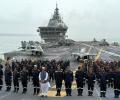
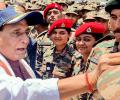
In an interaction with naval warriors on board aircraft carrier INS Vikrant off Goa, Singh sent a stern warning to Islamabad saying India will not hesitate to use the methods to deal with terrorism that Pakistan cannot even think of.

President Pezeshkian on Saturday said that Iran unequivocally denounces such "inhumane acts", Iran's embassy in New Delhi said in a post on X.
UN Secretary-General Antonio Guterres has called for maximum restraint between India and Pakistan following a deadly terror attack in Jammu and Kashmir. Guterres' spokesperson, Stephane Dujarric, said that the UN chief is following the situation "very closely and with very great concern." Dujarric also stated that any issues between the two countries "can and should be resolved peacefully, through meaningful, mutual engagement." India has downgraded diplomatic ties with Pakistan and announced a raft of measures, including expulsion of Pakistani military attaches, suspension of the Indus Water Treaty of 1960 and immediate shutting down of the Attari land-transit post in view of the cross-border links to the terror attack.

Two Al-Badr terrorists, responsible for the recent attacks on migrant labourers in Kashmir, were killed in an overnight encounter with security forces in Pulwama district, the police said on Thursday.
'Diplomatic and economic responses are first announced and then implemented. A military response is announced only after it is done.'

Pakistan has banned Indian-flagged ships from entering its ports with immediate effect after India imposed fresh punitive measures, including a ban on the import of goods and entry of Pakistani vessels into its ports, against Islamabad amid heightened tensions following the Pahalgam terror attack. The move comes after India announced a raft of punitive measures against Pakistan, including the suspension of the Indus Waters Treaty, shutting down of the only operational land border crossing at Attari, and downgrading of diplomatic ties following the terror attack. The Pakistan Army has also conducted a successful training launch of the Abdali Weapon System, a surface-to-surface missile with a range of 450 km, saying it was aimed at ensuring the operational readiness of troops and validating key technical parameters. India considers the test launch of the ballistic missile a "blatant" act of "provocation."
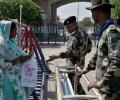
Pakistan Defence Minister Khwaja Asif has admitted the country's history of supporting, training and funding terrorist organisations as 'dirty work' for the West, a mistake for which he said Pakistan had suffered.

In a significant shift, Kashmiris from villages once considered strongholds of militancy have joined the condemnation of the recent massacre of 26 people in Pahalgam, raising slogans against terrorism and expressing solidarity with the victims. This unprecedented display of public sentiment across the valley marks a possible turning point in the region's fight against violence.
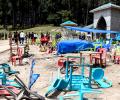
Following the deadly Pahalgam attack, Michael Rubin, a former Pentagon official and senior fellow at the American Enterprise Institute, issued a strong statement and said that 'it is now the duty of India to do to Pakistan and to Pakistan's Inter-Services Intelligence (ISI) what Israel did to Hamas', calling for decisive action against Pakistan's intelligence agency for its alleged role in supporting terrorism.
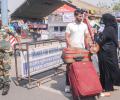
United States Charge d'Affaires Natalie Baker on Wednesday met Deputy Prime Minister and Foreign Minister Ishaq Dar as part of efforts to de-escalate tensions with India following the Pahalgam terror attack on April 22 in which 26 people were killed.
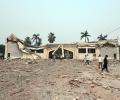
A total of nine terror sites in Pakistan, including five in Pojk, linked to Lashkar-e-Taiba (Let) and Jaish-e-Mohammed (Jem), were targeted with meticulous planning to avoid civilian casualties.
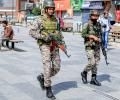
'Pakistan is economically very weak and will not be able to sustain a war for long.'
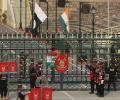
In the India-Pakistan situations, off-ramps have come either through foreign mediation (after months of kinetic warfare over Kargil, and a long stand-off with Op Parakram) or when a situation made it possible for both sides to claim a win, explains Shekhar Gupta.

Constable Reyaz Ahmad Thokar was shot at in Gudoora in the district on Friday morning, a police spokesman said.
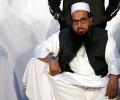
'The fight against terrorism will continue. We have set a new normal and the new normal is that we will follow an offensive strategy. Wherever terrorists are, we have to kill those terrorists and we have to destroy their infrastructure. So it is still not over but as we speak the ceasefire is still intact'
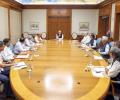
Terrorism and insurgency in J&K had subsided when India demolished East Pakistan -- for the simple reason that Pakistan understands power. We need to follow Chanakya's dictum of Saam, Daam, Dand, Bhed for strategising against Pakistan, asserts Lieutenant General Prakash Katoch (Retd). The ground truth is that unless we are prepared to acknowledge our shortcomings, including massive intelligence failures, punish those responsible and take corrective actions, we will continue in the same vein, asserts Lieutenant General Prakash Katoch (Retd).
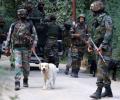
At least four civilians were injured in a grenade attack by militants on security forces in Pulwama district of Jammu and Kashmir on Tuesday.

'We will take all necessary steps to ensure that Abir Gulaal is not released in India.'

'I am the daughter of a martyr and had lost my father in Kashmir in 1994. I understand what drastic circumstances life brings in front of you.'

Union Home Minister Amit Shah said on Friday that the Operation Sindoor undertaken by the Indian armed forces in retaliation for the Pahalgam terror attack has "completely exposed" the fact that terrorism in India is sponsored by Pakistan. Shah also said that the operation showed the "firm" political will of Prime Minister Narendra Modi, the "precise" intelligence inputs from agencies, and the "lethal" capabilities of the armed forces. He added that the operation was successful as it used the correct firepower and achieved its aims besides "showing the reality" to Pakistan.

The terrorists lobbed a grenade at a tent housing labourers at Gadoora village in Pulwama, a police spokesman said.
The United Nations Secretary-General, Antonio Guterres, has called for de-escalation between India and Pakistan, expressing deep concern over rising tensions following a terrorist attack in Jammu and Kashmir. Guterres reiterated his condemnation of the attack and urged both sides to avoid a confrontation, which he described as catastrophic. The Secretary-General has also offered his good offices to support de-escalation efforts. The President of the UN General Assembly, Philemon Yang, has also expressed concern over the escalating violence and called for a resolution through diplomatic means. Meanwhile, Pakistan has denied any involvement in the attack and reiterated its commitment to fighting terrorism.

The attack took place in Pinglana area of the south Kashmir district.
"According to you Congress should guarantee foolproof intelligence to BJP and nothing should be asked of the BJP," Raj said in a post on X.
