
The 51-hour countdown for the 17th flight launch of Indian space agency's Polar Satellite Launch Vehicle PSLV-C 15 from Sriharikota spaceport is expected to begin on Saturday morning."The rocket will put into orbit five satellites remote sensing satellite Cartosat-2B from India, Alsat from Algeria, two nano satellites from Canada and Switzerland, and a pico (very small) satellite called Studsat built by 7 Indian engineering students.
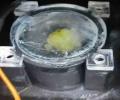
The spinach callus tissue, sent by Amity University-Mumbai to space, has shown signs of growth in the POEM-4 module that is orbiting the earth at an altitude of 350 kms, scientists associated with the experiment said.
The Polar Satellite Launch Vehicle is carrying 1360-kg satellite 'Resourcesat -I'.
India's Polar Satellite Launch Vehicle on Wednesday successfully sent into orbit four satellites, including the Indo-French tropical weather satellite Megha-Tropiques.
India will join an elite group of nations with the launch of a new mission to test re-entry technology, which would be a forerunner to developing reusable vehicles like space shuttles.

India on Wednesday successfully launched a record 104 satellites -- all but three of them foreign--from Sriharikota and put them into orbit in a single mission onboard its most dependable Polar rocket.

The success of the PSLV-C34 mission is a result of ISRO's professionalism and the hard work put in by their scientists over the last many decades., says Ajay Lele.

Why did ISRO's workhorse Polar Satellite Launch Vehicle rocket fail during its 41st flight?
The 44 metre tall four-stage PSLV placed Italian satellite AGILE into orbit at 550 km above the earth.
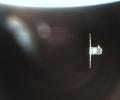
The Indian Space Research Organisation (ISRO) has successfully performed the docking of satellites as part of the Space Docking Experiment (SpaDeX). The docking was achieved after a series of maneuvers, including a trial attempt on January 12. The SpaDeX mission, launched on December 30, 2024, aims to demonstrate in-space docking technology using two small spacecraft. This technology is crucial for achieving complex mission objectives that require multiple rocket launches.
"It is beautiful to see the countryside. There are so many colours. I think I have mentioned that before how colourful it is being in India. From the space, it is the same," she said.

'To access our satellite, you don't need any IQ test, you don't need to write an examination.' 'You can be a Class 1 student, an engineering student, a 60-year-old person, anybody can access our satellite.'
The 50-hour countdown for the launch of Indo-French climate monitoring satellite Megha-Tropiques and three other nano satellites on board PSLV-C18 on October 12 from the spaceport of Sriharikota is progressing well, the Indian Space Research Organisation said.

The two satellites that PSLV will release in the orbit will help the country's mapmakers and amateur radio operators.

Narayanan has a long and distinguished career at ISRO, having played a key role in several important missions, including Chandrayaan-2 and 3, and the Gaganyaan programme.
The 44.5-metre-tall, 295-tonne PSLV-C7 lifted off from the launch pad at 9.24 am.
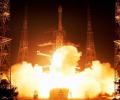
ISRO is part of an exclusive league which has forayed into the Moon and Sun.

'The launch of Nila, our very first satellite was very emotional as well as nerve wracking. We tried to calm ourselves by cracking some poor jokes!'
Indian Space Research Organisation is using the most powerful configuration of its rocket Polar Satellite Launch Vehicle to launch a communication satellite from Sriharikota on July 15, as it braces for the nearly Rs 200 crore mission.
There is a huge spurt in demand to launch smaller satellites, those as light as 1 kg, with a lifespan of two to three years. But there aren't enough rockets to carry these, reports T E Narasimhan
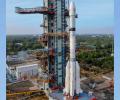
At 6.23 am on 29.1.2025, the 50.9 metre tall and weighing 420.7 ton Geosynchronous Satellite Launch Vehicle-F15 (GSLV-F15) is slated to blast off from the second launch pad carrying the 2,250 kg NVS-02 navigation satellite.
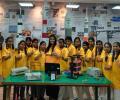
If it becomes a reality, the Chennai-based company will become the first private player from India to conduct such a mission to the lunar surface.
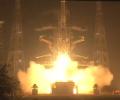
The Indian Space Research Organisation successfully launched its 100th mission on Wednesday, with a GSLV rocket carrying navigation satellite NVS-02.

The primary satellite TeLEOS-2 is a synthetic aperture radar satellite developed under partnership between Defence Science and Technology Agency (DSTA) representing the Government of Singapore and ST Engineering.

Docking technology is crucial for sending people and cargo to space stations.

India's PSLV-C9 blasted off into space, carrying ten satellites including the country's latest remote sensing satellite CARTOSAT-2A, from Indian Space Research Ogranisation's Satish Dhawan Space Centre in Sriharikota on Monday.Scientists cheered as the Polar Satellite Launch Vehicle, in its thirteenth flight, soared into the clear sky in a perfect lift off at 9.23 am from the second launch pad.Besides the 690 kg CARTOSAT-2A, the PSLV is also carrying Indian Mini Satellite.

The Indian Space Research Organisation (ISRO) is set to welcome the new year with the launch of its first X-Ray Polarimeter Satellite that would offer insights into celestial objects like black holes, onboard a Polar Satellite Launch Vehicle rocket on Monday.
The Polar Satellite Launch Vehicle PSLV-C15 carrying five payloads, including India's remote sensing satellite Cartosat-2B, successfully lifted off from the spaceport in Sriharikota on Monday.

On Sunday, July 30, 2023, the Indian Space Research Organisation successfully launched its proven Polar Satellite Launch Vehicle rocket carrying seven Singapore satellites from the Satish Dhawan Space Centre in Sriharikota and placed them into intended orbits.

The Indian Space Research Organisation (ISRO) successfully launched its third and final developmental flight of Small Satellite Launch Vehicle here on Friday whose payloads can be used in applications like satellite-based surveillance, disaster and environmental monitoring, fire detection, volcanic activity among others.
For carrying the 360-kg Italian satellite, meant for astronomical studies, Indian Space Department's commercial wing Antrix Corporation would receive a fee from the Italian space agency.
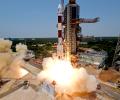
The successful launch of Aditya-L1 - the country's maiden mission to study the Sun - is expected to garner increased investor interest in the Indian space sector and trigger more funding for private players. Several private sector players, including Larsen & Toubro (L&T), MTAR Technologies, and Ananth Technologies, have played a pivotal role in the Indian Space Research Organisation's (Isro's) solar observatory mission. Aditya-L1 on Saturday set off on a 125-day journey on a PSLV-C57 rocket, in its attempt to study various elements relating to the nearest star from the halo orbit around Lagrange point 1 (L1) of the Sun-Earth system, which is about 1.5 million km from Earth.
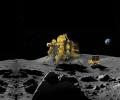
In a boost to the space programme, the government on Wednesday approved the Chandrayaan-4 mission to bring back moon rocks to earth, to send a spacecraft to orbit planet Venus and to expand the Gaganyaan project to build an Indian space station.

Once deployed and operational, it will be used to support the satellite imagery requirements of various agencies within the government of Singapore.

Weighing 320 tonne at lift-off, the vehicle used larger strap-on motors to achieve higher payload capability.

'With India's growing capabilities in the space sector, this creates promising opportunities for enhanced collaboration and market access.'

The successful launch of the maiden solar mission of the Indian Space Research Organisation came on the heels of the historic lunar landing mission - Chandrayaan-3.
The Indian Space Research Organisation (ISRO) on Monday successfully launched its maiden X-Ray Polarimeter Satellite that would offer several insights into celestial objects like black holes.

Indian Space Research Organisation (ISRO) will conduct three more test vehicle missions under the ambitious Gaganyaan programme after the maiden TV-D1 test flight, which is scheduled on October 21, the space agency's chairman S Somanath has said.
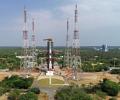
Days after landing on the Moon, India will aim for the Sun on Saturday with its maiden solar expedition, as ISRO's trusted PSLV will carry the Aditya L1 mission on a 125-day voyage to the Sun.
