US strikes on Iran's three main nuclear facilities have once again raised concerns that Tehran might shut down the Strait of Hormuz - one of the world's most critical chokepoints, through which a fifth of global oil and gas supply flows.

The Reserve Bank of India (RBI) and the central government have introduced a package of measures, including tax exemptions for FPIs on government securities and a concessional foreign-exchange swap facility, aiming to attract up to $50 billion in foreign capital. This initiative is designed to strengthen India's balance of payments and potentially cover the projected BoP gap for FY27.

Iranian Foreign Minister Abbas Araghchi said his trip to Islamabad was "very productive" and involved "good consultations" with Pakistan's top leadership amid uncertainty over the second round of peace talks to resolve the war in West Asia.
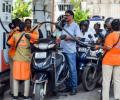
Over the past two decades, India has witnessed several major petrol price hikes, driven by global crude oil fluctuations, economic crises, currency depreciation and geopolitical conflicts. How did we get from Rs 34 to over Rs 100 today

This sharp Iranian response came after a series of uncompromising remarks from the US president.

Karex, the Malaysian company that makes roughly one in five of the world's condoms -- about five billion a year, supplying Durex and Trojan among others -- announced this week that it is raising prices by up to 30 percent. The reason is the Strait of Hormuz.

Pakistan is set to host a quadrilateral summit of foreign ministers from Saudi Arabia, Egypt, and Turkiye to discuss the ongoing conflict in West Asia and explore avenues for peace negotiations.

United States President Donald Trump has issued a strong warning to Iran, asserting that any attempt to impede the transit of petroleum through the Strait of Hormuz would be met with massive military retaliation.

Indian benchmark equity indices, Sensex and Nifty, experienced a decline in early trade, ending a three-day rally, primarily due to heavy selling in IT stocks and concerns over prolonged instability in West Asia.

The Indian rupee depreciated by 32 paise to close at 92.83 against the US dollar, influenced by escalating global tensions, particularly the US-Iran conflict, and the deadline for the RBI's instructions to banks to curb overnight positions.

Iran has blamed the US for disruptions in oil and gas shipping through the Strait of Hormuz, citing 'destabilising actions' as the cause amid the ongoing West Asia conflict and rising energy prices.
Despite ongoing tensions in West Asia, the successful arrival of the LPG carrier 'Nanda Devi' in Gujarat ensures a steady supply of liquefied petroleum gas to India, highlighting the country's efforts to secure its energy needs.

Dozens of US planes carrying ammunition landed in Tel Aviv, raising concerns about potential strikes on Iran. Negotiations between the US and Iran remain deadlocked over key issues, with both sides issuing fresh demands and warnings.

Indian companies, however, are now paying a premium of $6-$7 a barrel for Russian oil, compared with discounts of $8-$10 a barrel before the start of the conflict.

Direct talks between the US and Iran, mediated by Pakistan, have failed to produce an agreement after 21 hours of negotiations, with disagreements over Iran's nuclear ambitions and sanctions proving insurmountable.

Bessent indicated that the U.S. is evaluating the status of Iranian oil as the current campaign progresses.

India imports nearly 60 percent of its LPG, with most cargo previously coming through the Strait of Hormuz, now closed for commercial shipping.

The US and Iranian delegations left Pakistan after failing to reach an agreement in historic talks aimed at resolving the West Asia conflict and stabilising global energy markets.

Indian markets on Dalal Street rallied sharply as easing tensions in the US-Iran conflict and stable oil prices boosted sentiment. Track Nifty 50 and BSE Sensex performance and key global triggers.

The United States Central Command (CENTCOM) has confirmed the implementation of a naval blockade on Iranian ports, enforcing strict measures on vessels entering or departing, significantly escalating tensions between the two nations.

The United States has announced new sanctions targeting Iran's 'shadow oil economy,' accusing Tehran of using illicit oil revenues to fund the Islamic Revolutionary Guard Corps (IRGC) and its regional activities.

Iranian foreign ministry spokesperson Esmaeil Baghaei said that the country has held no "direct" talks with the United States as of now and added that it has received messages through some mediators regarding the US' desire for negotiations.

Facing escalating threats from the US, Iran is mobilizing its citizens to form 'human chains' around power plants as a defensive measure against potential airstrikes, raising concerns about international law and civilian safety.

The US has seized an oil tanker, 'Skywave', linked to Iran in the Indian Ocean, as part of efforts to disrupt Iran's oil shipments and enforce sanctions. The vessel was part of a network transporting sanctioned Iranian crude oil, with the seizure occurring amid heightened tensions between Washington and Tehran.
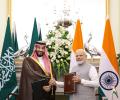
Prime Minister Narendra Modi spoke with Saudi Arabia's Crown Prince Mohammed bin Salman about the ongoing conflict in West Asia, emphasising the need to ensure freedom of navigation and secure shipping lanes.

Addressing the 36th extraordinary session of the Council of the International Maritime Organisation (IMO) held on Thursday in London, the Indian envoy said, "India remains deeply concerned about the evolving situation and continues to call for de-escalation through dialogue and diplomacy, with utmost restraint and priority being given to the safety of civilians."

External Affairs Minister S Jaishankar addresses the Indian Ocean Conference, expressing deep concern over the West Asia conflict and its economic repercussions on energy, trade, and food security. India calls for a swift return to peace and opposes targeting civilians and infrastructure.

Representative of Iran's Supreme Leader in India, Abdul Majid Hakeem Ilahi, expressed doubts about the United States' intentions regarding negotiations, citing conflicting actions and a desire to force Iran into accepting US demands.
Foreign Ministers from Saudi Arabia, Egypt, and Turkiye convene in Pakistan for a summit aimed at de-escalating the ongoing conflict in West Asia, with Pakistan actively seeking to broker peace through dialogue and diplomacy.

US President Donald Trump and Chinese President Xi Jinping met in Beijing to discuss a range of issues, including trade frictions and the war in Iran.
Pakistan is hosting a quadrilateral summit of foreign ministers from Saudi Arabia, Egypt, and Turkiye to discuss the conflict in West Asia and explore avenues for peace. The summit includes discussions on regional developments and meetings with Prime Minister Shehbaz Sharif.

Navy Chief Admiral Dinesh K Tripathi revealed that the Indian Navy was on the verge of striking Pakistan during Operation Sindoor following the Pahalgam terror attack, but kinetic actions were stopped. He also discussed the impact of the West Asia conflict on maritime traffic.

Indian equities on Dalal Street saw volatility as global market trends and oil price hike impacted investor sentiment. Track Sensex, Nifty50 movement and key market drivers for Apr 23, 2026.

An Indian-flagged crude oil tanker, Jag Laadki, safely sailed from the UAE's Fujairah port despite an attack on the terminal and is scheduled to reach India. The Indian government is working to ensure the safe passage of remaining Indian-flagged vessels in the region.

India's fertiliser subsidy bill is projected to increase by approximately 70,000 crore, reaching around 2.41 trillion in FY27, primarily due to rising import costs exacerbated by the ongoing West Asia crisis.

The Sri Lankan government attributes the sharp depreciation of the rupee against the US dollar to the ongoing conflict in West Asia, citing increased costs for essential imports like gas, fertiliser, and oil.

US President Donald Trump will visit China from May 13 to 15 at the invitation of President Xi Jinping. The visit occurs amidst global tensions, including the war in West Asia and trade disputes between the US and China. Discussions are expected to cover China-US relations, world peace, and economic issues.

Gold and silver prices saw a significant decline in the national capital, with silver falling by Rs 7,800 to Rs 2.43 lakh per kilogram and gold by Rs 1,500 to Rs 1.54 lakh per 10 grams, as investors booked profits amid persistent doubts over the durability of the West Asia ceasefire.

British Prime Minister Keir Starmer contacted US President Donald Trump to express his relief following a shooting incident near the White House Correspondents Dinner. The leaders also discussed the need to restore freedom of navigation in the Strait of Hormuz.
Indian benchmark equity indices, Sensex and Nifty, snapped a three-day rally, tumbling nearly 1 per cent due to heavy selling in IT stocks, a jump in crude oil prices, foreign fund outflows, and fears of prolonged instability in West Asia.
