
A Delhi court has affirmed that travelling abroad is an integral part of Fundamental Rights, allowing a woman accused in a money laundering case to visit Thailand for her children's summer vacation. The court balanced her right to travel against the risk of her fleeing justice, finding no evidence to suggest she would abscond.

'Why can't we work towards a dignified end of the person when a cure is not possible and the end is inevitable?'

Private schools failing to provide these facilities risk de-recognition

The Supreme Court of India has directed all states and Union territories to operationalise a single helpline number '112' for emergency responses and establish a functional good samaritan grievance redressal system within three months, emphasising that the right to trauma care is an integral part of the right to life.

Double Olympic medallist shooter Manu Bhaker has voiced her concern over student protests against alleged exam paper leaks, advocating for every child's fundamental right to education, safety, and a fair chance at life. She emphasised that the issue transcends politics and demands greater accountability to protect the nation's future.

The Supreme Court of India has affirmed that the right to live with dignity includes the right to live without the threat of harm from stray dogs, dismissing petitions seeking to overturn earlier directives on relocation and sterilisation.

Spain winger Lamine Yamal has been appointed as a UNICEF Goodwill Ambassador, becoming one of the youngest footballers to take on the global role ahead of the FIFA World Cup 2026.
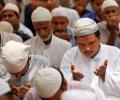
The All India Muslim Personal Law Board (AIMPLB) announced a nationwide movement against the 'deteriorating condition' and social and political marginalisation of Muslims in India, citing concerns over mob violence, demolition drives, and attempts to impose Vande Mataram.

The Supreme Court has admitted that it had violated fundamental rights of citizens during the 1975 Emergency. The observation was made by the court which in an unprecedented move commuted to life imprisonment the death sentence, earlier upheld by it, of a man who murdered four members of a family.
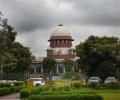
The Supreme Court of India has agreed to examine a constitutional challenge regarding gender discrimination within Parsi personal law, specifically focusing on whether a Parsi woman loses her religious identity upon marrying outside the community.

In 1954, a bench of eight Supreme Court judges declared that the Constitution-makers did not recognise the Fundamental Right to Privacy. It is hoped that a larger bench as and when constituted will uphold the Right to Privacy as a Fundamental Right overruling the 1954 decision, says the distinguished lawyer, P P Rao.

Wipro Technologies has issued a statement affirming its commitment to employee welfare and a safe workplace, stating it is fully cooperating with authorities regarding allegations of religious harassment, workplace discrimination, and forced resignation made by a former woman employee in Pune.
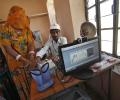
The top court rejected the Centre's vehement contention that there was no general or fundamental right to privacy under the Constitution.

The Centre had termed privacy as a 'vague and amorphous' right which cannot be granted primacy to deprive poor people of their rights to life, food and shelter.
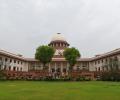
The Supreme Court of India is hearing petitions related to discrimination against women at religious places, including the Sabarimala temple in Kerala, and the scope of religious freedom practised by multiple faiths.

A 23-year-old British Sikh man has been sentenced to life imprisonment for the murder of a teenage student in Southampton, with the judge highlighting the racial tensions the case has ignited across the UK.
Privacy is liberty itself. And in ruling on it, the Supreme Court must not only seize the concerns of today but also gaze into the future, says Apar Gupta.
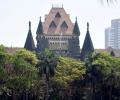
The Bombay High Court has questioned the denial of furlough to prisoners convicted under special Acts, citing a potential violation of fundamental rights. The issue has been referred to a larger bench due to conflicting previous judgments.

The Supreme Court of India has permitted euthanasia for rabid, incurably ill, or demonstrably dangerous stray dogs to mitigate the threat to human life. The ruling includes several directives to manage the rising stray dog population, emphasising public safety and animal welfare.
The Bombay High Court has referred to a larger bench the question of whether the state can deny furlough to prisoners convicted under special statutes like MCOCA and POCSO, citing potential violations of fundamental rights.

AG Venugopal asserted that right to privacy could not be bundled as a single right in a developing country like India where a few persons, claiming right to privacy, override the fundamental rights of 60-70 million people, who did not have access to basic amenities like food and shelter.

A row has erupted over former Union minister Maneka Gandhi's appeal to the Jain community to stop using 'picchis' (sacred broom) made of peacock feathers, claiming that their demand fuels illegal wildlife trade.

Harish Rana, the first person in India to be granted passive euthanasia, has died at AIIMS-Delhi after being in a coma for over 13 years. His case led to a landmark Supreme Court judgment allowing passive euthanasia and sparked discussions about the right to die with dignity in India.

The Bombay High Court overturned the conviction and death sentence of a man in a 2017 rape and murder case, citing a violation of his fundamental right to a fair trial due to lack of legal representation. The court ordered a fresh trial, emphasising the need for a fair process for both the accused and the prosecution.

WhatsApp is finally letting you hide your phone number behind a custom username. While it's a massive win for privacy, cybersecurity experts warn it could unleash a wave of identity scams. Here is what you need to know.
The Supreme Court of India has granted permission for passive euthanasia for a 32-year-old man who has been in a coma for over 12 years, authorising the withdrawal of his artificial life support.

Harish Rana, the first person in India to be granted passive euthanasia, has died at AIIMS-Delhi after being in a coma for over 13 years. His case led to a landmark Supreme Court judgment allowing passive euthanasia and sparked discussions about the right to die with dignity in India.

Through his commitment to democratic norms, debate, dissent and constitutionalism, Jawaharlal Nehru helped ensure that parliamentary democracy took deep root in independent India. Utkarsh Mishra evaluates Nehru's 17 years as India's first prime minister, examining his role in nation-building, democratic institution-building, economic planning, scientific advancement and foreign policy.
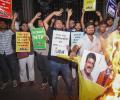
The Supreme Court on Monday said it was sad that National Testing Agency has not learn lessons from the earlier NEET paper leak as it sought response from the Centre, NTA and Central Bureau of Investigation on pleas for replacement of the testing agency with a robust and autonomous body to conduct the medical entrance exam.
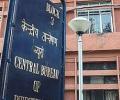
The Calcutta High Court has granted conditional bail to Sudipta Sen, the main accused in the multi-crore Saradha ponzi scheme, after 13 years of detention. The court cited the right to a speedy trial and Sen's prolonged detention as key factors in its decision.

The Bombay high court on Friday said all prisoners had a fundamental right to access their own medical records.

Prime Minister Narendra Modi on Sunday used two major public engagements in Kolkata to outline a broader vision for India's future -- one rooted in inner balance and collective well-being through yoga, and the other in national self-reliance and maritime strength.

We don't want 2 gay men holding hands walking on Marine Drive Marine Drive should be disturbed by the police'
The Delhi High Court has affirmed that consenting adults have the constitutional right to marry, and no one, including family or the state, can interfere with their decision. The ruling came in response to a petition from a couple seeking protection from the woman's father.
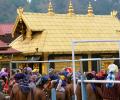
The Shabari story in the Ramayana found mention before a nine-judge constitution bench of the Supreme Court on Wednesday while hearing petitions related to discrimination against women at religious places, including the Sabarimala temple in Kerala.

Michel Danino, one of the NCERT academics previously barred by the Supreme Court over a controversial chapter on the judiciary, maintains the content was 'correct' and defends its inclusion in the textbook.
Congress MP Renuka Chowdhury has filed an adjournment motion in the Rajya Sabha to discuss the government's directive on pre-installation of the Sanchar Saathi App in new mobile handsets, citing privacy concerns.

Sri Lanka commemorated the 7th anniversary of the Easter blasts, with Archbishop of Colombo Malcolm Cardinal Ranjith urging authorities to investigate individuals directly or indirectly involved in the deadly attacks, irrespective of their status.

The Supreme Court has directed the Centre to rationalise airfares and provide relief to flyers, highlighting discrepancies in pricing for the same routes and airlines. The court is addressing a plea seeking a robust regulator to ensure transparency and passenger protection in the civil aviation sector.

The Delhi high court is reviewing a petition to remove journalist Rana Ayyub's tweets, and seeks her stand on a petition seeking the removal of the allegedly objectionable content from social media.
