
Amid escalating tensions with Iran, President Trump is urging nations dependent on Middle Eastern oil to deploy warships to the Strait of Hormuz to safeguard critical global energy supplies.

Trump has made it clear: the US will not lift its blockade of Iranian ports until a deal is signed.

The question is no longer whether the war will expand. It has. The next few days will tell us whether the war stabilises around Hormuz or whether the Strait itself becomes the trigger for a far larger rupture. What to watch for over the next 48 hours is simple: Any move by the US toward direct naval control of the Strait; any credible Iranian attempt to disrupt or mine shipping lanes and, critically, whether energy infrastructure in the Gulf continues to be targeted.If those lines are crossed in tandem, the war will no longer be containable within the region.

In this exclusive interview with Rediff.com's Suman Guha Mozumder,Time International's new Editor Bobby Ghosh discusses Iraq, India and the New Journalism.
A fascinating conversation with one of the world's finest reporters.

'I am a great believer that print will not disappear. The two medium will continue to evolve and reinforce each other,' says Christine Brendle, MD, Wall Street Journal Asia.

'Disengagement is merely the first step in a lengthy process of arriving at a new normal along the LAC in Eastern Ladakh and the entire land boundary.' 'The Indian government should insist on the restoration of the status quo ante in Eastern Ladakh.'

At this poignant historic moment one can only wish that institutions are not built by bricks and mortars, but also by the rich Parliamentary traditions which have stood the test of time which needs to be strengthened by all stakeholders, notes Rup Narayan Das, a former joint secretary of the Lok Sabha Secretariat.

The National Security Strategy document should flag all major issues concerning security strategy and provide guidelines to concerned departments to work out suitable action plans. Since the global and regional geopolitical canvas is dynamic, the NSS document should be deliberated at length before formulation and should be reviewed periodically, recommends Commodore Venugopal Menon (retd).
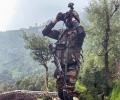
Pakistan may want to undertake a 'false flag' operation in J&K to divert attention from the situation in Balochistan and Khyber Pakhtunkhwa but infiltrating one SSG battalion into J&K and having two SSG battalions waiting to follow suit means war, which Pakistan cannot afford in its current economic crisis, notes Lieutenant General Prakash Katoch (retd).

Singh, accompanied by Army Chief Gen Manoj Pande, also carried out a comprehensive review of India's military preparedness along the Line of Actual Control (LAC) in Arunachal Pradesh and lauded the troops for guarding the border with "unwavering commitment and unparalleled courage."

The meeting on the sidelines of the Shanghai Cooperation Organisation Summit in Bishkek is their first interaction after Modi's re-election following the stunning victory of the BJP in the general elections last month.

Even as the bilateral relationship between the two neighbouring countries remains hostile, there is growing coordination between India and Pakistan on one multilateral forum - the World Trade Organization (WTO). Both countries have made two joint submissions at the WTO as co-sponsors in the past two months. In June, Pakistan joined India, Cuba, and 44 African countries, seeking sufficient flexibility in intellectual property rights for developing countries to fight the Covid-19 pandemic.
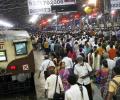
Our industrial-era mindset prevents many business leaders from throwing away the fancy access cards that dock an employee's pay if they haven't put in nine hours at work.
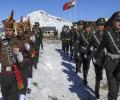
The Chinese government had "planned" the Galwan incident in June even as Beijing ramped up its multiyear coercion campaign against its neighbours, provoking military or paramilitary standoffs with countries from Japan to India, the United States top panel said in its report released on Wednesday.
The combination of sanctions, and low fuel prices is really hurting the Putin regime.
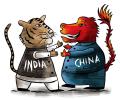
India and China achieved a major milestone this year when their bilateral trade crossed the landmark figure of $100 billion but it did not generate any fanfare in both capitals as the two Asian giants are going through a "particularly bad patch" in their relations due to a set of actions by Beijing in violation of agreements that led to the military standoff in eastern Ladakh. Starting with a modest $1.83 billion in 2001, the bilateral trade crossed $100 billion-mark in the first 11 months this year, a significant milestone for which the two countries carried out campaigns to boost trade and build it as a major stakeholder to improve the relations between two nations, whose ties otherwise remained frosty over the festering boundary dispute and strategic rivalry. According to last month's data from China's General Administration of Customs (GAC), the India-China bilateral trade totalled $114.263 billion, up 46.4 per cent year-on-year from January to November 2021.

The ministry's year-end review is silent on the continued occupation by Chinese troops of territory that India has always claimed and patrolled.

We knew from the moment the pandemic took hold that this would be a long haul -- at least 12 to 18 months. Nothing should have changed that assessment, says Mihir S Sharma.
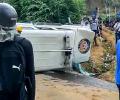
The bandh, called by Barak Democratic Front and supported by political outfits including opposition AIUDF and social organisations, was "total" and there was no report of any untoward incident from any district, another official said.
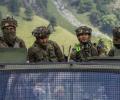
'A breakthrough in eastern Ladakh leading to disengagement and creation of a buffer zone will obviate the need of military deployment through the winter months ahead,' notes Ambassador M K Bhadrakumar.

Weidong said India and China "should live in peace and avoid conflicts."
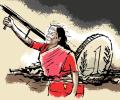
If Nirmala Sitharaman does indeed present a 'never-before' like Budget on February 1, going by her promise, she would create a new benchmark for post-contraction Budgets, observes A K Bhattacharya.

India's doctrinal policy shift in combating terror by carrying out the Balakot air strikes inside Pakistan, appointment of a Chief of Defence Staff and hastening work on military modernisation marked a new beginning in 2019 in dealing with complex security challenges.

India must break out of this strategic triangulation between China and Pakistan. We need to settle our issues with one of the two, notes Shekhar Gupta.
A realistic assessment will tell us that not much has changed between India and Pakistan; the relationship remains as fraught as before with little prospect of reconciliation, notes Ajai Shukla.
'Since each chief single-mindedly pursues his service's interests in the competition for turf and in core matters such as budget share. The CDS, therefore, must act as an "honest broker" whose decisions serve the broader national purpose, rather than narrow service interests,' says Ajai Shukla.
Prime Minister Narendra Modi and Home Minister Amit Shah will soon get around to reworking their organisational set-up and administrative priorities to regain lost ground in the wake of the Delhi electoral debacle, but there's third course available to them as well. That is to introduce the presidential form of government, which prime ministers Indira Gandhi and A B Vajpayee flirted with before abandoning it. Will Modi go further than them? N Sathiya Moorthy analyses the scenario.

'The Chinese -- up to the highest leadership -- will avoid a conflict because they know they will be badly licked.' 'The reputation they have painstakingly built over the last two-three decades of being a global power will be destroyed.'

'It is certainly time for New Delhi to open up. Not only should it go ahead at full steam with the roads to the LAC, but the government must also allow tourists to visit these stunningly beautiful areas of Indian territory.'

The savings would be better spent and might actually reach the poor, says Rahul Khullar.
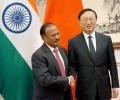
The decision was taken during the annual 19th round of boundary talks in Beijing between National Security Advisor Ajit Doval and his Chinese counterpart Yang Jiechi.

Aseem Chhabra looks at the year's best Non-Hindi Indian movies.

'In the first meeting of this new year, we took a joint new year resolution that we will complete it this year. At the time things were not very clear, but the mood was clear that yes, we must resolve it.' 'Yes, details have to come out, but there are some sensitivities, there are some stake-holders not yet on board, especially other Naga undergrounds etc, we would like them to come on board... So at a proper time it has to be revealed to the country, and to the legislature. Perhaps, we may have to wait for some more time.' 'With better understanding of the Indian system, many of them have learnt, realised, appreciated that Naga nationalist aspirations can be accommodated in the Indian system. The Indian system is pretty comprehensive and flexible.' 'A Naga has as much stake, claim over India as any other Indian. There is no distinction. This, Nagas have realised, that yes, Naga nationalist aspirations and Indian nationalism are not mutually exclusive.' Ravindra Narayan Ravi, the Government of India's Special Interlocutor for the Naga talks, explains how the Naga Peace Accord was reached in an exclusive interview to Saisuresh Sivaswamy/Rediff.com
 © 2026 Rediff.com - Advertise with us - Disclaimer - Privacy Policy - Sitemap - Feedback - About us - Terms of use - Grievances