
Sebastian Rotella, the award-winning reporter relentlessly exposing the David Headley case, in an exclusive interview with Rediff.com's Vicky Nanjappa.
US federal prosecutors have released interrogation tapes of admitted Pakistani-American terrorist David Headley, who helped plot the November 2008 Mumbai terror attacks, after a Chicago judge's order.
'We will continue to probe the Fahim Ansari angle since there is one stark similarity between him and Headley. Both men were in touch with the man called Sajid Mir.'
When Tahawwur Rana's defence attorneys cross-examine David Headley this week, it's possible that they will severely damage him, or that he will self-destruct on the stand. Investigative journalist Steven Rotella reports for ProPublica.org on the Lashkar operative's credibility problems
David Headley, the Lashkar-e-Tayiba operative who was arrested by the FBI in October, is proving to be an important link in unraveling the terror network. Intelligence Bureau agents have informed the Mumbai police that Headley made several visits to the city. The Mumbai police is now probing Headley's links with the 26/11 terror attacks.
India is yet to receive the final nod from US to interrogate David Headley, but Indian intelligence officials are already ready with their list of questions for the Lashkar-e-Tayiba operative.

'I am convinced Headley was working for the Americans, for the FBI. I had nicknamed him agent Headley,' Rahul said in an interview to UK's Channel 4.
The United States administration on Friday said the 35-year sentence without parole imposed on Lashkar-e-Tayiba terrorist David Headley, one of the Mumbai terror attack plotters, marks another step in its efforts to bring to justice those responsible for 26/11.
United States President Barack Obama's top counter terrorism adviser has listed David Headley, the 26/11 terror attack convict, among the high-value targets arrested by the US in the last four years.
Intelligence sources tell Vicky Nanjappa/Rediff.com how investigators overlooked an important aspect of the 26/11 case. A key suspect, who helped Pakistani-American terrorist David Headley gather information for the 2008 Mumbai attacks, has never been captured.
NIA sources told rediff.com that Headley is wanted for larger crimes in India and the concept of dual sovereignty is being quoted in the latest bid to extradite or at least question him once again.
As David Headley appeared before the court for his sentence hearing, American victims of the Mumbai terror attack said it would be an outrage if he was let off with just a 35 year imprisonment for his involvement in the massacre of 2008.
Pakistani-American Lashkar-e-Tayiba terrorist David Headley, who "unquestionably contributed" to the Mumbai attacks that claimed 166 lives, was sentenced by a Chicago court
'The bond between Rahul and David was a powerful one. While Rahul saw a father figure in Headley, the latter saw Rahul only as a codename for Mumbai. Rahul had spent approximately 1,000 hours with Headley and planned to spend more, when Headley was finally busted in the US. Rahul was devastated. He had lost a father figure for the second time in his life...' Exclusive excerpts from S Hussain Zaidi's latest book, Headley and I.
In the third of the four-part series ProPublica's Sebastian Rotella reveals how the United States continued to believe that David Headley was an informant, even after receiving complaints from two of his wives about his radicalisation and his Lashkar-e-Tayiba links. The US State Department communicated the warnings to the CIA and FBI, but it remains unclear why they failed to act upon it.

Here is how Headley became an 'international' terrorist from being a nondescript
All governments indulge in spin. One should not, therefore, blame the government of Dr Manmohan Singh for indulging in spin in the case of David Coleman Headley, of the Chicago cell of the Lashkar-e-Tayiba, and for trying to mislead the hapless Indian public with the help of obliging journalists that the plea bargain entered into by the Federal Bureau of Investigation with Headley was not a setback, but a great triumph for Indian diplomacy.

If the radical Islamic movement had been largely peaceful, Headley would have probably found another way to ensure real life excitement.' 'But I really do believe that his relationship with radical Islam is real. Very real.' 'It was a match for his desires.'

Here's what Headley told the court on Thursday:
The Headley case highlights that the Indian government proved incapable of assessing the geopolitical dimensions of the US-led war in Afghanistan, while Pakistan has shrewdly exploited the fallacies in India's foreign policy orientation to navigate itself to an unprecedented geopolitical positioning, writes M K Bhadrakumar.

David Coleman Headley, the Pakistani-American Lashkar-e-Tayiba operative is being deposed before a Mumbai court on Monday through video conference.

Infamous 26/11 reconnaissance operative David Coleman Headley will be questioned again between March 22 and 25.
Pakistani-American terrorist David Headley, who confessed to plotting the Mumbai terror attacks, had a dual personality that enabled him to switch between a Westerner and a devout Muslim and evade suspicion, according to his maternal uncle. "It could not have been more different between the two worlds. In one world, where he wants to be Pakistani, he was considered to be an American. With Americans, he was being seen as a Muslim. So he had to get used to a duality of life."
A United States lawyer representing Tahawwur Hussain Rana, an accused in the Mumbai terror attacks, has said that the Pakistani-Canadian has been "betrayed" by his friend David Headley.
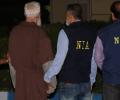
According to the chargesheet, Rana played a crucial role in supporting terrorist David Coleman Headley, a Pakistani-American operative linked to Lashkar-e-Taiba, by facilitating his reconnaissance missions across Mumbai.

While Intelligence Bureau is relying on David Headley's testimony, the CBI is seeking clarification from the NIA, which rejects the claim that Headley spoke to Ishrat Jahan. Vicky Nanjappa reports
Investigators have painstakingly pieced together how American terror suspect David Headley used different people to plan out the 26/11 terror attack.
Tahawwur Hussain Rana, a key accused in the 26/11 Mumbai terror attack case, had helped co-conspirator David Coleman Headley to obtain an Indian visa, a Mumbai police official familiar with the probe said. Rana was arrested by the National Investigation Agency (NIA) on Thursday evening following his extradition from the United States. Rana, who had served in the Pakistan Army medical corps, had emigrated to Canada in the late 1990s and started an immigration consultancy firm. He later moved to the US and set up an office in Chicago. Through his firm, Rana gave cover to Headley to carry out reconnaissance mission in Mumbai prior to the November 2008 attacks and helped him get a ten-year visa extension. During his stay in India, Headley used the front of running an immigration business and was in regular contact with Rana. There were more than 230 phone calls between the two during this period. Rana was also in touch with 'Major Iqbal', another co-conspirator of the attacks during this period, as per the NIA charge sheet. Rana himself visited India in November 2008. As per the charge sheet filed by Mumbai Police against Rana in 2023 in the 26/11 attack case, he lived in a hotel in Powai, and had a discussion about crowded places in South Mumbai with a person who has been listed as a witness in the case. Subsequently, some of these places were targeted by the Pakistani terrorists during the deadly attacks that claimed 166 lives.
Extradition of Lashkar-e-Tayiba terror operative David Headley is an option that India will continue to pursue, Home Minister P Chidambaram said during a press briefing on Monday. Speaking on the contentious issue of the United States not sharing intelligence about Headley with India on time, Chidambaram said, "What the US knew and when they knew about David Headley vis-a-vis 26/11 is a matter under full review in the US. They will share it with us once the review is over."

Tahawwur Hussain Rana, an accused in the 2008 Mumbai terror attacks, has been extradited to India from the US. Former home secretaries believe he will be convicted and could face the death penalty. Rana was an associate of David Coleman Headley, who played a key role in the attacks. The extradition is seen as a significant achievement for India and a message to terrorists that they will face justice. Rana's testimony is expected to provide valuable information about the planning and execution of the attacks.
Pakistani American terror operative David Headley's 'valuable information' to Federal Bureau of Investigation, mapping out Lashkar-e-Tayiba's hierarchy and providing organisational structure of the Pakistan-based terror outfit responsible for the Mumbai attacks, is of interest not only to America but also other countries, according to US prosecutors.
Home Secretary G K Pillai talks to rediff.com's Vicky Nanjappa about the lack of information from the United States on Lashkar operative David Headley
David Headley dominated the discussions between the CIA and their Indian counterparts on Monday.
William said he was in disbelief that his own nephew was connected with the massacre in Mumbai. Headley wrote letters to his uncle from a Chicago jail, addressing him as "Dear Uncle Billy (Mama)". William said Headley had communicated to him that he was doubtful he would be let off, after he was arrested on terror charges in October last year. In a letter dated December 18, 2009, Headley wrote to his uncle that "despite his heritage, he is now a 100 per cent Muslim."
Vicky Nanjappa provides a glimpse of what Rahul Bhatt, filmmaker Mahesh Bhatt's son and a 'witness' in the case against David Headley, revealed during questioning.

Headley, 55, was pardoned on December 10 and made an approver by additional sessions judge G A Sanap who presides over special cases related to terrorism, including those under the now repealed Terrorists and Disruptive Activities (Prevention) Act.
An NIA official, who was part of the team that interrogated David Headley in FBI custody, tells Vicky Nanjappa that the Pakistani-American terrorist was beaming with pride each time they asked him about his association with the Lashkar and also his role in the 26/11 attacks.
"We are burning the midnight oil, working our fingers to the bone," he said, to ensure access to Headley for India, as it was "so important to India, the Indian people, the Indian government."
In a volte-face, the United States has said no decision has been taken on providing India direct access to 26/11 accused David Headley.
Days after Pakistani-American Lashkar-e-Tayiba operative David Headley implicated Inter-Services Intelligence in the Mumbai attacks during his testimony in a United States court, Interior minister Rehman Malik has described him as a convict who has "no credibility and cannot be trusted."
