
The Indian Air Force has launched 'Dronathon 2026' at the Pokhran range in Jaisalmer, a three-day event showcasing advancements in unmanned aerial systems (UAS) and counter-UAS technologies by domestic manufacturers. The initiative aims to bolster the IAF's capabilities in the unmanned domain, align with the 'Atmanirbhar Bharat' objective, and assess indigenous technologies against operational requirements through live demonstrations. It also fosters interaction between the IAF, industry, and even students, promoting the development of scalable unmanned solutions.

Scientists are examining how a possible glacial collapse and ice-rock avalanche may have triggered the devastating flash floods along Nepal's Bhote Koshi River, with preliminary assessments indicating that debris may have temporarily blocked the Lhende River and created a landslide dam that subsequently gave way.
The Indian Air Force (IAF) demonstrated 'Vayu UTtaM', an indigenously developed multi-mode Unmanned Traffic Management (UTM) system, at 'Dronathon 2026' in Pokhran. This ground-based system is designed to manage drone operations in congested airspace and identify rogue drones, with applications extending to critical infrastructure, civil aviation, and public safety. The event also saw the release of the 'IAF UAS Roadmap' to guide indigenous innovation in unmanned systems.

Chief Justice of India Surya Kant stated that while artificial intelligence (AI) can augment judicial reasoning, it cannot substitute judicial conscience, and a permanent apex body is proposed to supervise AI adoption and accountability within the judiciary.

'The trigger for the flood was definitely natural, but the damage that it caused was human-made.'

Prime Minister Narendra Modi, addressing the SCO summit in Bishkek, called for a united front against terrorism and its financing, rejecting double standards. He emphasised resolving conflicts through dialogue and diplomacy, not battlefields. Modi also highlighted that connectivity projects must respect national sovereignty and territorial integrity, a veiled reference to China's Belt and Road Initiative. India's vision for SCO rests on security, connectivity, and opportunity.

Japan is deepening its defence relationship with India while simultaneously expanding its economic, infrastructure and security engagement with countries around India -- particularly Bangladesh. The result is an emerging Japanese conception of South Asia in which India remains the strategic anchor, but the geography surrounding India is becoming increasingly important, points out Varun Arya.

The H-1B visa once symbolised the American Dream for Indians, but today's students are increasingly asking whether they need America at all. In 1995, the question was: How do I get to America? In 2026, it may be: Do I need to?

Punjab Governor Gulab Chand Kataria has called upon schools to play a proactive role in safeguarding youth from drug abuse. He emphasised the role of educational institutions in the statewide anti-drug campaign and criticised the neighbouring country for allegedly pumping drugs into Punjab.
History may remember Takaichi Sanae not as the leader who simply accelerated Japanese rearmament, but as one who governed during Japan's transition from an industrial-age security model to a post-industrial strategic member of the global order, points out Varun Arya.

West Bengal minister Agnimitra Paul defended the detailed application form for the Annapurna Yojana scheme, stating it ensures benefits reach only Indian citizens. She also announced stringent waste-related penalties and a 'Swachh App' to improve urban cleanliness.

India could start some element of military training for its youth, especially in border areas, but compulsory training on the lines of Russia and other countries is ruled out.

A lesson for India is to clearly define objectives beforehand, so that the adversary or other parties do not attempt to mitigate them midway.
A new MoU between the Centre for Cellular and Molecular Platforms (C-CAMP) and Imperial College London has paved the way for deepening India-UK ties in the life sciences sector.

A combination of security pressure and rehabilitation efforts has significantly weakened Naxalism in India, leading to numerous surrenders and the elimination of key leaders.

'Should China's interest in the Teesta River projects be approved, it would likely result in heightened Chinese presence near the Siliguri corridor.'
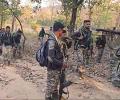
The Madhya Pradesh government promoted 60 police personnel for their role in anti-Naxal operations, celebrating the state's success in eradicating Maoist influence.

'The watershed moment was June 22, 2024, when the divisional in-charge of Gadchiroli, Giridhar Tumreti, who was their senior-most commander, along with his wife, came forward to surrender before the then deputy chief minister and home minister Devendra Fadnavis.'
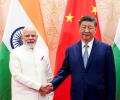
'What's currently underway is not a 'reset'.' 'What needs to be arrived at is a new balance.'

The interim budget 2024-25 on Thursday allocated Rs 202868.70 crore to the Ministry of Home Affairs (MHA) with the highest share of funds going to the paramilitary forces like Central Reserve Police Force (CRPF), Border Security Force (BSF) and Central Industrial Secular Force (CISF), showing priority on internal security and border guarding.

The peace plan included that Gaza will be a deradicalised, terror-free zone that does not pose a threat to its neighbours and will be redeveloped for the benefit of the people of Gaza. The peace plan stated that if both sides agree to this proposal, the war will immediately end. Israeli forces will withdraw to the agreed upon line to prepare for hostage release.

Union Home Minister Amit Shah has announced that India will soon create a comprehensive anti-drone unit to secure its borders. He highlighted the increasing threat posed by drones, especially along the India-Pakistan border, and emphasized a 'whole of government' approach to tackle this issue. Shah also spoke about the ongoing Comprehensive Integrated Border Management System (CIBMS) and the Modi government's Vibrant Village Programme, which aims to develop and integrate the population of northern borders.

The district-level standing committee on security met under the chairmanship of deputy commissioner, Jammu Sachin Kumar Vaishya, the spokesman said.

China plans to build a new highway along the Line of Actual Control (LAC) with India as part of Beijing's efforts to strengthen its strategic position and project its power, a media report said on Wednesday.
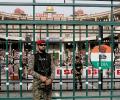
India registered its protest at the board of IMF, which met on Friday to review the EFF lending programme for Pakistan.

'The biggest game changer has been the belief among Maoists that they can surrender and join the mainstream'

The era when anyone could encroach on India's land has passed and no one can dare to eye its border, Home Minister Amit Shah said in Kibithoo, Arunachal Pradesh, on Monday.

Lt Gen Kalita also stated that the Army is constantly monitoring the activities across the border and is well prepared to meet any emerging challenges.

The ministry has got Rs 1,03,927 crore for 2019-20 which is 4.9 per cent more than Rs 99,034 crore given in 2018-19.
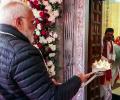
Prime Minister Narendra Modi visited the Mukhwa temple in Uttarakhand, the winter abode of Goddess Ganga, and offered prayers. The visit is expected to boost winter pilgrimage and tourism in the state. Modi also flagged off a trek and bike rally and addressed a public meeting in Harshil. This comes a day after the Cabinet Committee on Economic Affairs approved two major ropeway projects to Kedarnath and Hemkund Sahib worth over Rs 6,000 crore.

Chief of defence staff Bipin Rawat on Thursday said the controversy about the Chinese coming into the Indian territory and building a new village is 'not true,' and that the villages were well within the Chinese side of the Line of Actual Control.

The Ayush ministry has been roped in by the BSF for the project. The ministry has provided the border-guarding force with the beehives and required expertise to fix those on the alloy-made "smart fence".
The move bears significance in view of the increased Chinese activities along the border and transgressions by China's People's Liberation Army (PLA).

Union Home Minister Amit Shah will visit Arunachal Pradesh on April 10 and 11 where he will launch the 'Vibrant Villages Programme' in Kibithoo, a village along the India-China border.

Union Home Minister Rajnath Singh has painted a grim security situation in the country's border with Myanmar and Bhutan where there were reports of insurgents, weapons and drugs crossing over and said that his ministry was taking measures to effectively manage the international borders.

Local residents and even security personnel are using Nepalese SIM cards in border areas of Uttarakhand as no state-owned or private telecom company from India is providing services in the area, raising security issues.

'Still, people are asking why we have not gone for a full-out war. As a military man, if ordered, I will go to war, but that will not be my first choice'
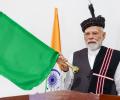
In the last 11 years, India and the world witnessed what he stood for, what he promised and did not deliver, and what he actually stood for and practised without fearing how history would judge him. Modi's tenure has been punctuated with headline-grabbing decisions, symbolic gestures, and stage-managed moments that continue to define his leadership and India's politics, points out Ramesh Menon.
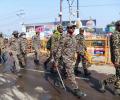
The Union Budget 2025-26 on Saturday allocated Rs 2,33,210.68 crore to the Ministry of Home Affairs with the majority of the fund -- Rs 1,60,391.06 crore -- being given to central police forces like Central Reserve Police Force (CRPF), Border Security Force (BSF) and Central Industrial Security Force (CISF) which are responsible for internal security, border guarding and security of vital installations.
India has planned 14 strategic railway lines in areas bordering China, Pakistan and Nepal, but most of these projects are stuck for want of funds. Anusha Soni reports
