

In the last 11 years, India and the world witnessed what he stood for, what he promised and did not deliver, and what he actually stood for and practised without fearing how history would judge him.
Narendra Modi's tenure has been punctuated with headline-grabbing decisions, symbolic gestures, and stage-managed moments that continue to define his leadership and India's politics, points out Ramesh Menon, author of Modi Demystified: The Making Of A Prime Minister.
It was a bright and quiet Sunday morning in Ahmedabad, sometime in mid-1986, when there was a knock on my door.
I wondered who the solemn-looking elderly men all dressed in white kurta pyjamas were. After they settled down in my living room, they exchanged questioning glances.
After an awkward silence, one of them said, "We do not like what you write in India Today.
"As a correspondent of a highly respected magazine, you need to be more responsible. All your writing reeks of an anti-Hindu stance when you report communal riots. As a Hindu, you have a sacred duty to support us and be on our side."
Not figuring out who they were, I asked. "We are from the Vishwa Hindu Parishad," they said.
"You have got me wrong. I am not a Hindu. I am a journalist. Journalism is my religion, I said plaintively.
Displeased with my response, they suggested I meet a Rashtriyata Swayamsevak Sangh pracharak, who also wanted to speak with me at its headquarters in Ahmedabad. They fixed it for the coming Sunday.
Every meeting was meaningful for me as a journalist, and I was there at the appointed time.
A young bearded man appeared and said, "I am Narendra Modi, one of the pracharaks here."
Modi was not a known figure at that time.
Nobody had heard of him as he was a quiet backroom worker. In a genial tone, he repeated what the VHP activists had told me earlier. I repeated my stand on how I was a journalist and not a Hindu.
He got up, said a polite namaste and bid me goodbye. It was not even a five-minute meeting.
My subsequent encounter was when he was the general secretary of the BJP, and I wanted to interview him for Rediff when his party's top leader, Bangaru Laxman, was caught accepting cash from an undercover Tehelka magazine reporter in a sting operation.
Fifteen years had passed, but Modi remembered meeting me in Ahmedabad.
A day after the interview was published, he called me saying that many NRI supporters had said he had defended the party well.
But that was years ago. Today, Modi does not grant interviews to mainline journalists unless it is one that he wants with his questions and answers.
There is hardly any major media organisation today that is truly independent and dares to ask questions to power.
Modi has not had a press conference in India for more than a decade! He has carried his disdain for the media right from the time he tasted power.
Narendra Damodardas Modi is not an accidental prime minister. He dreamed of becoming one many decades ago as a backroom RSS worker in Gujarat.
Shankersinh Vaghela, one of his long-time Gujarat-based associates and former chief minister, told me that Modi had nursed an ambition to rise to extraordinary heights where he would exercise total power.
On one occasion, when he was asked to go and work in a remote tribal area, he reportedly refused, saying that he was destined to do greater things, recalled Vaghela.
He systematically worked his way to the top, jumping over every hurdle, making calculated moves.
It is difficult to imagine that at one time, the BJP leadership in Delhi asked him to stay away from Gujarat as it felt he was trying to torpedo the tenure of the then chief minister, Keshubhai Patel.
When the massive 2001 Bhuj earthquake devastated parts of the state, sources said Modi told the BJP leadership that Keshubhai had failed to handle the crisis, and the party was bound to lose the next election.
The leadership panicked. Gujarat was the BJP's prize state.
They dispatched Modi to Gujarat to do the firefighting. When the leadership suggested to Modi that he could be a deputy to Keshubhai, he refused, wanting the top job. Ultimately, they had to install him as chief minister.
The rest is history.
When he took over, he was a bit shaky and nervous, unsure of himself. But he learnt fast, took complete control of the party, its finances, his cabinet, and the bureaucracy. But it was still a rocky boat.
However, after the Godhra riots, he emerged as a towering Hindutva icon.
It dramatically changed Modi's public persona as his rhetoric, deportment, and political certainty hardened after Godhra.
The shift from a chief minister to a combative mass leader was clear.
His body language and lexicon changed, and he was sure he would ride victorious in the state elections of 2002.
He did.
One of the first things he did was to shake off the stigma of the riots that killed over 2,000 people by fashioning himself as a development wizard and changing his image by bringing in visible development projects, making voters see the difference.
They were simple ones like the Sabarmati riverfront project, where he got water from the Narmada to flow into a virtually dry and dirty Sabarmati river, creating an attractive plaza on both sides, which were earlier lined with shanties and slums.
This is where he took leaders like Chinese President Xi Jinping, while talks between the two leaders that was billed as a great diplomatic move by Modi to normalise relations.
It is another thing that, at the same time, China was deliberately making incursions into India, claiming the land as its own.
Using autocratic ways, he completely dominated the political scene, decimated the Opposition, and ensured no second rung of leadership in his party evolved.
He wanted to be the one and only leader.
He completely controlled the bureaucracy, and no one dared to challenge or tell him he was wrong. A couple who did not do what he wanted were shunted off and isolated in useless postings, signalling others to fall in line.
They did.
He was a master at optics, plastering his image all over the state on anything and everything possible.
He hated the media and did not meet them or answer queries if addressed to his office.
He treated the legislature with contempt, choosing not to attend when the Opposition wanted to ask tough questions. For example, when they tried to discuss the irregularities exposed by the CAG report.
He knew he would ride to power again and again as the voter base in Gujarat was polarised entirely along communal lines after the Godhra riots.
When one examines Modi's reign in Gujarat, one can understand him better. He is doing precisely what he did in Gujarat at the national level today.
Modi's journey with the RSS started when he joined one of its shakhas in Vadnagar in Gujarat at the impressionable age of eight.
He worked there for many years. He loved donning the RSS uniform: Black cap, white shirt and khaki shorts.
Laxmanrao Inamdar, a pracharak at Hedgewar Bhavan, the RSS' Gujarat headquarters in Ahmedabad, took him under his wing.
Vaghela remembers how Modi wanted to be different: "He insisted on wearing white shorts and growing a beard. But when RSS sarsanghchalak Madhavrao Sadashiv Golwalkar was to visit, Modi would quickly change into khakhi shorts and shave off his beard."
At the RSS headquarters in Ahmedabad, seniors noticed Modi as he quickly picked up organisational skills.
However, he had no traction in Delhi.
In fact, the BJP asked the RSS to send Laljibhai Patel, a well-known pracharak, instead of Modi as a full-time worker to be made the party's organising secretary.
Immediately, Modi convinced senior RSS leaders Madhubhai Kulkarni and Sureshrao Ketkar that some in the party were opposing him as they feared that he would ensure that RSS interests were not compromised.
Finally, it was decided that Modi should be deputed to the BJP.
No one dreamt that this one move would dramatically change the fortunes of the party, perhaps forever.
Modi saw an opportunity to back L K Advani's Rath Yatra across the country from Somnath to Ayodhya.
Modi ensured that there were crowds at each of his meetings on the way. Advani was impressed with Modi's crowd management skills.
It was Advani who ensured that then prime minister Atal Behari Vajpayee could not sack Modi after the Godhra riots.
Soon after he again became chief minister in 2002, winning 127 of the 182 seats in the Gujarat assembly, Modi set about methodically consolidating power, leaving no room for political rivals and detractors. He retained essential portfolios.
In a calculated way, he made dissent in the party and outside irrelevant by putting it down with a firm hand.
When Modi was designated to become the prime minister after a landslide win for the BJP in 2014, no one knew who his successor would be in Gujarat, as he did not cultivate a second line of leadership.
Eleven years later, little has changed in his style of functioning. No one knows who will succeed him if he surprises everyone by stepping down.
He has turned 75, but even the rule he helped engineer of how those who touch 75 should not aspire for any post, as they should turn mentors.
That would certainly not be something that he would abide with.
Those who opposed Modi or differed from him were politically isolated.
A retired bureaucrat from Gujarat said he found Modi to be a fast learner, meticulous with research, listened to bureaucrats, and then made the decision he wanted.
Even for such a positive statement, he did not want to be quoted by name. It eloquently revealed the unease about commenting on Modi.
Fear was palpable.
Modi is definitely one of the most choreographed politicians that India has seen.
He shrewdly crafted his image, getting down to the minute details and getting experts to work on his speeches, rallies, and clothes. In his speeches, his actions and pauses were planned.
His elaborate PR machinery and spin doctors, some from abroad, worked closely with him to build a persona like no other in Indian politics.
His stage performances catered to the optics he wanted to create for the voter and populist programmes.
For his rallies in Gujarat, the stage would always be constructed in such a way that his right hand would point to the west so he could menacingly point at neighbouring Pakistan and talk about the dangers of terrorism in a border state.
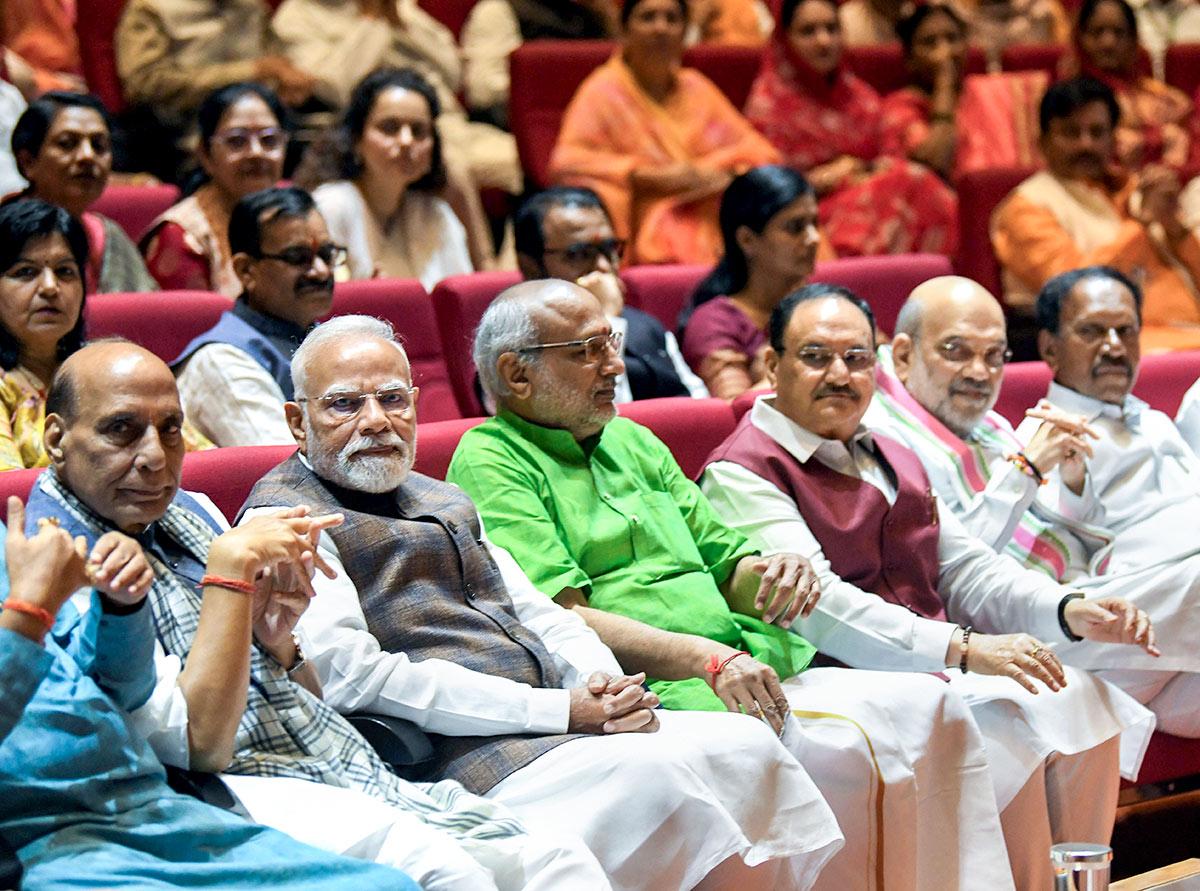
After over a decade in Gujarat, Modi invited world leaders to his swearing-in as the prime minister.
It was a hot and muggy evening on May 26, 2014, when Modi was crowned prime minister.
Mixed emotions swept through the country on that day. One part dreamt he would usher in a new India, and the other part was very apprehensive of his divisive ways, autocratic stance, lack of respect for democratic traditions, and democratic institutions.
In the last 11 years, India and the world witnessed what he stood for, what he promised and did not deliver, and what he actually stood for and practised without fearing how history would judge him.
Many of the claims he made in his anecdotal speeches were debunked by fact checkers, but that did not stop him from whipping up more anecdotes, like how he was convinced that he was not a normal biological person, but was sent by God to do some good work on earth.
The bhakts lapped it up, while cynics cringed. But this cocktail of oratory and tall claims helped him win election after election.
A handful of instances show how he got his image to evolve from 2014 to 2024.
He continued the traits he perfected in Gujarat: Controlling the Cabinet, bureaucracy, and the media. Collective decision-making was virtually absent; power flowed in a single direction.
One of the first blows he struck on civil society was cancelling the licences of thousands of NGOs, particularly those receiving foreign funding.
He never liked NGOs because they asked uncomfortable questions and raised issues like freedom and human rights.
Greenpeace India, Amnesty International India and others were targeted through regulatory pressure. The foreign funds they were getting were choked off, crippling their activities.
In November 2016, Modi, in typical style, sent streaks of fear and surprise, announcing the withdrawal of Rs 500 and Rs 1,000 notes in a late-evening broadcast. Even his Cabinet was taken by surprise, as it was a one-man decision.
The demonetisation drive triggered panic in business, disrupting it. At the same time, political parties in Uttar Pradesh, which dealt with vast amounts of cash for their campaigns, were paralysed.
Small businesses collapsed. The country was promised that demonetisation would destroy the black market economy and end terrorism.
Nothing of the kind happened.
However, it helped him to get his party to sweep the Uttar Pradesh elections.
While demonetisation failed to curb black money, it did enhance his image as a leader who could take bold decisions.
Economists had warned that it was a move that would take India back years.
Modi intended to project himself as an anti-corruption crusader, but it ended up destroying thousands of small businesses and countless livelihoods.
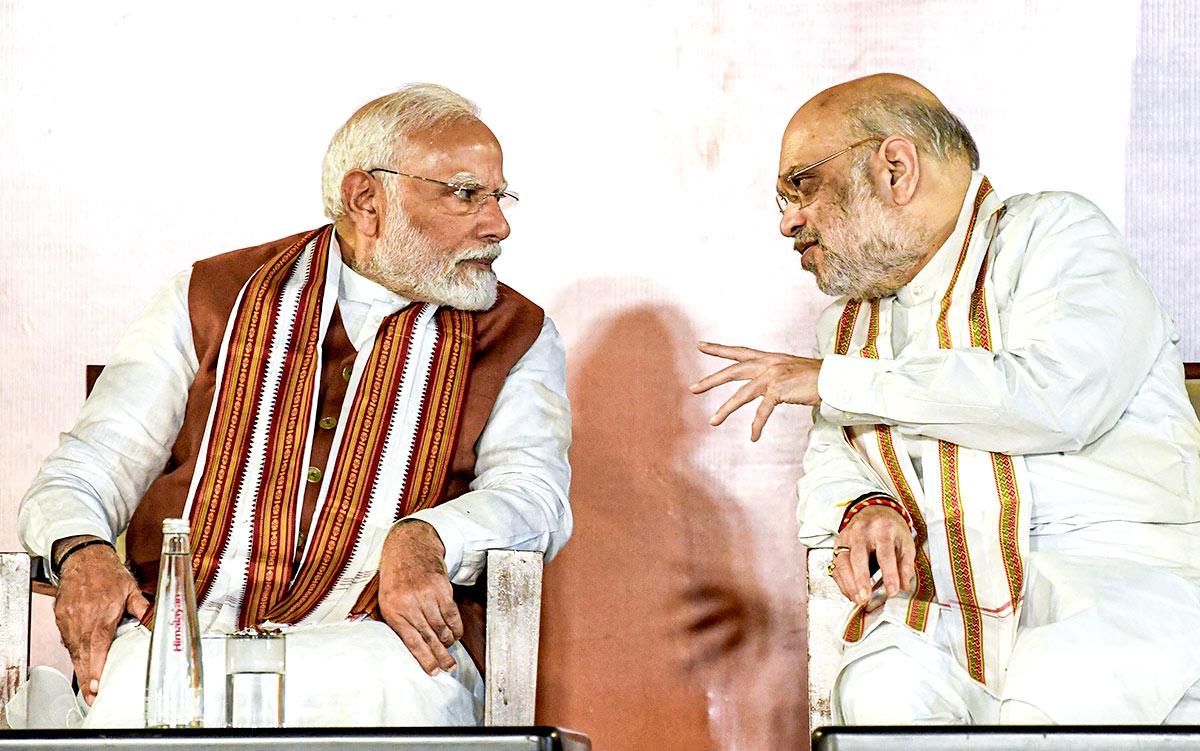
After the Pulwama terror attack in February 2019, Modi burnished his strongman credentials, ordering Indian jets to strike Balakot in Pakistan.
Though the actual damage was contested, the strikes became a rallying point in the run-up to the general election.
He won again as he was presented as a strongman defending India.
Six months later, on August 5, he revoked Jammu and Kashmir's special status under Article 370. It was one of the most audacious moves in recent times.
Look at his knack for stagecraft. In August 2020, he appeared on the show Man vs Wild with Bear Grylls at the Jim Corbett national park, recounting childhood struggles and voicing concern for the environment.
It is another story that the country's environment has been dangerously altered with poorly thought out projects and mining contracts.
A month later, in Houston, he shared the stage with Donald Trump at the 'Howdy, Modi!' rally before 50,000 Indian-Americans, turning a diaspora event into global political theatre.
It is another story that his PR machinery and media projected closeness to Trump did not help India stave off the unreasonably high tariffs on Indian goods.
During the COVID-19 pandemic in 2020, he urged citizens to bang thalis and light diyas for nine minutes on a particular day, requesting the virus go away!
It was another gesture to whip up mass rituals of obedience and reassurance. He was mocking scientific temper and getting away with it.
In early 2021, Modi launched 'Vaccine Maitri', gifting and selling doses abroad to boost its international image. The devastating second wave exposed domestic shortages and widespread deaths that were not reported.
One arena he misjudged was the farmers' protest against new agricultural laws. As the Punjab elections were approaching, he was forced to repeal it in November 2021. The BJP lost in the 2022 Punjab elections.
In September 2023, when India hosted the G20 summit, he got millions of photos plastered all over the country as if it were his show.
Finding even one opportunity where he missed showcasing himself is like searching for a needle in a haystack.
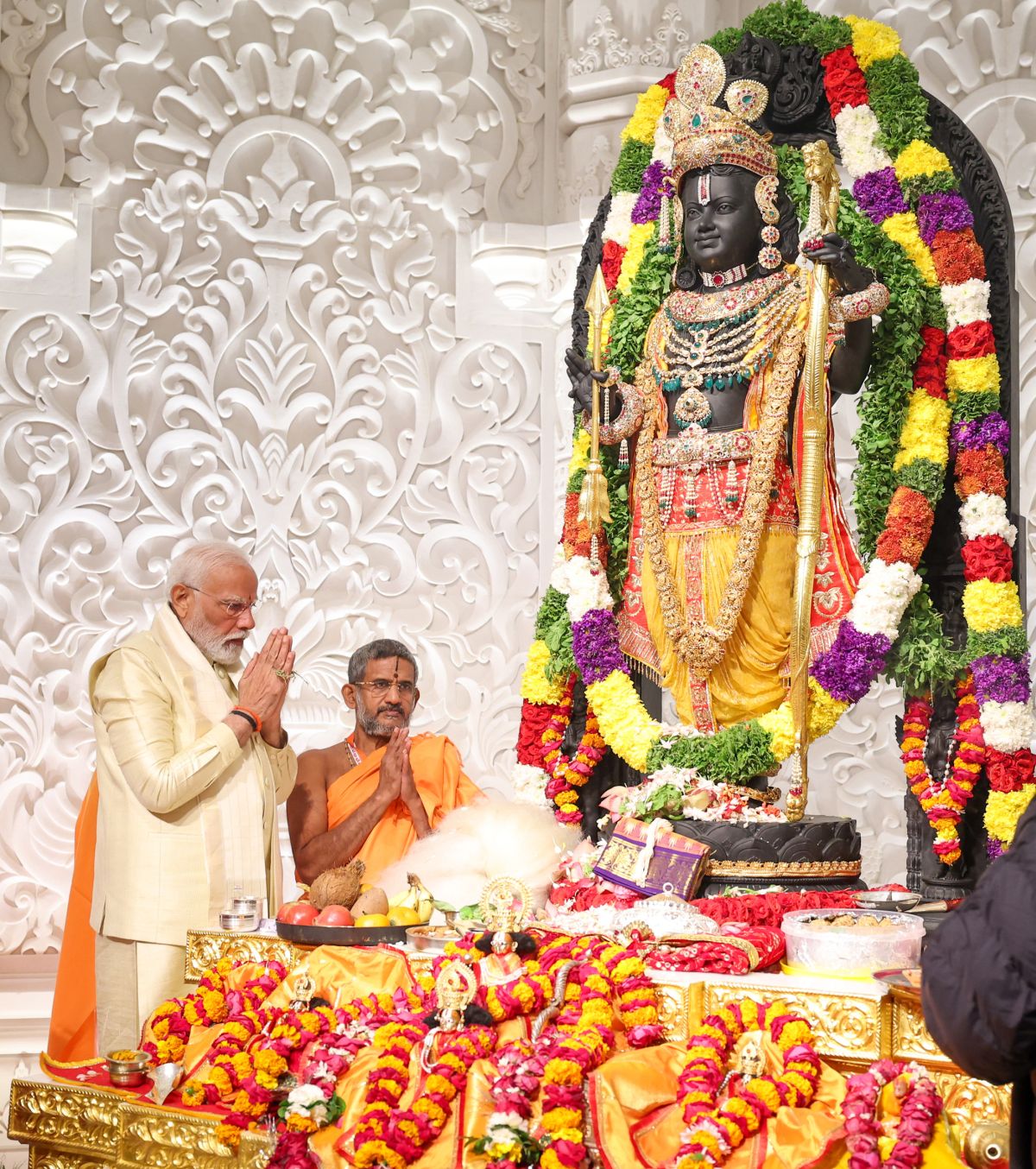
In January 2024, Modi presided over the consecration of the Ram temple in Ayodhya, when it should have been done by high-profile priests.
The imagery of Modi as a religious icon was beamed into every Indian home.
Modi ensured that the moment was rich in symbolism, marking the culmination of a movement that had shaped his party for decades, and cemented his position as the BJP's most important political figure.
Modi and his party used the event in the 2024 election.
In May 2025, India launched Operation Sindoor, a coordinated set of air and missile strikes on terrorist outfits and training camps in Pakistan and Pakistan-occupied Kashmir.
Soon after, Modi used it in speech after speech, wringing it for electoral mileage and voter support.
Many felt India had done the right thing, and others thought the government had stopped the action before any real gains in cornering Pakistan for supporting terrorism.

Modi is not worried about how history would judge him for his divisive agenda, his autocratic ways, his attitude towards the legislature, executive, judiciary, and the media, the four pillars of democracy.
He is more obsessed with optics than with governance.
The BJP is okay with that as it is winning elections, as if that is why it was voted to power.
Modi's tenure has been punctuated with headline-grabbing decisions, symbolic gestures, and stage-managed moments that continue to define his leadership and India's politics.
His style of politics has also hollowed out institutions, weakened dissent, and created a political culture where personality overshadows policy.
The question is: How sustainable is this model of governance built on spectacle and raw power?
What happens to Indian democracy when all decisions, all credit, and all blame rest on one man's shoulders?
Ramesh Menon, award-winning journalist, educator, documentary film-maker and corporate trainer.
Photographs curated by Manisha Kotian/Rediff
Feature Presentation: Aslam Hunani/Rediff




 © 2026