
Why is China's supreme leader promoting Han Chauvinism so aggressively, asks Claude Arpi.
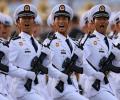
China's latest defence budget surges to $275 billion, fueling its ambitious military modernisation program and intensifying geopolitical dynamics in the region.

Trump's outburst comes amid escalating tensions between the US and its northern neighbour, following recent remarks by Canadian Prime Minister Mark Carney at the World Economic Forum (WEF) in Davos.
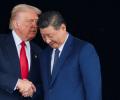
Speaking to reporters aboard Air Force One, Trump stated, "We have a deal," referring to the trade pact which will be routinely extended. "Every year we'll renegotiate the deal, but I think the deal will go on for a long time, long beyond the year. We'll negotiate at the end of the year," he added.
Bolton slammed Trump's tariff policy, asserting that it has "shredded" decades of Western efforts to align India away from its Cold War ties with the then Soviet Union (Russia) and address the growing threat from China.

United States President Donald Trump on Wednesday announced his upcoming diplomatic trip to Malaysia, South Korea, and Japan, highlighting a significant meeting with Chinese President Xi Jinping in South Korea.

On May 16, Russian President Vladimir Putin arrived in China for a two-day State visit as both countries looked to further deepen the relationship between Moscow and Beijing.

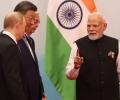
Check out these images from the Shanghai Cooperation Organisation summit in Tianjin, China, on Monday morning featuring Prime Minister Narendra Modi, Chinese President Xi Jinping and Russian President Vladimir Putin, taking bon homie to a new level.

The agreement was to disengage from remaining standoff sites along the Line of Actual Control (LAC), two days before a meeting between Chinese President Xi Jinping and Prime Minister Narendra Modi on the sidelines of the BRICS Summit.

There is no official word either from China or from India on who will represent Beijing at the upcoming G20 summit.

Modi is visiting Uzbekistan at the invitation of President of Uzbekistan Shavkat Mirziyoyev.
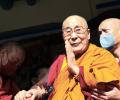
This past week, His Holiness has been in Leh, the capital of Ladakh, the Union Territory where Indian and Chinese soldiers have been in a standoff for two years, since April 2020.

China has imposed sanctions on 20 US defence firms in response to the Trump administration's approval of a record USD 11.1 billion arms sales package to Taiwan.
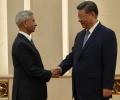
External Affairs Minister S Jaishankar met Chinese President Xi Jinping and apprised him of recent developments in India-China bilateral ties during the Shanghai Cooperation Organisation (SCO) Foreign Ministers' meeting in Beijing.

'Does it mean that we are witnessing the end of an era?' 'Probably not, but the post-Trump trade war has certainly brought a lot of instability in China,' notes Claude Arpi.

After constantly threatening China with 100% plus tariffs, US President Donald John Trump was all chummy when he met Chinese President Xi Jinping at Gimhae international airport during the Asia-Pacific Economic Cooperation summit in Busan, South Korea, on Thursday, October 30, 2025.

His attack on the government came days after Indian Army personnel clashed with Chinese soldiers in the Tawang sector in Arunachal Pradesh.

If Xi Jinping can establish control over the PLA Ground Force, relations between India and China will settle down to an even keel. The next few weeks will show whether Xi has finally succeeded in gaining control over the PLA Ground Force. That could bring about the substantive shift in India-China relations that both our leaders have been working for, observes Ambassador Prabhat Shukla.

Trump made the announcement in response to what he described as China taking "an extraordinarily aggressive position on trade" by sending "an extremely hostile letter to the world."

'Is Xi's China stable?'
'No one can say whether the regime will fall all at once or if its leaders are devising a new solid and competitive -- anything but democratic -- model.' A fascinating excerpt from Francois Bougon's Inside The Mind of Xi Jinping.
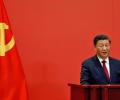
Xi's ascent to power and the quick consolidation of his leadership of the party with a shock anti-graft campaign securing the title of the "core leader" of the party bequeathed only to Mao has indeed forced his rivals in the party to submission and caught the attention of the world.

The Congress on Wednesday termed Chinese claims of mediation between India and Pakistan concerning and said the people of India need clarity on the issue.

Taking Kharg would give the US control over virtually all of Iran's oil exports and thus provide significant leverage, notes Prem Panicker in his must read daily blog on the Gulf War. It would also put American troops within range of Iran's remaining missiles, drones, and artillery on a piece of real estate that is just eight square miles in size, and just 15 miles from the Iranian mainland.
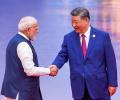
A senior Chinese Communist Party official stated that the meeting between Prime Minister Narendra Modi and President Xi Jinping was fruitful, leading to a new consensus on developing bilateral relations. Both countries aim to enhance cooperation and manage differences.

On his arrival, Xi will be welcomed by traditional peformances including 'tappu' folk drum art display at the airport by about 500 artistes.

He spoke about North Atlantic Treaty Organisaiton (NATO) and Greenland, with an emphasis on ownership, while also hinting that China would not take any steps against Taiwan, till Trump was in office.
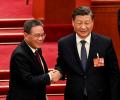
The annual session of the National People's Congress, a ceremonial body that routinely passes the proposals of the ruling Communist Party of China, approved Li Qiang's candidature after his name was proposed by Xi himself.
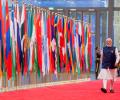
During a special briefing in Tianjin, Misri confirmed that the prime minister will first address the SCO plenary session before meeting President Putin.

In his fresh directive, Xi said that more targeted patriotic health campaigns should be conducted as the country's COVID-19 epidemic prevention and control faces new situations and new tasks.

Vladimir Putin on Wednesday said that Russia has successfully tested a nuclear-powered submersible drone with unlimited range.

The Global Times, a prominent state-run Chinese media outlet, published an article titled "China and India are cooperation partners, not rivals: Xi," highlighting President Xi Jinping's remarks about the bilateral meeting, saying, "as long as the two countries stick to this overarching direction, China-India relations can sustain steady and long-term growth."

India and Canada are negotiating a long-term uranium supply agreement worth $2.8 billion. They are also exploring expanded civil nuclear cooperation after the passage of the SHANTI Bill.

China executed Bai Tianhui, a former top official of a state-owned financial firm, for accepting bribes totaling CNY 1.108 billion (about USD 157 million).

'After the Galwan clash, the rules of engagement changed with the army commanders allowed to use any means at their disposal as they deem fit for tactical operations.'

'The title of 'core' of the leadership gives Xi Jinping greater political authority at a time when China is beset by various problems as well as a slowdown in economic growth,' points out former RA&W officer Jayadeva Ranade.

During the meeting, President Xi addressed the ministers and discussed the bilateral issues among the countries and the issues affecting the South-Asian regions.
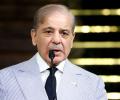
United States President Donald Trump is set to engage in high-stakes bilateral meetings on Thursday, including a closed-door session with Pakistan's Prime Minister Shehbaz Sharif in the Oval Office, according to Trump's public schedule released by the White House.

Describing the visit as "productive" in a post on X, the PM said he emphasised India's position on key global issues during his engagements.
China's ruling Communist Party is holding its annual leadership conclave to discuss the new five-year plan, the impact of US President Donald Trump's tariff war, and the ongoing anti-corruption crackdown in the military.

'If one puts the context of what Xi Jinping said at the UN about not wanting a 'hot or cold war with any country', one realises that his speech was quite bizarre.' 'The world does not expect such statements from China, a nation aspiring to be a superpower.
