
India's soft power diplomacy came into play during this cataclysm affecting the world as the pandemic defies barriers and borders, notes Rup Narayan Das.

External Affairs Minister Sushma Swaraj on Tuesday flagged off the first batch of pilgrims for Kailash Mansarovar yatra in Tibetan Autonomous Region of China through a new route via Nathu La pass.

India and China will hold the 18th round of border talks in Delhi from Monday - the first round of negotiations after PM Modi came to power last year.

'During his visit to Vietnam on September 3 -- the first visit by an Indian prime minister in 15 years -- Modi will notice the widespread anti-China sentiment in that country.'

'While China expressed reservations on the Indian role in the South China Sea, Beijing threw to the winds Indian concerns on Kashmir by announcing $46 billion in investments Pakistan occupied Kashmir,' says Srikanth Kondapalli.
'A breakthrough in eastern Ladakh leading to disengagement and creation of a buffer zone will obviate the need of military deployment through the winter months ahead,' notes Ambassador M K Bhadrakumar.

India is committed to finding an 'early settlement' to the vexed boundary issue: Swaraj

China on Wednesday said it attaches 'great importance' to Sushma Swaraj's visit to Beijing.
'Anyone familiar with Modi's track record will know he never forgets a slight, a betrayal,' notes Virendra Kapoor.

An outbreak of a pneumonia-like illness that started in the city of Wuhan in China has put health authorities on high alert around the world. The new coronavirus-named 2019-nCoV-is thought to have originated in the food market of the central China metropolis and has since infected more than 4,000 people worldwide.
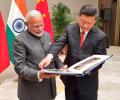
'Xi's meeting with Modi in the southern Indian city of Chennai on Friday and Saturday is expected to focus more on the two countries' historical and present differences, and how to move beyond them to realise their cooperation potential'

China on Tuesday maintained that its decision to block the bid to get Jaish-e-Mohammed chief Masood Azhar banned by the United Nations was in accordance with "facts and relevant resolutions"
External Affairs Minister Sushma Swaraj is expected to raise the issue of China blocking India's bid to ban Jaish-e-Mohammed chief Masood Azhar by the United Nations with her Chinese counterpart Wang Yi,.

New Delhi must clearly demonstrate to Beijing that China will pay a price for its relentless strategic undermining of India, says Ajai Shukla.
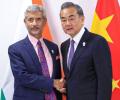
The joint statement said Jaishankar and Wang agreed that both sides should take guidance from the series of consensus reached between leaders of the two countries on developing India-China relations, including not allowing differences to become disputes.

China and India on Wednesday held their upgraded strategic dialogue to shore up bilateral ties amid hectic parleys to resolve differences over Beijing's reluctance to support India's bid for Nuclear Suppliers Group membership as well as a United Nations ban on JeM chief Masood Azhar.

'The virus of trust deficit seems to be taking a toll of the friendship built over the years by succeeding leaderships of the two countries,' notes Rup Narayan Das.
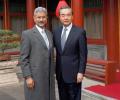
India on Wednesday hit out at China for demanding "solid evidence" for getting Jaish-e-Mohammed chief Masood Azhar banned by the United Nations

Playing down its unsuccessful bid to establish diplomatic ties with Bhutan, China on Monday said it is glad to see New Delhi and Thimphu develop their relations further during the just-concluded visit of Prime Minister Narendra Modi.

The prompt approval to set up a radar station on the Andaman and Nicobar Islands signalled the Modi government's intent to deal with China on its own terms.
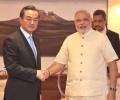
Special Envoy of the Chinese President and Foreign Minister Wang Yi on Monday called on Prime Minister Narendra Modi and conveyed his government's keenness to engage with the new Indian dispensation to strengthen cooperation in key areas.
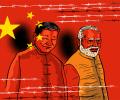
The reasons for China's negative response are located in its territorial dispute with India but also to its grand designs of dominating the region from its previous position of being merely a "balancer" between India and Pakistan, points out Srikanth Kondapalli, Professor in Chinese Studies at JNU.

This was the first round of talks for Wang after he succeeded State Councillor Yang Jiechi earlier this year.

China plans to build a 540-kilometre strategic high-speed rail link between Tibet and Nepal passing through a tunnel under Mount Everest, a move that could raise alarm in India about the Communist giant's growing influence in its neighbourhood.
The US has been, historically, a sleeping partner in India-China relations. Today, any attempt by the Modi government to make a bilateral move to improve relations with Beijing could upset Biden's apple cart, notes Ambassador M K Bhadrakumar.
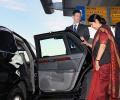
This is her first visit to Beijing after she took over the office last year.
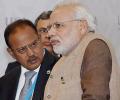
The US has all along interfered in India-China issues. The objective is clear: Bring the Sino-Indian standoff to a flashpoint that would compel Modi government to take shelter under an American umbrella, argues Ambassador M K Bhadrakumar.

China said Islamabad is at the frontline of combating terrorism.

It will not be to India's advantage to create misperceptions that it is bandwagoning with some Anglo-American project for regime change in Myanmar, argues Ambassador M K Bhadrakumar.

'The muscularity of the last three years didn't bring any dividends and if anything, Chinese attitudes only hardened,' says Ambassador M K Bhadrakumar.

Shed suspicion and manage differences to improve Sino-Indian ties, says Chinese Foreign Minister.

Top Indian and Chinese officials on Tuesday finalised President Xi Jinping's maiden visit to India, including the programme and key issues to be discussed, amid indications that he may begin his tour in Prime Minister Narendra Modi's home state of Gujarat on September 16.
.jpg)
Prime Minister Narendra Modi made Bhutan the destination of his first foreign visit. Now two weeks later, the foreign minister of the Himalayan kingdom, Rinzin Dorje, is in Beijing discussing the China-Bhutan border issue. The move poses a serious challenge to New Delhi because any negotiation on China-Bhutan border dispute is bound to affect India's border negotiations with China. Bhutan and China share 470 kilometres of border, which is also close to India's 'chicken's neck' -- the narrow Siliguri corridor which links the northeast.

Continuing his fast-paced diplomacy, Indian Prime Minister Narendra Modi spoke to China's Premier Li Keqiang on Thursday. During the phone call, Li conveyed his government's desire to establish a robust partnership with the new government in India.

China on Sunday said the border dispute with India has been "contained" and the Indian elephant and Chinese dragon should "do more" to strengthen the bilateral cooperation to facilitate its settlement.
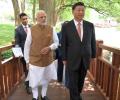
'India's preference today seems to be to exploit the deepening chill in relations with China to breathe new life into its meandering partnership with the US,' argues Ambassador M K Bhadrakumar.
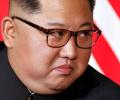
The visit, Kim's third since March, is taking place amid sharp escalation rhetoric between Beijing and Washington over tariffs almost spiralling into a trade war.
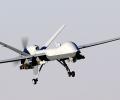
The Indian defence ministry said its border security personnel, as per standard protocol, immediately alerted their Chinese counterparts to locate the UAV and they later reverted with its location.

Xi-Kim meeting took place amid concern in Beijing that the North Korean leader is getting too close to US sidelining China pointing to its declining importance in the Korean Peninsula peace process.

This is a high-stakes strategic conflict between a power which wants to preserve the status quo in its favour and one which wants to usurp that throne. The rest is all theatre, says Harsh V Pant.
 © 2026 Rediff.com - Advertise with us - Disclaimer - Privacy Policy - Sitemap - Feedback - About us - Terms of use - Grievances