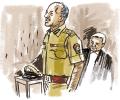
Clusters of policemen and television journalists alertly anticipated the arrival of Mumbai's joint commissioner of police, who, it was confirmed by most people I asked, does not visit court often. No one could remember when they had last heard of Deven Bharti appearing as a witness in a murder trial.

She continued to cry, harder, feebly dabbed her eyes with the handkerchief she had received, and declared painfully: "He is hurting my emotions!"

'Could the Khar police and the CBI have tinkered with the driver's call data records?' 'And did their fiddling with the information not make it that they were tampering with the lives of people that were in the balance as a result of this case?'
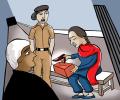
A mere pair of shoes sets off the kind of harsh condemnation Indrani draws in these corridors of justice. That she being a woman who killed her daughter -- never mind that she is an undertrial and the crime has not yet been proven -- apart from making her an object of curiosity, also makes her, by perception, more evil than the men that flood these corridors, facing trial for similar or worse crimes.

'I'm not withdrawing any allegations. I want those CDRs (Peter's call data records).' 'Those are my feelings.'

'A man, probably a lawyer, in black trousers and a white shirt, next to me, was talking to a woman in white.' 'My stock-taking stopped frozen in its tracks.' 'I was sitting almost right next to Indrani Mukerjea.'

Accused No 1 announced that there had been a change in the circumstances of her health condition. She produced a thick 19-page document, written in her neat, very feminine handwriting, detailing her condition, its symptoms and the consequences it could have on her health and well-being.

Mekhail hopped off the bench in a hurry and turning his back to Indrani, stood at the window. Indrani ignored him too. Mekhail is getting married later this year. His mother will, of course, not be in attendance. Nor, of course, would he want her to be there, if she could.

One couldn't help feeling a certain melancholy viewing these now vagrant documents and photographs that would never be rightfully cherished. The pictures spoke to you. They offered slices of extinguished lives. They breathed sadness too, for what could have been and will never be. The sweet promises that Life made and insolently, arrogantly never kept.

'After Indrani's arrest did you go to the police and say I did this kind of forgery?'

'You don't want to admit that it is your wife in the video because she said you were arrested on Wednesday (August 19; Shyamvar Rai states he was arrested on August 21, a Friday).'

Indrani, radiant in an immaculate white and gold salwar-kurta that matched the moment, her hair open, a bindi gleaming on her forehead, beamed placidly, fully enjoying this small minute of victory.

Happy with her latest move, Indrani departed from Courtroom 51 with a spring in her step. The woman who hopped up into the jail truck was a cheerful one.

Though on the face of it appeared Pasbola was asking a series of odd questions that would be difficult for anyone to answer, there was, it gradually emerged, it seemed, a method to the questioning. Somehow, somewhere instinctively, Pasbola knew there was something not right with Riyaz's account.

How much more gray or bald would Inspector Alaknure have become when we see him next? Will Peter still be wearing white shirts and khaki trousers and eating large lunches? Will Judge Jagdale be still in charge of the case? Who will be the prime minister when Alaknure appears in court next?

'I ask for bail in the name of justice.' 'Give me a chance to stay alive and see the trial till its end.'

One of the high points of the proceedings was when Indrani Mukerjea's lawyer smartly utilised Dr Zeba Khan's expert status to pose her A Most Curious Question. He asked her if a skull can grow new teeth, even after the person, who it belonged to, had died, three years before. We can be sure that the discrepancy between the number of teeth discovered in the skull unearthed in 2012 and the skull shown in court in September 2019 will come up soon in Courtroom No 51. Vaihayasi Pande Daniel reports from the Sheena Bora Murder Trial.

Indrani, who is lodged in the Byculla prison, is among the 200 inmates against whom a case was on Sunday registered for rioting, unlawful assembly, assault on public servant and other relevant sections under the Indian Penal Code, a police official said.

'People wondered aloud why she had given up on the aging, getting-day-by-day-more-infirm avatar. And was freshly blooming.'

So concluded a day in court that saw a woman accused of murder don a fresh role of heroine of the moment. Even Bollywood couldn't have come up with such a curious twist.
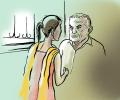
As Peter sits outside the court with his sister, Indrani walks in with a request. It has been three months since Peter has started speaking to Indrani again, after a long silence of two years.
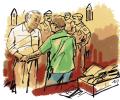
It will be his fifth birthday in jail as an undertrial. He was arrested two days before his birthday in 2015. Tuesday also marked Peter's fourth year in jail.

'It is perhaps kind of easy to see why Peter and the police clash.' 'The obvious air of entitlement that emanates from him, maybe unknowingly, probably gets the goat of the policemen.'

Indrani looked cheerful and upbeat and announced she had quite recovered from her wounds...

The Mukerjeas' former driver could remember every detail of Sheena Bora's alleged murder five years ago, including on what day he took Indrani to the beauty parlour, and the brands of liquor he bought, but was unable to recall anything subsequently or more recently...

'Indrani said she had some things to discuss with Peter, which he digested with minor surprise.' 'He looked mildly dismayed. And refused to sit down next to her, in spite of her welcome.' In spite of months of wariness from Peter's side, the ice was broken.

The attempts to unearth the document started getting more and more frantic. The clerks began to flip pages of files full of documents, some hand written, some bearing thick seals or multiple stamps, some in Hindi, some in Marathi. Several junior lawyers joined in, perusing different files and dockets. But in spite of the best of efforts the document was not to be found.

'Indrani gave a mirthless laugh on spying The Suitcase, from the accused enclosure and, in sign language, gestured the impossibility of anyone fitting in such a small bag.'

In just 18 frames, the photograph of the dainty Sheena, with her winsome smile and starry eyes, dissolved, flesh falling off her facial bones, into what the CBI alleged was her corresponding yellowed, morose-looking skull with hollow, haunting eye sockets.

Lawyer: 'Did YOU not ever feel scared?' Shyamvar Rai: 'I am a driver, I said okay. Madam said it is your job...'

'I kept photographs of everyone. Because I was working for them.' 'Madam, Saab...' Shyamvar Rai, the approver in the case, said in a tone that tried to suggest that that would be a routine practice for a driver.

In walked the scruffy band of pirates, without any swagger. Mostly tall or burly men, with weather beaten, resigned faces, the majority were dressed in track pants and tees; a few had skull caps. Some of their T-shirts had messages like 'I'm not in danger, I'm danger' or 'Long Beach California Surfer'.

'Not only will Peter, Indrani, Sanjeev be making twice monthly trips to the sessions court for many years, so will their family, their lawyers and the journalists covering the case, becoming almost like bittersweet friends, as large portions of their lives play out there.'

Not Mekhail. Not Rahul. Not anyone. 'Wouldn't someone have asked?' Indrani asked.

Will there be answers? Will we ever know the truth about who murdered Sheena Bora?

Indrani is clearly in charge in her little corner. She is speaking rapidly to a not-very-tall, pot-bellied, balding man, whom she repeatedly, decisively, asks, "Have you understood?" The tone is that of a boss talking to an employee. The words "cheque" and "two lakhs" float by.

'How much fashion she used to do.' 'Now all gone in the water!' 'All good things have to come to an end.' 'And all bad things have come to an end.'
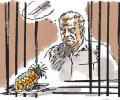
He was getting fruits, but no implement to cut them with. He told the judge, sadly: "I have tried and it is very difficult, your honour." His statement quickly brought up the imagery of Peter trying to cut a pineapple with his teeth or a papaya with a pen or a toothbrush.

There it lay, a photograph on the desk under a stapler, and later a stamp pad, forgotten, done with, like its subject, a Mumbai Metro One employee who vanished overnight.

'As Rai spoke, in an unbelievably dead pan, almost off-the-cuff tone, about helping plan the murder of two youngsters, drugging them with vodka and whiskey spiked with dava (medicine), smothering one, dragging a body in rigor mortis out of a car, burning a corpse, destroying evidence, and so on, it felt like he was discussing nothing more surprising than the intricacies of the weather.'
 © 2026 Rediff.com - Advertise with us - Disclaimer - Privacy Policy - Sitemap - Feedback - About us - Terms of use - Grievances