
The space agency lines up GSLV-III and Chandrayan-II in 2017-18.

It is scheduled for lift-off at 1658 IST on Thursday from the space port at Satish Dhawan Space Centre at Sriharikota, about 100 km from Chennai.
The Polar Satellite Launch Vehicle is carrying 1360-kg satellite 'Resourcesat -I'.
The flight took off from Sriharikota in the Bay of Bengal on schedule.

The third of the total of five orbit raising manoeuvres of the Mars Orbiter spacecraft was performed early on Saturday, raising its apogee, the farthest point from Earth, to over 71,000 km.

This is the first mission by the Indian Speace Research Organisation this year.
The indigenous rocket will carry the second technology experiment satellite GSAT-2.

The rocket is almost 49 meters high -- as much as a 17-floor building. It weighs 415 tons -- as much as the combined weight of 80 full grown elephants.

The ISRO is strengthening 'eye in the sky', which helped the Indian army carry out surgical strikes last year, with the launch.

The launch of IRNSS IC, the third of seven satellites in the series to put in place India's navigation system at par with US' Global Positioning System, that was deferred following a technical snag has been rescheduled for October 16.

In its first multi-orbital launch, India's workhorse PSLV will on Monday inject eight different satellites, including the country's weather satellite SCATSAT-1 and five from other nations, into two different orbits.

Indian skipper Virat Kohli, on Monday, lauded ace sprinter Hima Das for winning five gold medals in a span of 20 days.

The ISRO is aiming for a soft landing of the lander in the South Pole region of the moon where no country has gone so far.

The RISAT-2B would replace the RISAT-2, which has been actively used by India to monitor activities in camps across the border in Pakistan to thwart infiltration bids by terrorists.

Except Pakistan, seven SAARC countries are a part of the project.

The announcement comes two days ahead of the proposed historic launch of the ISRO's 100th satellite along with 30 others in a single mission from Sriharikota.
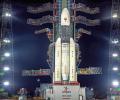
Late on Monday night, in a last-minute revision of schedule, ISRO announced that the launch of India's second lunar mission 'Chandrayaan-2' has been called off due to a technical snag.

The Indian space agency has already begun work on the third generation of the earth observation satellite -- the first of which will be ready by 2018 and boost the capability to generate digital maps.
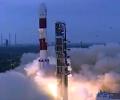
RESOURCESAT-2A, intended for resource monitoring, is a follow-on mission to RESOURCESAT-1 and RESOURCESAT-2, launched in 2003 and 2011 respectively. It is intended to continue the remote sensing data services to global users provided by RESOURCESAT-1 and 2.
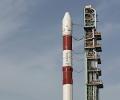
ISRO said, initially the launch was slated for 9.49 am, but now there is a 3-minute delay owing to the probability of space debris in the path of rocket.
.jpg)
India's maiden mission to Mars has traversed beyond the sphere of influence of Earth extending about 9,25,000 km in its 10-month long voyage to the red planet.

Countdown began on Thursday for the launch of the latest navigation satellite that will make India on par with the GPS of the US.

Indian Space Research Organisation will announce a revised launch date later.

ISRO Chairman K Sivan said there might by a postponement if the weather was not conducive.
Indian Space Research Organisation's Mars Orbiter, which was placed in inter-Mars trajectory in the early hours on Sunday, has crossed Moon's orbit and is travelling beyond Earth's natural satellite.
.jpg)
The 56 and-a-half hour countdown for the launch of India's first space mission to Mars, slated for November 5, commenced on Sunday at the Satish Dhawan Space Centre in Sriharikota.

India's ambitious space mission to explore planet Mars would be launched on November 5 from the spaceport of Sriharikota, ISRO announced on Tuesday.

India's heavy-lift rocket GSLV MkIII, carrying communication satellite GSAT-19.

Other than the Cartosat-2 series satellite, the PSLV is carrying 29 nano satellites from 14 countries - Austria, Belgium, Chile, Czech Republic, Finland, France, Germany, Italy, Japan, Latvia, Lithuania, Slovakia, the United Kingdom and the United States of America besides a nano satellite from India.

Chandrayaan-3's success is a must for India's space ambitions; we can't afford to lose out. And for realising our space dreams, the Indian private sector must be encouraged because if we lose this race, the moon, Mars, and mineral-rich asteroids will already be crowded before we reach there.

The six satellites will be launched on PSLV-C29 from the Satish Dhawan Space Centre in Andhra Pradesh on December 16, 2015.

Microsat-R, an imaging satellite, is meant for military purposes, but the ISRO did not give any details about it.

A recap of events that occurred in India in the past 24 hours.

Heralding a new era, India on Friday night launched its heaviest commercial space mission ever with its polar rocket successfully putting five British satellites into the intended orbit after a flawless takeoff.
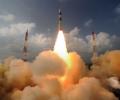
The second orbit raising manoeuvre of India's Mars Orbiter spacecraft was performed in the early hours of Friday, three days after its successful launch by PSLV C-25 into orbit around the Earth.

India is the fourth country to demonstrate the flight testing of Scramjet Engine after the United States, Russia and European Space Agency.

The primary goal of HysIS, whose mission life is five years, is to study the earth's surface in visible near infrared and shortwave infrared regions of the electromagnetic spectrum.

PSLV C-29 blasted off from the Satish Dhawan Space Centre, about 110 km from Chennai, at 6 pm and released the six satellites one by one into a 550 km circular orbit.

The GSAT-31 is a 'high power' communication satellite going to serve and replace some of the satellites that are going to expire soon.
 © 2026 Rediff.com - Investor Information - Advertise with us - Disclaimer - Privacy Policy - Sitemap - Feedback - About us - Terms of use - Grievances