
The Indian space agency is all set to embark on its most complex mission.

The Polar Satellite Launch Vehicle PSLV-C15 carrying five payloads, including India's remote sensing satellite Cartosat-2B, successfully lifted off from the spaceport in Sriharikota on Monday.

The polar satellite launch vehicle-C42 launch vehicle carrying the two satellites blasted off from the first launchpad at the Satish Dhawan Space Centre at 10.08 pm.

The Indian Space Research Organisation on Wednesday placed in orbit seven satellites including Oceansat-2 within a span of 20 minutes, its first successful mission after the abrupt end of the ambitious Chandrayaan-I project.
The final 52-hour countdown for the October 22 launch of the country's first moon mission, Chandrayaan-I, began early on Monday morning at the Satish Dhawan Space Centre at Sriharikota in Andhra Pradesh.
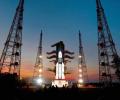
Despite the odd time, hordes of enthusiasts had reached the island, some of them travelling long distances on two wheelers, to witness the historic moment.
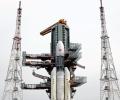
The Indian Space Research Organisation said that the countdown started at 6.51 am on Sunday.
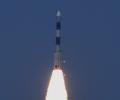
Prime Minister Narendra Modi lauded the scientists saying, "with this successful launch, we will determine our own paths powered by our technology".
Roddam Narasimha, space scientist, says that one of the most important assignments during this mission, which cost over Rs 300 crore, would be to tap and see how useful the helium found on the moon would be.

Cartosat-3 satellite is a third-generation agile advanced satellite having high-resolution imaging capability.
For carrying the 360-kg Italian satellite, meant for astronomical studies, Indian Space Department's commercial wing Antrix Corporation would receive a fee from the Italian space agency.
Stage is set for the launch of PSLV-C9 from the Satish Dhawan Space Centre, Sriharikota. As many as ten satellites will be launched on Monday by the Indian Space Research Organisation, including country's latest remote sensing satellite and eight nano satellites.
Greet the scientists on achieving this major milestone!
The GSLV will put into orbit the INSAT-4CR, which carries 12 high-power Ku-band transponders for direct-to-home television services, video picture transmission and digital satellite news gathering.
It is raining heavily at Sriharikota where the Satish Dhawan Space Centre is located
"It will take about five-and-half days for Chandrayaan-1 to get to the moon," officials said, adding that the probe will be in a 100 km polar orbit around the Moon.
India becomes the fifth country after United States, Russia, China and France to enter the launch market.
The ISRO will launch its ambitious and maiden mission to the moon, Chandrayaan-I, from the Satish Dhawan Space Centre at Sriharikota on April 9, 2008. "We are looking for a launch on April 9," Mylswamy Annadurai, head of Chandrayaan-I said.
Delhi will be the first place to be mapped by Cartosat followed by Goa.
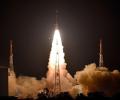
"I am really grateful to the entire ISRO family for having worked this hard and making IRNSS-1I a success," said the space centre's chief K Sivan.

India is all set to script history by launching a record number of 22 satellites, including a number of micro and nano ones from foreign countries, in a single mission in May this year.
India on Monday successfully launched Israeli satellite 'Polaris' from the Satish Dhawan Space Centre in Sriharikota by a homegrown Polar Satellite Launch Vehicle, a spokesman of the Indian Space Research Organisation said. This is the second time that a 'core alone' PSLV configuration had put a satellite into orbit. In April 2007, an Italian satellite Agile was put into the orbit, the space agency spokesman said.
The 44 metre tall four-stage PSLV placed Italian satellite AGILE into orbit at 550 km above the earth.
The PSLV-C8 rocket will make its first commercial launch with an Italian astronomical satellite on board.

A recap of events that occurred in India in the past week.
'The goal seems to be that we do not invest further in our system to make our system more accurate and more reliable or more global in reach,' an ISRO source tells Shivanand Kanavi.
INSAT-4CR is similar to INSAT-4C, which was lost during the unsuccessful launch last year.

The 3,423 kg GSAT-29 carries Ka and Ku band high throughput transponders intended to meet the communication requirements of users, including in the North East and in Jammu and Kashmir.
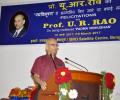
'One remembers Professor Rao with fondness as the man who gave the space programme a very professional front face, a very different appearance from the raw energy of a Vikram Sarabhai or the polished passion of a Dr Satish Dhawan.'

Here's a recap of the events from the past 24 hours.
India will join an elite group of nations with the launch of a new mission to test re-entry technology, which would be a forerunner to developing reusable vehicles like space shuttles.
The 44.5-metre-tall, 295-tonne PSLV-C7 lifted off from the launch pad at 9.24 am.
ISRO's Polar Satellite Launch Vehicle-C6, carrying India's remote sensing satellite CARTOSAT-1 and a micro satellite HAMSAT, blasted off from the Satish Dhawan Space Centre in Sriharikota on Thursday.

The two satellites that PSLV will release in the orbit will help the country's mapmakers and amateur radio operators.
The launch vehicle that lifted off from a newly built launchpad will release two satellites in the earth's orbit.
Antrix, ISRO's commercial arm, is eyeing 10% of the $357 billion global market.
This is the first time ISRO was putting into orbit a two-tonne class satellite.\n\n
The satellite was placed at 4.18 pm, a little over 17 minutes after the Geosynchronous Satellite Launch Vehicle (GSLV-F-01) carrying it was launched from the Satish Dhawan Space Centre in Sriharikota.
 © 2026 Rediff.com - Investor Information - Advertise with us - Disclaimer - Privacy Policy - Sitemap - Feedback - About us - Terms of use - Grievances