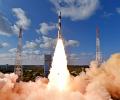
Andhra Pradesh will establish two expansive integrated space cities in Lepakshi and Tirupati, spanning around 33,000 acres.

Meanwhile, Musk said some parts of the ISS were "simply getting too old and obviously that risk grows over time."

Indian astronaut Shubhanshu Shukla and three others were getting ready for their journey to the International Space Station on board SpaceX's Falcon-9 rocket that is scheduled to blast off from the Kennedy Space Centre (KSC) in Florida on Tuesday evening.
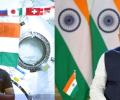
The interaction is planned via a telebridge set up at the U R Rao Satellite Centre in Bengaluru, said the Amateur Radio on International Space Station (ARISS), which facilitates interaction of school students with astronauts on the orbital laboratory.

Indian Space Research Organisation's 101st mission from Sriharikota, an earth observation satellite onboard the agency's trusted Polar Satellite Launch Vehicle (PSLV) rocket, could not be accomplished on Sunday following a pressure issue in the third stage of the launch vehicle, the space agency said.

Indian astronaut Shubhanshu Shukla stands on the cusp of history as he prepares to set off on a space odyssey, marking India's return to space flight 41 years after his idol Rakesh Sharma orbited the earth for eight days as part of Soviet Union's Interkosmos programme.

NASA, Axiom Space, and SpaceX are now targeting 12.01 PM (IST), Wednesday, June 25, for launch of the fourth private astronaut mission to the International Space Station, Axiom Mission 4, NASA said.

Astronaut Shubhanshu Shukla concludes his 18-day stay at the International Space Station, praising India's ambition, confidence, and pride as seen from space. He echoes Rakesh Sharma's iconic words and expresses gratitude to all involved in the Axiom-4 mission.
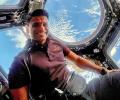
Shubhanshu Shukla's first seven days in space have combined science, ceremony, and moments of levity.
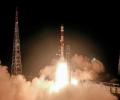
State-run Hindustan Aeronautics Limited has won a bid under which it will receive technology from the Indian Space Research Organisation for the end-to-end commercial production of the Small Satellite Launch Vehicle (SSLV), a first for the industry as India seeks to become a global hub for small satellite manufacturing and launches.

'The launch of Axiom 04 slated for 11th June 2025 for sending first Indian Gaganyatri to ISS is postponed.'
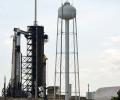
Indian astronaut Shubhanshu Shukla and three others are expected to travel to the International Space Station on June 19, after SpaceX successfully resolved the liquid oxygen leak in its Falcon-9 rocket, the Indian Space Research Organisation (ISRO) announced on Saturday.
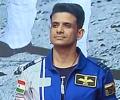
Shukla will be the second Indian to travel to space four decades after Rakesh Sharma's iconic spaceflight onboard Russia's Soyuz spacecraft in 1984.

On Thursday, NASA announced that it was working with Roscosmos to understand a new pressure signature, after the recent post-repair effort in the aft-most segment of the International Space Station's Zvezda service module.

"If we have to ensure the safety of our country, we have to serve through our satellites. We have to monitor our 7,000 km seashore. We have to monitor the entire northern part continuously. Without satellite and drone technology, we can't achieve that."

Following the postponement of the Axiom 4 mission, Group Captain Shubhanshu Shukla's father, Shambhu Dayal Shukla, said that his family is 'mentally' prepared for the mission.

The rocket flight was aborted in order to plug the liquid oxygen leak identified during post-static fire Falcon 9 rocket inspections.
Indian astronaut Shubhanshu Shukla and three others are set to embark on the Axiom Space's fourth human spaceflight from National Aeronautics and Space Administration's (NASA) Kennedy Space Centre in Florida on June 10 and are likely to dock at the International Space Station on June 11 at about 10 pm IST, after a nearly 28-hour journey.

The mission was originally scheduled for lift-off on May 29 but was put off multiple times when engineers detected a liquid oxygen leak in the boosters of the Falcon-9 rocket and NASA also detected leaks in the ageing Russian module of the ISS.

Indian astronaut Shubhanshu Shukla will enjoy a range of Indian dishes, including rice varieties, moong dal halwa, and mango nectar, during his 14-day mission aboard the International Space Station (ISS). He will also have the option to choose from international cuisine, as approved by NASA. ISRO and DRDO have developed the Indian food options for astronauts of the Gaganyaan mission and Shukla will be able to savor them with NASA's approval.
Axiom-4 mission to the International Space Station, piloted by Indian astronaut Group Captain Shubhanshu Shukla with three other crew members, has been delayed and will now be launched from the Kennedy Space Centre in Florida on June 8 at 6:41 pm IST.

K Kasturirangan, former chairman of the Indian Space Research Organisation (ISRO), passed away at the age of 84 in Bengaluru on Friday. He was suffering from age-related ailments for the past few months. Kasturirangan, who also served as the chairperson of the drafting committee on the New National Education Policy (NEP), was a renowned space scientist and had a distinguished career spanning several decades. He was known for his contributions to ISRO's successful space programs and his role in shaping India's education policy.
SpaceX's Falcon-9 rocket was scheduled to blast off from the Kennedy Space Centre in Florida on Tuesday evening.
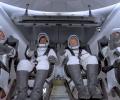
The Lucknow-born Shukla, former NASA astronaut Mission Commander Peggy Whitson, Slawosz Uznanski-Wisniewski of Poland, and Tibor Kapu of Hungary are part of the Axiom-4 mission that marks the return to space for the three nations.
If Rakesh Sharma represented the dreams of a nascent India looking outward, Shubhanshu Shukla embodies a confident India reaching for the controls.

SpaceX, National Aeronautics Space Administration (NASA) and Axiom Space are closely watching weather patterns at the Kennedy Space Centre in Florida where Indian astronaut Shubhanshu Shukla and three others look forward to their travel to the International Space Station (ISS), now scheduled for Wednesday.

The Indian Space Research Organisation (ISRO) has received approval for the Chandrayaan-5 mission, which aims to study the Moon's surface using a 250kg rover. The mission will be conducted in collaboration with Japan. This follows the success of the Chandrayaan-3 mission, which achieved a soft landing on the Moon's South Pole in August 2023. ISRO is also planning to establish a space station, Bharatiya Space Station, in the near future.
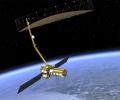
NISAR will not be used for surveillance and will be used to observe the earth.
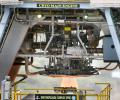
The Indian Space Research Organisation (ISRO) on Saturday said it has successfully conducted the flight acceptance hot testing of the cryogenic engine identified for the sixth operational mission of LVM3 launch vehicle (LVM-M6) at ISRO Propulsion Complex, Mahendragiri in Tamil Nadu.
'I think that kind of change is coming. We should stay prepared for that change, whichever industry or sector we are in, we must be prepared.'
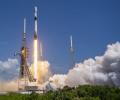
'ISRO recommended to carry out in-situ repairs or replacement and conduct a low-temperature leak test to validate system performance and integrity, before proceeding with launch.'
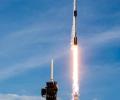
'The solution is to replace, clean up, retest and proceed.' 'There is nothing to worry about if corrected.'
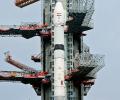
The main focus of the all weather RISAT-1B satellite will be to observe the Indian land with its C-band synthetic aperture radar.
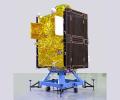
The need for NavIC was cemented after India was denied access to crucial navigation data from global providers during the 1999 Kargil War.
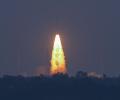
A PSLV rocket carrying Earth observation satellite EOS-09 failed to launch from the Sriharikota spaceport early on Sunday.
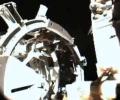
The Indian Space Research Organisation (ISRO) has successfully de-docked the SpaDeX satellites, a significant achievement that clears the path for future missions such as exploring the moon, human spaceflight, and building India's own space station. The de-docking, announced by Union Minister Jitendra Singh, follows a successful docking experiment conducted in January. The SpaDeX mission involved launching two satellites, SDX01 and SDX02, to demonstrate the docking technology in space.
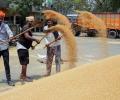
ISRO has projected wheat production of 122.24 million tonnes.
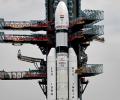
'The LVM3 rocket will orbit one Block 2 BlueBird satellite in Low Earth Orbit.'
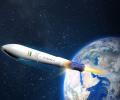
The Vikram-I rocket will fly with its maximum carrying capacity and put the satellites in a Low Earth Orbit.

The 'mediation' by the United States from behind the scene on the diplomatic track appears to be once again working, which calls on both Delhi and Islamabad to show restraint and pull back from a military confrontation, notes Ambassador M K Bhadrakumar.
 © 2026 Rediff.com - Investor Information - Advertise with us - Disclaimer - Privacy Policy - Sitemap - Feedback - About us - Terms of use - Grievances