
'India in 2020 is a lot better prepared than in 1962.' 'It is no longer a pushover; and anything other than a crushing Chinese military victory will be a major loss of face for China,' observes Rajeev Srinivasan in the first of a three part column.

'If the almost literally heart-stopping Suez block has any positive outcome, it is to be hoped that it will accelerate the setting up of a fab (perhaps Taiwanese) in India,' asserts Rajeev Srinivasan.

'It is entirely possible that there are many treasures of our history and our faith buried deep underground,' points out Rajeev Srinivasan.

Historian Stanley Wolpert, author of several books on India, passed into the ages recently. We remember Professor Wolpert with Rajeev Srinivasan's March 1997 interview published on the occasion of his controversial book on Jawaharlal Nehru.

'You were a good man, a luminous soul. You gave me more than I could ever thank you for.' Rajeev Srinivasan remembers a beloved uncle who passed into the ages recently.

Did we miss the DeepState's Brazil Model in action in India in 2004 and 2009, asks Rajeev Srinivasan.

'This has absolutely nothing to do with Kalburgi or anybody else, it only has to do with two words: Bihar elections. It's electioneering by other means, let's save the fig leaf of morality,' says Rajeev Srinivasan.

India had been engaged in a contentious battle with the US over the issue, especially in the pharmaceutical sector.

While we have to hiss loudly and do the lunging bit to keep our foes on their toes, that's only a tactical matter. What is the strategic goal? What is the end game? In my opinion, there is only one possible end game: the unwinding of Pakistan into several pieces: Balochistan, Sind, Balawaristan (Gilgit, Baltistan, the rest of PoK), the Pashtun area Khyber Pakhtunwa which will merge with Afghanistan, and the rump Punjab, says Rajeev Srinivasan.

Trump's foreign policy juggernaut has shelved the 'Deep State' and 'Axis of Evil'. But where is India?

'Sreedharan epitomises the way in which an Indic ethos can be brought to bear upon the seemingly intractable problems facing India,' says Rajeev Srinivasan.

'How many people have been skilled up and thus able to escape from needing to be in NREGA? The true success of NREGA would lie in its irrelevance -- that is, people no longer need it as a crutch.' 'NREGA should enable them to climb out of poverty and stand on their feet.' 'But this is expressly forbidden by NREGA rules. Skill development, which is what India needs more than anything else, appears to be outside the purview of NREGA,' points out Rajeev Srinivasan.
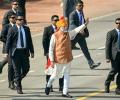
The 2019 election gives the Indian public the same choice: Between growth and oligarchs (or, in our case, dynasts and crony capitalists). If we chose wisely, well and good. If not, well, we have the Nehruvian Rate of Growth and massive corruption to fall back on. In a large sense, it is a choice between the India of the Lutyens elites and the Bharat of the real citizen, says Rajeev Srinivasan.

'The effect of demonetisation has been largely to drive black money above ground. But there are several interesting side-effects. One is the uncomfortable realisation that this can happen again, which is a deterrent to future sinners,' says Rajeev Srinivasan.

'Now with many itchy-fingered ex-bosses being raked through the mud, their marriages ruined, their careers trashed, their finances hit, the inclination of many male hiring managers will be to hire fewer women,' believes Rajeev Srinivasan.

'It is a great misfortune that the Nehruvian Stalinists of India have colluded with the grand project of demeaning and destroying Sanskrit. Today, the number of Sanskritists in India is low, and falling,' says Rajeev Srinivasan.
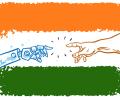
'It is in electronics that the gap between where we are and where we need to be is most obvious and most persistent.' 'It is not only a national security issue, but also a commercial issue,' argues Rajeev Srinivasan.

'India missed the software products revolution (and now is in danger of missing the platform revolution), complacent that we are the software experts of the world based on IT services prowess,' points out Rajeev Srinivasan.

'Banning conversion would harm Hinduism by taking away the need for reform.'

'In the last one year, it looks like there were bad things that didn't take place, and there were good things that didn't take place,' says Rajeev Srinivasan.

Deep-learning machines are conquering realm after realm of human expertise, but is there a difference between Them and Us?

'Hillary Clinton is no friend of India,' says Rajeev Srinivasan. 'Not that Trump is necessarily one, but at least he gets the benefit of the doubt.'

'India should think big: About how in a multi-polar world, India can indeed be one of the poles, rather than being a secondary power that has to worry about 'alignment' with one of the poles. A G3 in other words, India should look to getting others to align with itself rather than the US or China,' says Rajeev Srinivasan.

Prime Minister Narendra Modi's Nepal visit was an eye-opener for most Indians, as it appears as though the hard feelings of 17 years of neglect by Indian PMs has been overcome by this single, sincere visit, says Rajeev Srinivasan.

'A bit of marketing, a bit of positioning, and a lot of strategic thinking is required, and all this should be in aid of India's strategic intent: Becoming the third pole in a global G3 and aiming for Numero Uno,' says Rajeev Srinivasan.

'It is clear that Britain is a country with a limited future,' says Rajeev Srinivasan.

The US #DeepState has had a fine run, but will now discard Saudi Arabia as it is no longer useful to them, says Rajeev Srinivasan.

Germany, as the locomotive of Europe, has much to teach India in manufacturing and process management, says Rajeev Srinivasan.

Ever pragmatic, the Americans are convinced that the future is in the Indo-Pacific.
There is a new Indo-Pacific century, and India has to decide whether it has its eyes on the prize, says Rajeev Srinivasan.
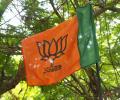
One cannot but infer that this brouhaha is a crafty ploy to create an issue out of a non-issue. An overview of post-independent India's history reveals that it is not the BJP or the Sangh Parivar but Marxist historians who have been guilty of debasing history to suit their vested interests, says Vivek Gumaste.

'If the Iran nuke deal holds, Iran becomes a gateway to Afghanistan, and a better one than Pakistan because the route is not so mountainous. Correspondingly, I imagine Pakistan's value to the US will fall,' says Rajeev Srinivasan.
A left-leaning centralised socialist model has created a shortage/entitlement economy. In fact one of the reasons for India's limited progress is that post-independent India is at odds with its true nature. It is something that educated right of centre Hindus are trying to correct, says Sanjeev Nayyar.

'Why would the Communists do this? I have three possible answers: One, they are specifically opposed to the Global Education Meet that the ambassador organised. Two, they are beginning to realise their days are numbered in Kerala. Three, the standard modus operandi of leftists is anarchism because they are not constrained by any codes of ethics. Roughly, the bad, the good, and the ugly,' says Rajeev Srinivasan.

'Modi is a symbol of Asia Rising; and, for the first time in decades, a non-white has the potential to be the most compelling global leader.'

'Today the Chinese think they can slap India, and there will be no consequences.' 'They must be made to feel the consequences through any and all means,' says Rajeev Srinivasan.

Rajeev Srinivasan tells how he came very close to being another number in the 'disappeareds' during the Emergency.

Just as Billa-Ranga had become symbols of everything that was wrong with the system many years ago, Nestle is now portrayed as the wickedest of the wicked. Every known food crime in India is now attributed to Nestle including deliberately increasing the level of lead in their noodles, as well as deliberately destroying the health of millions. That's not only unfair, it's downright idiotic, says Rajeev Srinivasan.
'The BJP can kill two birds with one stone by wresting back control of the message; and the steps are fairly obvious. Once the media is neutral, there is a level playing field,' argues Rajeev Srinivasan.

'Rahul Gandhi accuses the Modi government of being in thrall to corporate fat cats at the expense of farmers and other common folk. But the facts do not bear out this argument, as Indian farmers are relatively better off compared to the really wretched of the earth, the unfortunate landless, often itinerant, labourer. And since Rahul's ancestors are the ones who failed them, it is a little disingenuous of him to ignore them in his rhetorical flourishes,' says Rajeev Srinivasan.

'As in the Panchatantra tale of the cat and the monkeys, it is possible for the clever swing State to play off the two competing powers.'
 © 2026 Rediff.com - Investor Information - Advertise with us - Disclaimer - Privacy Policy - Sitemap - Feedback - About us - Terms of use - Grievances