
Rajeev Srinivasan on the cavalier nature of the Indian State's actions against its own citizens

Rajeev Srinivasan on why the Thai troubles should be an eye-opener for India, which faces similar insurgents with covert agendas.

As far as Hindus are concerned, the eclipse of Wokeism cannot come any sooner, says Rajeev Srinivasan.
'It is likely that when Obama is in India, Manmohan Singh will announce a new 'package' which would, shorn of marketing verbiage, hand over either all of Jammu and Kashmir or just the Vale of Kashmir to the stone-throwers and other separatists.'
'That there will be appeals is disappointing, because it means the status quo will be maintained. It is in the vested interests of many to keep the Ayodhya issue unresolved, a festering wound that annoys Hindus and rallies Muslims.'
Rajeev Srinivasan on whether social media can lead to lasting change, or whether it is merely a flash in the pan.
Rajeev Srinivasan on how EVM problems are much bigger than technology or politics.
Rajeev Srinivasan on how insurgents and terrorists seem to have more human rights than the average citizen in India.
Rajeev Srinivasan on how the uncaring State does not give a damn about the rights of the poor and the middle class.

Rajeev Srinivasan on one of the best film festivals in India.
Rajeev Srinivasan on one of the best film festivals in India.
Rajeev Srinivasan on how apportioning blame for the failure of the talks misses the big picture on the ground -- the Great Game is afoot
'Unfortunately, the most likely outcome is that they will press India to give in to the ISI, or, equally disastrously, ask for Indian troops to join them in Afghanistan.'
'India should strive to establish itself as a pole in a multi-polar world instead of being a satellite to a sinking America.'
'Why this disproportionate support for cricketers, who make a thousand times what a track-and-field medallist makes?'
'Indian civilisation has thrived for millennia because of the element of Dharma in society, however strong the demons are.'

The iPad might allow Apple to disrupt the publishing industry, as it has done with music and telecom already, says Rajeev Srinivasan.
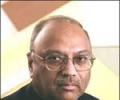
Rajeev Srinivasan considers the legacy of the man who popularised strategic intent and the Bottom of the Pyramid.
By not putting in place mechanisms to ensure there is punishment for sinning, India is creating the right environment for 'moral hazard'.
This was a crucial year for India. Its economy is doing fairly well, but it continues to suffer from a non-existent long-term agenda. The latter may well result in India seizing defeat from the jaws of victory: Despite the 'demographic dividend', the lack of a compelling 'idea of India' may well cause it to flounder aimlessly, if not disintegrate into a million pointless mutinies. Events in 2009 would have sown the seeds of either success or failure.
'A nation that has no long-term strategic intent, and whose leaders can be easily manipulated through flattery, is a banana republic. Unlike China, which intends to rule the world, India, which can only imagine itself as a second-rate power, will remain one.'
The Communists demonstrated that they are tyrants just like the Tsars.
None of the politicians who held the position of President particularly distinguished himself. Kalam, on the other hand, certainly stood out.
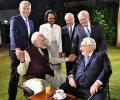
'It's pretty likely that Kissinger, Rice et al came bearing gifts (read Trojan Horses) from McDonnell Douglas, Boeing, Grumman, Northrop, and all the other Military Industrial Complex stalwarts,' argues Rajeev Srinivasan.
Mukherjee will brief Natwar Singh on the situation in Nepal.
India needs to stop pretending it's something other than what it really is. Only then will its native genius allow it to reach for the stars, once again.
An interview with one of the greatest masters of Indian fiction, O V Vijayan.

'China has gone too long as a rogue power, trashing international norms, agreements, and treaties as if they were not the paper they were written on.' 'The ill-advised attack on Ladakh may be the beginning of the end of that nonsense,' advocates Rajeev Srinivasan.

'The fatal mistake for the USSR was the invasion of Afghanistan.' 'Quite possibly the fatal mistake for the Chinese empire is the assault on Ladakh,' observes Rajeev Srinivasan.

The only thing that may salvage Narendra Modi's trip to the US is his meetings with CEOs, such as those of Blackstone, First Solar, Qualcomm, Adobe, and General Atomics, asserts Rajeev Srinivasan.

'Whoever owns the best chip industry will be the Saudi Arabia of the era of data,' predicts Rajeev Srinivasan.

The billions India invested in dams, schools, etc in Afghanistan will be gone. The Hindu and Sikh population of Afghanistan has already shrunk from some 200,000 to about 500, points out Rajeev Srinivasan.
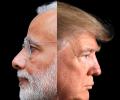
Here's why Rajeev Srinivasan believes there will be nothing particularly positive about the prime minister's US visit.

Does Abhijit Banerjee's Nobel Prize help India reduce extreme poverty, asks Rajeev Srinivasan.

'Why isn't the story of the valiant 13th Kumaon a part of every child's textbooks?' 'Why have we let these brave men die unwept, unmourned, and unsung?' asks Rajeev Srinivasan.
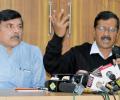
It would be far more sensible for AAP to build on what they have achieved than to destroy what credibility they have by floating wild conspiracy theories, says Sankrant Sanu.

Not to say that India couldn't have handled the situation better, but on average, it didn't do anywhere near as badly as the naysayers make it out argues Rajeev Srinivasan.

Rajeev Srinivasan on why there is the strong possibility that this whole thing is an elaborate charade and how the mainstream might have just played into Trump's showman hands.
 © 2026 Rediff.com - Investor Information - Advertise with us - Disclaimer - Privacy Policy - Sitemap - Feedback - About us - Terms of use - Grievances