
'The BNP's election manifesto lists grievances against India, mirroring the attitude of past BNP governments.' 'Political parties have been careful not to say bad things about China.'
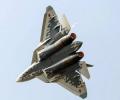
However, these are understood to be exploratory talks, with an agreement unlikely to be formalised during the current visit.

The Russians have termed Putin's visit to India, his first to this country since the outbreak of the Russia-Ukraine war, as 'Druzhba Dosti', which means 'friendship' in Russian and Hindi respectively.
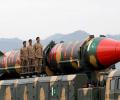
After Donald Trump became president of the United States, he unleashed economic weaponisation, upsetting the old world order, leading to much unrest. If that wasn't all, the threat of an imminent nuclear war was issued by the US, Russia, China, North Korea and Pakistan. In today's fractious times, Dr Paulos Mar Gregorios would have made a dent, notes His Holiness Baselios Marthoma Mathews III.
'There are only a few countries in the world that have deployed combat-ready laser systems.'

Defence Minister Rajnath Singh emphasizes the need for India to remain prepared for uncertainty, even during peacetime, and highlights the increasing importance of the defence sector as an economic driver.
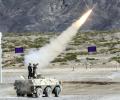
The Chinese military Thursday declined to comment on the performance of China-made weapons used by Pakistan in the recent conflict with India.

Nearly all of the nine nuclear-armed States, including India and Pakistan, continued intensive nuclear modernisation programmes in 2024, upgrading existing weapons and adding newer versions, according to a report by a global think-tank.
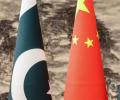
The Chinese military on Monday denied reports that its largest military cargo plane has carried arms supplies to Pakistan and warned legal action against those spreading such rumours.
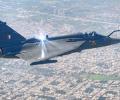
India's military expenditure in 2024 was nearly nine times that of Pakistan's, according to a study released by the Stockholm International Peace Research Institute (SIPRI). India's spending reached USD 86.1 billion, while Pakistan spent USD 10.2 billion. China's military spending continued to rise, reaching USD 314 billion, accounting for 50% of all spending in Asia and Oceania.
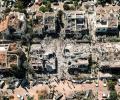
Trump has a major decision to take in coming days -- specifically, how to rescue Israel from the attritional war that lies ahead, points out Ambassador M K Bhadrakumar.
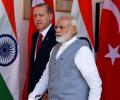
India-Turkiye ties are strained over Ankara's Islamabad tilt, its arms links with Pakistan, and fallout from the Pahalgam terror attack.
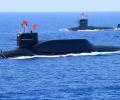
China has delivered a second advanced submarine to Pakistan, part of a larger deal to bolster the South Asian nation's naval capabilities in the Indian Ocean. The move underscores China's growing influence in the region and its strategic partnership with Pakistan.
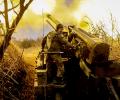
The five largest exporters of major arms in 2020-2024 were the US (43 per cent), France (9.6 per cent), Russia (7.8 per cent), China (5.9 per cent), and Germany (5.6 per cent).

'The first and most basic responsibility of any government is to protect its people from external threats and internal harm.' 'Budget 2025-2026 has to focus on meeting this responsibility,' asserts R Jagannathan.

HAL, BEL and MDL feature on Sipri's list of the 100 largest arms producers in the world.

The report put India's 'stored' nuclear warheads at 172 in January this year while the number for Pakistan was 170.
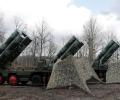
Russia continued as India's main arms supplier, the Stockholm International Peace Research Institute said.

New Delhi has reached out to Moscow while waiting for a new president in Washington. New Delhi knows well that in international relations, there are no permanent friends or foes, only permanent national interests, points out Dr Rup Narayan Das.

India's defence sector presents an ordering opportunity worth $138 billion between fiscal years 2023-24 (FY24) and FY32, said a latest note by Nomura, which has initiated coverage on two defence-related players - Hindustan Aeronautics (HAL) and Bharat Electronics (BEL) - with a 'buy' rating. The research and broking house sees an upside potential of 28 per cent and 32 per cent, respectively in these two stocks from the current levels.

The increase in India's military spending was "mainly a result of growing personnel and operations costs" which made up almost 80 percent of the total military budget in 2023, the SIPRI report claimed.

India spends significantly less on defence than could be expected from a country that faces simultaneous armed threats from two hostile neighbours -- China and Pakistan.

Co-founders of fact-checking website AltNews Pratik Sinha and Mohammed Zubair and Indian author Harsh Mander are among the favourites to win this year's Nobel Peace Prize, according to shortlists released ahead of the announcement.

Officials hint the visit could finally see a formal defence industrial road map being adopted by both nations.

With military expenditure of USD 81.4 billion (one billion=100 crore), India's spending was up by six per cent from 2021 and by 47 per cent as compared 2013.

India remained the world's top arms importer, but its imports declined by 11 per cent between 2013-17 and 2018-22, according to a report released on Monday by Stockholm-based defence think-tank SIPRI.
49.4 per cent of India's arms imports between 2016 and 2020 were from Russia.
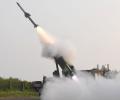
'China is in the middle of a substantial expansion of its nuclear weapon arsenal, which satellite images indicate includes the construction of over 300 new missile silos,' SIPRI's statement noted.
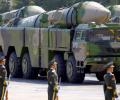
According to the experts, a lot of countries have little or no faith in Chinese companies because of poor after-sales support and equipment that rapidly declines into non-functional machinery.

The United States, Russia, United Kingdom, France, China, India, Pakistan, Israel and North Korea possess approximately 16,300 nuclear weapons collectively. A glimpse of nine countries with nuclear weapons.

The "bumper" 40 per cent increase followed a number of sweeping reforms intended to transform the "bloated People's Liberation Army, into a more modern, nimble fighting force".

India's military spending of USD 76.6 billion ranked third highest in the world.
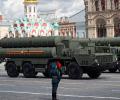
In contrast, India's arms imports from France increased more than tenfold, making it India's second largest arms supplier in 2017-21, it stated.

The nine nuclear-armed states -- the United States, Russia, the United Kingdom, France, China, India, Pakistan, Israel and the Democratic People's Republic of Korea (North Korea) -- together possessed an estimated 13,080 nuclear weapons at the start of 2021.

The 33 per cent drop in arms imports between 2015 and 2016 affected Russia the most, but India's imports of US arms also fell, by 46 per cent, the report points out.

Both the Asian giants were among the top three countries spending more on armaments, according to a new report by the Stockholm International Peace Research Institute.
India's import of weapon systems is three times higher than Pakistan and China as it continues to be the largest buyer of arms in the world, a Swedish think tank said on Monday.

Refuting reports about an increase in its nuclear arsenal, China on Monday said it has kept its capability at the "lowest level", commensurate with the need for national security. "We always kept our nuclear capability at the lowest level, commensurate with the need for national security," Chinese foreign ministry spokesman Hong Lei told a media briefing.

Anyone within range of China's expanding navy will have to build capabilities faster and/or work more closely with the US, as Australia has just announced, asserts T N Ninan.
 © 2026 Rediff.com - Advertise with us - Disclaimer - Privacy Policy - Sitemap - Feedback - About us - Terms of use - Grievances