
The independent institute advising the PM on jobs seems to have missed the point that the challenge is to create net additional jobs, says Mahesh Vyas.

Can 3 crore out of the 8.9 crore young male population of the nine states set off on a pilgrimage that extends for about a month? If yes, then what can we infer regarding the state of the young working population in these states, asks Mahesh Vyas.
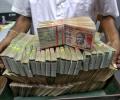
Pvt sector holds back, waits for key reforms

'The Modi government is about privatising profits and nationalising losses.'

The central government's deposits with the RBI had fallen to just Rs 100 crore as of June 8.

The senior Congress leader also said over 90 per cent of jobs are in the SME sector which requires an urgent push to boost the economy.

'If the 7 million estimate is true, then either our understanding of the past was all wrong or the economy has changed dramatically but so surreptitiously that we did not even notice it,' says Mahesh Vyas.

The Union Budget seems to have elicited a starkly opposite view from rural India compared to urbanites, says Mahesh Vyas.
Hopefully, the small recovery in the labour force and employment seen in the September-December 2017 wave will gather momentum in the coming waves, says Mahesh Vyas.The challenge, says Mahesh Vyas, is to find the corresponding jobs for these aspirants.

Nearly 31 million Indians are unemployed and looking for jobs. While economic growth has been humming along, the pace of job creation has been poor. A revealing excerpt from Dev Kar's India: Still A Shackled Giant.

More people felt optimistic about their economic condition in November than in the same month a year ago, says Mahesh Vyas.

'Our first great challenge is to create 12 million new jobs each year, to make the demographic dividend an economic dividend.' 'We are nowhere near that,' points out Mohan Guruswamy.

Given the rapid changes in the Indian labour market, there is an urgent need to have current, accurate and publicly available data through regular, dynamic and comprehensive surveys. Indeed, this was the intention behind constituting the NITI Aayog Task Force on Improving Employment Data. The attempts by the government to "improve" labour data has actually made it worse, say Rosa Abraham, Janaki Shibu & Rajendran Narayanan.

The study says the entire supply chain of goods and services will suffer a massive liquidity shock.

Rising unemployment rate reflects a rise in the labour participation rate, which in India's case has been worryingly low.

Sticky labour laws and a difficult business environment have led to employers shifting their new hiring in favour of contract labour where social security is much lesser, says Mahesh Vyas.
As of the week ended July 2017, the unemployment rate was 3.1 per cent. This is the lowest unemployment rate recorded. Rural unemployment was also very low at 2.8 per cent.

'It does not look like unemployment is a priority for the government.' 'If there was one external factor which could have made an impact on low investment and low jobs, it was the Budget and it has not made any difference.' '2020 is going to be a difficult and challenging year.'
'In India, a large proportion of the labour force does not have a regular job.' 'People are mostly employed as daily wage workers, agricultural labourers, small farmers and self-employed traders.' 'These move in and out of "jobs" fairly rapidly.' 'It is the high proportion of these workers in India that makes unemployment volatile,' explains Mahesh Vyas.

It is necessary that at least three million additional jobs (if not more) are created every year to ensure that there isn't an increase in the stock of unemployed, says Mahesh Vyas.

Rajan also said the outlook for agriculture is subdued, in view of both rabi and kharif prospects being hit by monsoon vagaries.

A V Rajwade wonders if the Modi sarkar is pursuing price stability at the cost of potential social instability in both rural and urban India.

'Under-employment continues to be a very big problem.' 'What we see today is many youth who would have accepted any kind of job are not willing to accept any job.' 'They are ready to wait for a better job, one that justifies their educational qualification. 'This is one of the reasons why unemployment has risen.'

Gujarat, the home state of Prime Minister Narendra Modi and portrayed as 'growth engine' of India has witnessed a steep fall in new investments for the second quarter of 2014-15 compared to the first quarter of the same fiscal.

The Budget will obviously be crucial. But US President Donald Trump may have even more of an influence than Finance Minister Arun Jaitley when it comes to sentiment, argues Devangshu Datta.

Available evidence suggests that we are on the way to a very costly failure of the current demonetisation scheme, says M R Narayana.

Slowdown persists in China. India's GDP estimates for 2015-16 are liable to be pared; projections for 2016-17 are lacklustre.
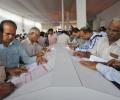
Questions on the efficacy of the government's drive towards filing of more returns by individuals and on whether raising tax exemption levels has led to reduced compliance in filing of returns by those who go out of the tax net, says A K Bhattacharya.

Modi placed a $12.6 billion bet in this year's budget on road building

The corporate sector does not care from where the money is coming.
 © 2026 Rediff.com - Investor Information - Advertise with us - Disclaimer - Privacy Policy - Sitemap - Feedback - About us - Terms of use - Grievances