

'Usually, urban wage rates are 50 per cent higher than rural wage rates. But, this could be narrowing very rapidly now,' points out Mahesh Vyas, CEO, Centre for Monitoring Indian Economy.

'The jobs that are being created now are the delivery boy jobs which are of extremely poor quality, or contractual jobs where you hire a person on a per piece basis.'
Indian economy, which is 75 per cent dependent on agricultural output is seen to grow at the rate of 6.5 per cent in 2003-04 on the back of normal monsoon rains.
Indian tea exports are expected to decline by 6.9 per cent at 165 million kg in 2003 as compared to last year even as production is likely to record a 5.3 per cent rise at around 870 million kg.
The production of major agricultural crops is likely to drop by 12 per cent for 2002-03, reflecting an adverse impact of poor monsoon, according to the Centre for Monitoring Indian Economy.\n\n\n\n
India's agricultural output declined during the year 2002-03 to 183 million tonne compared to 212 million tonne produced in previous year, a drop of 13.9 per cent, according to Centre for Monitoring Indian Economy.
Tax collections might fall short of expectations of the Union Budget for 2002-03, in spite of recording a "healthy" growth during the nine-month period ended December 2002, according to Centre for Monitoring Indian Economy.\n\n\n\n
India's agricultural production could see its biggest drop in more than two decades this year, due to a drought that hit nearly one-third of the country, Centre for Monitoring Indian Economy said on Friday.
Gross fiscal deficit of the central government during 2002-03 is likely to be higher at Rs 1,52,300 crore (Rs 1,523 billion) as against the budgeted amount of Rs 1,35,524 crore (Rs 1,355.24 billion), according to CMIE.
CMIE ups Indian 02-03 GDP growth forecast to 3.7%
The Centre for Monitoring Indian Economy on Tuesday said industrial production growth is likely to decline in the second half of the current fiscal, while the first advanced estimate of kharif crop showed a 10 per cent drop in food production.\n\n\n\n

'People are getting back to work.' 'The worst seems to be over.' 'It is very likely that the recovery is mostly among the informal, self-employed, workers who cannot afford to be away from work for too long,' notes Mahesh Vyas.

Several opposition members, including from the Dravida Munnetra Kazagham and the Communist Party of India-Marxist, also pointed out that the government took almost two months to impose the lockdown after the first case came to light in January, and claimed the delay had proved costly.
The Centre for Monitoring Indian Economy on Monday pegged the growth of Indian economy at 7.5% for the first quarter of 2004-05 and that for the entire next fiscal at 6.3%.

The employment that is returning is mostly essential services required by Indian households. Most urban Indian households cannot function without a retinue of maids, cooks, drivers, cleaners, notes Mahesh Vyas.

'One cannot take it that the economy has recovered, and the GST payment has increased because of that, or that production is back to January 2020 level.'

Companies, so far, were constrained by the provisions of Articles 370 and 35A, which restricted the purchase of land and hiring manpower.

Go beyond the curriculum. Talk to experts. Build your network, says Dr NV Raghavendra.

Former Reserve Bank of India governor Raghuram Rajan said that Rs 65,000 crore is required to help the poor affected by the coronavirus-induced lockdown. He also laid stress on the need to restart the economy while taking precautions.

Concerned by the continuous downward revision in the monthly net enrolment numbers, the EPFO has begun counting people quitting their previous jobs and joining a new one as an addition to the net payroll. According to experts these people cannot be counted as those who got a new job.
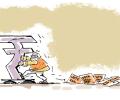
'Since the growth is not fast enough to provide jobs for the young, the fallout will be political and social,' warns T N Ninan.

India has lost almost the entire buffalo meat export market to Brazil, Australia and the US.

ASK Wealth Advisors says 5 million, CMIE's estimate is 2 million and Ghosh & Ghosh said it was 7 million!

'Wage earners are shrinking. In both, the organised and unorganised sectors. And, entrepreneurs are growing.' 'But the increase in entrepreneurship is of a kind that does not create salaried employment or daily wage employment,' says Mahesh Vyas.

Those who have been handed the pink slip shouldn't make too many loan queries, advises Raj Khosla.

In a paper, EAC-PM accused Subramanian of "cherry-picking high-frequency indicators" to express his skepticism about the growth rates after 2011-12.

'If businesses are focused on de-leveraging, they can hardly be investing. This is the price extracted by investment mistakes during UPA rule, and should have been foreseen. 'But Modi-I must share the blame, for muted reform of the financial sector, partisan policy in telecom, the harm done to exports by an over-priced rupee, and so on,' says T N Ninan.
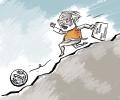
'The large scale and widespread shrinking of the labour force in November, the peaking of unemployment in October and the fall in lead indicators in October and November point towards a worsening of the slowdown of the Indian economy in the third quarter of 2019-20,' says Mahesh Vyas.

India Inc closed FY15 on a positive note.

He attacked the dispensation over issues such as the state of the economy, the situation in Kashmir, the National Register of Citizens in Assam and action by probe agencies against opposition leaders.

He cautioned however that these are the early signs and one should not start celebrating.

'It could take 12 months or more for hiring to get back on track.' 'New opportunities would come up and there will be demand for skillsets that can help dealing with the current situation.'

This whirlwind of activity only confirms that rushing around creating an impression of pompous busy-ness is not the same thing as solving problems, argues Mitali Saran.

It's high time we now turn the popular question on its head -- when there is no growth in jobs for several years, how can the real GDP grow at 7 per cent per annum, says Mahesh Vyas.
Rural and urban regions present different labour participation and employment levels. These differences also are not tuned to India exploiting its demographic dividend, says Mahesh Vyas.

If everyone had decent meaningful jobs, the rally maidans would be largely empty and, save for the Akhara babas and curious foreigners and the devout senior citizens, not very many would spare time for the Kumbh Mela, says Mahesh Vyas.
The key to job creation is to increase labour participation - draw more people into the labour force and to provide them formal jobs in the organised sectors. Self-employment is not job creation, says, Mahesh Vyas.

'It is not simply demonetisation or GST, it is this government's failure to manage the financial sector crisis.'
 © 2026 Rediff.com - Investor Information - Advertise with us - Disclaimer - Privacy Policy - Sitemap - Feedback - About us - Terms of use - Grievances