
India and China on Friday agreed to seek a "political" solution to the border dispute at the earliest as Prime Minister Narendra Modi asked Beijing to "reconsider its approach on some issues" and announced CBMs like e-visa for Chinese tourists and operationalisation of hotline between two militaries.
How should sophisticated countries deal with others that have a huge body but a small brain?

The choking of natural drainage brings monsoonal Mumbai to its knees year after year.

The frosty Indo-Pak ties briefly gave way to some warmth when a smiling Prime Minister Narendra Modi and his Pakistani counterpart Nawaz Sharif on Thursday shook hands and exchanged pleasantries, but India cautioned against reading too much into such "courtesies".

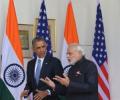
It is for the companies and the industry to ascertain where they want to run with the US-India civilian nuclear agreements reached by Washington and New Delhi, says United States Assistant Secretary of State Nisha Biswal. Aziz Haniffa reports for Rediff.com from Washington, DC

The startling story of how a bitter ex-girlfriend helped capture artifacts raider Subhash Kapoor.

Modi also said the people of India felt proud that President Xi has twice received him out of the capital.

'In the last one year, it looks like there were bad things that didn't take place, and there were good things that didn't take place,' says Rajeev Srinivasan.
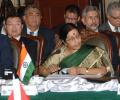
India on Wednesday extended a hand of friendship to Pakistan, saying it was time the two countries display "maturity and self-confidence" to do business with each other.

'An ardent advocate of nuclear disarmament, Obama may even be secretly heaving a sigh of relief that the NSG is unlikely to reach unanimity of opinion on India's candidature,' says Ambassador M K Bhadrakumar.
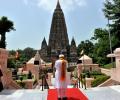
'The Mahabodhi temple is the only example in the world where a religion's most sacred place is controlled by people belonging to another religion.'

Unlike in the past, Modi made candid, frank and direct remarks on his hosts by suggesting that the Chinese side is holding back on further improving relations, says Srikanth Kondapalli.
'Both Modi and Xi know that if all that there is to show for Modi's visit -- barely eight months after Xi's India trip -- is a repeat of the same old declarations, there will be a terrible sense of letdown in the public mood resulting in future summits losing credibility. Only the possibility of new ground being broken can justify Modi's trip at this time,' says B S Raghavan.

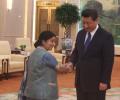
Swaraj said there is scope to do a lot more and this would be an important element of their deliberations.
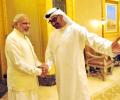
Apart from key bilateral issues, the two leaders also discussed situation in the region, particularly in wake of the increasing threat of terrorism and extremism from various sources including the Islamic State militant group.
Modi's name sparks muted enthusiasm, scepticism among youth; people expect better development pace from the prime minister
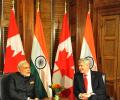
Canada will supply uranium to energy-starved India beginning this year over a period of five years, a decision which was termed as a launch of a new era of bilateral cooperation and mutual trust by Prime Minister Narendra Modi.

Modi is the first foreign leader to be invited to the palace by the Crown Prince, who appreciated the role played by Indian workers in the development of UAE as a modern nation, ministry of external affairs spokesperson Raveesh Kumar tweeted.
'This is a US-India effort and it is not necessarily to counterweight anyone.'

'With Prime Minister Modi's electoral victory, President Obama very quickly reached out, and we were off to the races.' 'We've seen two highly successful leader-level engagements in the past five months. We've really turned things towards a new beginning -- a new energy, a new momentum...'

'Pakistan's negativism should be seen as the reason for India losing interest in SAARC.'

Prime Minister Narendra Modi's visit to Myanmar is aimed at transforming the arch of Bay of Bengal into the Circle of Southeast Asia, says Anirban Ganguly.
'We don't want confrontation; we are trying to build a cooperative relationship in which both sides have stakes in producing an improving climate of relations and responsible behaviour.' What does Shiv Shankar Menon, one of India's most brilliant diplomats and the former National Security Advisor, think of the Modi visit to the US, the Chinese stand-off in Ladakh and the situation on the LoC?

A group of concerned individuals as the India Pride Project and the support of one man dubbed America's Indiana Jones has resulted in the return of India's heritage back to the country, says Vijay Kumar.

'Our countrymen should be made aware of the need to be polite and friendly to our African guests.' 'They should know the dictum, athithi devo bhava, whether they are black or white,' says Ambassador T P Sreenivasan, who once served as India's high commissioner to Kenya.
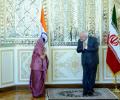
India's low passion, very cautious, relationship with Iran of the last 36 years awaits transformation, says Lieutenant General Syed Ata Hasnain (retd). Prime Minister Modi's visit cannot be a negotiating event; it is a symbolic one to strengthen the politico-diplomatic relationship.
After one year in power, Prime Minister Narendra Modi is pretty much on the back foot, even if he continues to display bravado in his public pronouncements. He knows within his heart that he has wasted a lot of his political capital without getting much in return, says M K Venu.

From France to Canada, from Japan to South Korea, all of Modi's barbs came in front of an NRI audience. Over the last one year, with 19 foreign visits, Modi has tried to use diplomacy as a PR event and foreign policy as a means to shore up his image back at home, says Shehzad Poonawalla.
India has a 'natural global partnership' with US, says PM.

'Modi is a symbol of Asia Rising; and, for the first time in decades, a non-white has the potential to be the most compelling global leader.'
'China made it evident that neither the swing-ride at Ahmedabad nor the red carpet at New Delhi worked, by timing its muscle-flexing in Ladakh to coincide with Xi's visit.'
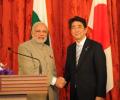
India and Japan are natural partners at sea, and Narendra Modi's recent visit underlined the need to keep the association going

Modi's arrival has changed the optics of the visit. There is a different demonstration of the confidence level in the Indian leadership, but not much has changed beyond that, reports Sheela Bhatt/Rediff.com.
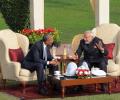
'When George Bush Senior decided in 1992 that India and the United States must start talking in this-now-changed world, who would have thought that 10, 15 years down the road, we will start looking at each other as strategic partners?'

'Today the Chinese think they can slap India, and there will be no consequences.' 'They must be made to feel the consequences through any and all means,' says Rajeev Srinivasan.
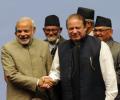
'Modi has said he has been made the PM of India not to do small things but big things. What bigger thing can there be than to have peace with Pakistan and in the neighbourhood?'

'A participant in many rounds of the border talks with China once told me that China seemed not interested in resolving the border issue as it wanted to keep it as a ready excuse to intervene in the sub-continent,' says Colonel (retd) Anil A Athale.
'We should not flatter ourselves that China is fixated on encircling India. She has greater goals, becoming the pre-eminent power in the world, and India as a major power is dealt with as part of that strategy.'
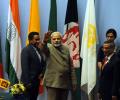
'If his three priorities are the economy, the economy, the economy, then there is need for a stable region, a stable neighbourhood.'
 © 2026 Rediff.com - Advertise with us - Disclaimer - Privacy Policy - Sitemap - Feedback - About us - Terms of use - Grievances