
'I don't see how any Indian government or any Indian military leadership can now ask the soldiers to patrol without weapons.'

'The fatal mistake for the USSR was the invasion of Afghanistan.' 'Quite possibly the fatal mistake for the Chinese empire is the assault on Ladakh,' observes Rajeev Srinivasan.

'Could the Chinese have taken a leaf out of our book?' 'That their unprecedented build-up is their attempt at coercive diplomacy with India?' 'And if so, what is it that they could be expecting as a quid pro quo?' asks Shekhar Gupta.

Here's the full text of President Ram Nath Kovind's address to the nation on the eve of 72nd Republic Day.

'Our people are crazy about cricket, but they are more crazy about their country, and their armed forces.' 'To the people of India, there is nothing that is above the nation, not even cricket.'

'China was a relationship from which Mr Modi had expected the most it seems.' 'It showed in a string of summits, and somewhat breathless celebration of Xi Jinping.' 'It was hasty and simplistic,' observes Shekhar Gupta.
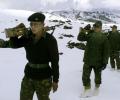
'It is a miracle how a soldier handles the lack of oxygen, stands his post and also confronts the Chinese at 14,000 feet where survival itself is a challenge.'
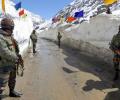
'They cannot use firearms.' 'They have to be restrained.' 'It is a game of patience and chess board moves.' 'It is not like India and Pakistan where bullets get fired and people get killed.'
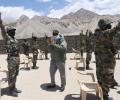
Only he, with his tremendous political capital and personal stature, can pull it off, observes B S Raghavan, the veteran civil servant.
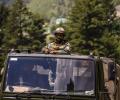
'Our biggest advantage is that the troops are much better trained and motivated than the Chinese and can improvise and manage with a part of the resources.'

'It could have moved from the use of small arms to artillery fire.' 'Anything could have happened like what happens on the LoC.'
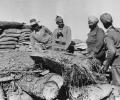
'The Himmatsinghji Report is still 'missing'.' 'It is a great loss for the knowledge of India's borders.' 'It would have an immense value at a time China is bound to shift its attention to other border fronts in the Himalayas,' notes Claude Arpi.
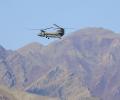
'Our strategy should be to 'hold the line' in the north on the Sino-Indian land frontier, but maintain and, if possible, enlarge India's current edge in the maritime south.'

'Open conflict would be a disaster for both China and India.'

The India-Japan joint naval exercises are a strategic signal for China, observes Dr Rajaram Panda.

'One must remember that a dragon has a forked tongue,' warns Vivek Gumaste.

From India's fight against COVID-19 to China face-off, Kovind spoke on several issues during the televised address.

We present our alphabet of 2020, pulling in everything you'll remember about this year we'd rather forget.

When China protested strongly over the August decision on J&K -- not once but twice -- we ignored it. And to compound matters, we simply turned our back and walked over to the 'Quad' alliance with the US, upgrading it to ministerial level, and thereafter began following the American footfalls on Taiwan and COVID-19 to taunt and humiliate Beijing, observes Ambassador M K Bhadrakumar.

General Zhao Zongqi is well known in India for having commanded the Chinese troops during the Dokalam episode. Zhao knows every inch and corner of the Indian border, at least the Eastern and Central sectors, including the Naku La area which witnessed fist-fights between Indian and Chinese troops in April/May. Claude Arpi introduces us to the PLA generals masterminding the Chinese aggression in Ladakh.

Here's the full text of President Ram Nath Kovind's customary address to the joining sitting of Parliament on the first day of the budget session.
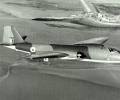
'If we had sent a few airplanes (into Tibet), we could have wiped the Chinese out.' 'And everything could have been different in the 1962 War.' 'They did not believe me there was no Chinese air force.' 'Can you imagine what would have happened if we had used the IAF at that time?' 'The Chinese would have never dared do anything down the line.'

On the title page of the Top Secret Report, Henderson-Brooks quotes the Chinese tactician Sun Tzu: 'Know yourself, know your enemy: A hundred battles, a hundred victories', says Claude Arpi, highlighting where the Indian Army and government failed to counter the Chinese attack in 1962.
 © 2026 Rediff.com - Investor Information - Advertise with us - Disclaimer - Privacy Policy - Sitemap - Feedback - About us - Terms of use - Grievances