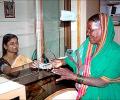
Prime Minister Narendra Modi announced the financial inclusion scheme in his first Independence Day speech last year.

Modi government has to come up with a robust economic agenda to impress the masses.
Economic growth in the last two years has stayed above seven per cent.

Swaraj emphasised that the UN must accept it needs fundamental reform.

P Chidambaram accused the BJP of making a u-turn on bills like GST after having stalled them during the UPA regime.

The finance ministry website that lists the total disinvestment revenues to be mobilised during the current year already shows that no receipts are expected from strategic sales in the current year.
Modi sarkar will have to undertake reforms to prove its mettle.

The remarkable feature of those reforms unveiled in 1991 is that none of those decisions has been disowned by subsequent governments in the last 25 years.

Three recent initiatives kicked off with renewed vigour to improve governance were actually started, perhaps in a different format by the UPA government.
NDA's energy plan powered UP win, but it's not a winner yet. Centre has claimed to have saved money by targeted coverage but critics say the system is not yet foolproof.

The government's initial promise and energy seems to have dissipated.

'There are two pre-conditions for big reforms. One, a sense of crisis and second, fairly concentrated levers of power.' 'India is growing at 7.5 per cent or something close to that.' 'Our levers of power are decentralised, not just between the Centre and states. Power is dispersed and there is no sense of crisis.'

As for structural reform, there are signs if one looks hard enough.

'There is a great scope for enhancing the use of organic fertilisers'.

Dharmendra Pradhan lays bare the next course of action for his ministry and says RIL will have to pay the same price at which it produced the volumes.
Four specific areas will be watched carefully in the first half of FY16
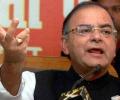
Finance Minister Arun Jaitley has said that the states were free to announce farm loan waivers if they had the fiscal space and that there would be no shortfall this year in divestment and non-tax revenues.

After helping the government in policymaking since October 2014, Chief Economic Adviser Arvind Subramanian is returning to academics and will be teaching at Harvard Kennedy School on a visiting position. In an interview to Dilasha Seth and Somesh Jha, he says the ease of doing business agenda needs to move forward and India must try to integrate with the global value chains. Edited excerpts.

Assessing the shape of the Indian economy just a couple of days ahead of the Union Budget for 2016-17, Saugata Bhatacharya, senior vice president and chief economist, Axis Bank, speaks about his budget wishlist and suggests measures that can help finance minister Arun Jaitley achieve the targeted fiscal deficit of 3.5 per cent of India's gross domestic product.
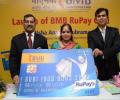
Relaxation in KYC guidelines has helped meet the target but this could lead to money laundering and financial malfeasance, it is feared.

Economic reforms seem to be on a slow train, while good old fiscal populism is alive and flourishing.
We are entering a period of turbulence, but you can profit off that volatility.
Like Indira Gandhi, even Narendra Modi seems to be relying on directing public-sector banks through ministry of finance supported by party cadres, says Debashis Basu.

The Budget touches a few highs and lows as far as personal finance is concerned, and one needs to be aware of them in order to optimise on one's investment plans.
Not only do you need an effective and independent regulator, you also need competition to flourish.

The Budget decides to take the lead in revving up infrastructure.

The abolition of wealth tax is again a welcome step.

With clouds of storm hovering over Parliament's budget session, President Pranab Mukherjee on Monday sought the "cooperation" of all MPs in the smooth conduct of legislative business but gave no indication of plans to bring changes in the controversial land acquisition ordinance.

India has undermined its own credibility.

It is time to take a few macroeconomic risks to kick start the growth.

Indeed, Prime Minister Narendra Modi, who as Gujarat chief minister was considered close to certain business groups and industrialists, has hardly been seen with any Indian business head.

Non-resident individuals (NRIs) have also been allowed to apply for the niche banking licence, provided they plan to return to India.

The president outlined the government's agenda in the coming financial year in his customary address to the joint sitting of both the Houses of Parliament.
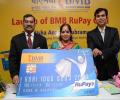
The government has opted for the RuPay debit card over the Aadhaar-based platform for "last-mile" authentication in its Pradhan Mantri Jan Dhan Yojana.
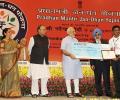
Against National Democratic Alliance's 75 million target, United Progressive Alliance added 61 million in 2013-14.

Angry Congress members staged a walkout during Modi's address.
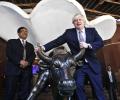
Finance minister Arun Jaitley has delivered a Arun Jaitley delivered a bold, far sighted budget

Most expect the Budget to be path-breaking.
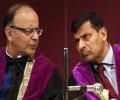
Arun Jaitley had a tough fiscal hill to climb.

'The finance minister and the government have met the immediate challenge. The wine this time is new and also in a new bottle, which, though not full, is less than half empty.'
 © 2026 Rediff.com - Investor Information - Advertise with us - Disclaimer - Privacy Policy - Sitemap - Feedback - About us - Terms of use - Grievances